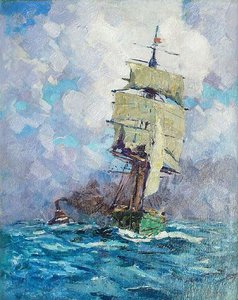
The Luminous Legacy of Eustace Paul Ziegler
To encounter the works of Eustace Paul Ziegler is to step into a world where light and landscape perform a delicate, eternal dance. A painter of profound sensitivity, Ziegler possessed the rare ability to capture not merely the physical contours of the earth, but the very soul of the atmosphere that clings to it. While his artistic journey began in the industrial heart of Detroit and took him through the prestigious halls of the Slade School of Fine Art in London, it was the rugged, untamed spirit of the American North that truly ignited his creative fire. His life was a tapestry woven from disparate threads: the disciplined study of classical traditions, the spiritual devotion of an Episcopal minister, and the raw, unscripted beauty of the Alaskan frontier.
Ziegler’s early training provided him with a formidable technical foundation. Studying under masters such as Frederic Leighton, he mastered the nuances of tonal gradation and the structural integrity of composition. However, his move to Alaska in 1909 transformed his palette from the academic to the elemental. As he traveled through mines, construction camps, and remote coastal villages, his eyes became attuned to a new spectrum of light—the ethereal glow of northern latitudes and the deep, brooding shadows of ancient glaciers. This period of his life saw him evolving into a chronicler of both nature and humanity, blending the meticulous detail of a trained etcher with the sweeping, emotional breadth of an Impressionist.
A Visionary of the North and Beyond
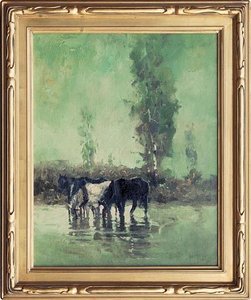
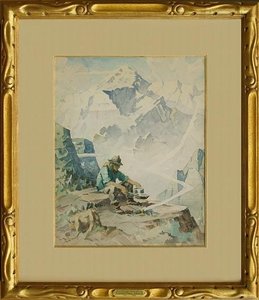
The true magic of Ziegler’s oeuvre lies in his dual mastery of landscape and portraiture. He was a specialist in the Alaskan wilderness, yet he never treated the land as a mere backdrop for human drama. Instead, his landscapes—often characterized by a luminous, almost spiritual radiance—stand as protagonists in their own right. He drew inspiration from the atmospheric perspective of Turner and the delicate compositions of Japanese ukiyo-e prints, allowing him to convey a palpable sense of depth and moisture in the air. His canvases often pulse with an inner light, suggesting that the scenery is breathing, shifting, and alive.
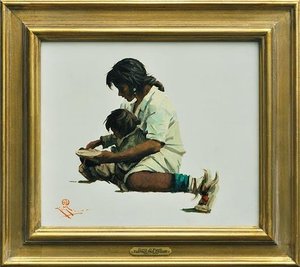
Yet, it was his "people pictures" that provided the human heartbeat to his vast wilderness. Unlike many of his contemporaries who focused solely on the grandeur of the mountains, Ziegler sought out the faces of those who inhabited them. He painted miners, fishermen, priests, and Alaska Natives with a dignity and intimacy that explored the human side of the frontier. His religious works, such as the Arctic Madonna, utilized local models to ground biblical narratives within the specific, frost-touched reality of the North. This ability to marry the sacred with the terrestrial remains one of his most significant artistic achievements.
Artistic Mastery and Historical Significance
Throughout a prolific career spanning over sixty years, Ziegler remained an active and influential figure in the American art scene. His contributions were not limited to the canvas; he was a muralist, an etcher, and a lithographer who helped shape the cultural identity of the Pacific Northwest. As a founder and the first president of the Puget Sound Group of Northwest Painters, he played a pivotal role in establishing a regional artistic community in Seattle. His work earned him numerous accolades, including prestigious prizes at the Northwest Art Exhibitions, and his pieces found permanent homes in esteemed institutions such as the Alaska State Museum and the Seattle Art Museum.
The historical significance of Eustace Paul Ziegler resides in his role as a bridge between eras and styles. He bridged the gap between the formal traditions of the 19th century and the expressive freedom of modern Impressionism. More importantly, he bridged the distance between the observer and the observed, inviting viewers to feel the biting chill of an Alaskan winter and the warmth of a flickering hearth. Today, his legacy endures through works that continue to captivate the imagination, reminding us that art is at its most powerful when it captures the fleeting essence of light and the enduring strength of the human spirit.