The Weaver of Mythic Landscapes: The Art of Ivor Davies
In the quiet, coastal reaches of Penarth, where the salt air meets the ancient echoes of Wales, the art of Ivor Davies takes flight. Born in November 1935, Davies has spent a lifetime constructing visual bridges between the tangible world and the ethereal realms of myth. His work does not merely depict landscapes; it breathes life into them, transforming the scenery of his homeland into a sacred tapestry woven with Byzantine grandeur and Celtic mystery. To encounter a Davies painting is to step through a veil, leaving behind the mundane to enter a space where every brushstroke serves as a vessel for storytelling and symbolic depth.
The foundations of Davies’s unique aesthetic were laid during his formative years, shaped by a profound and enduring connection to music. He found deep resonance in the compositions of Ivor Gurney, an influence that instilled in him a belief that art must function as an emotional narrative, much like a symphony. This musicality is evident in the rhythmic flow of his canvases, where color palettes are carefully orchestrated to evoke specific moods—from the tranquil serenity of a sun-drenched meadow to the haunting tension of a celestial storm. His formal education at Cardiff College of Art, Swansea College of Art, and later the University of Lausanne provided him with a sophisticated technical toolkit, yet it was his academic journey through the Russian avant-garde during his PhD studies that perhaps most sharpened his ability to blend abstraction with profound iconographic meaning.
Symbolism and the Byzantine Echo
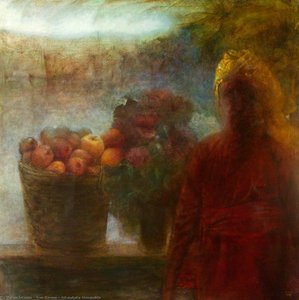
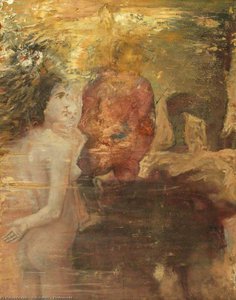
Davies’s artistic vision is characterized by a remarkable ability to translate ancient myth into modern visual language. He draws heavily from the rich wellspring of Welsh folklore, populating his landscapes with figures that feel both primordial and eternal. One might find the celestial presence of Branwen or the transformative essence of Blodeuwedd emerging from the textures of his work. These are not mere illustrations of legend; they are explorations of themes such as resilience, transformation, and the cyclical nature of life. By utilizing motifs reminiscent of Arthurian legends and deities like Taranis, Davies creates an immersive experience that invites the viewer into a state of deep contemplation.
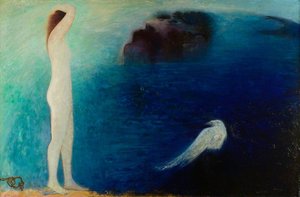
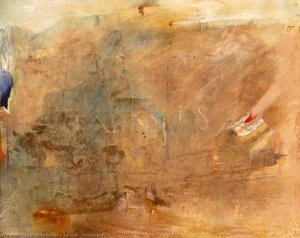
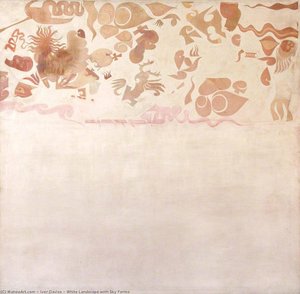
A defining element of his technique is the subtle infusion of Byzantine influences. This is most strikingly realized in works such as “White Landscape with Sky Forms,” where a seemingly monochromatic palette of beige and cream reveals a complex architecture of light and shadow. In this piece, the artist employs a decorative abstraction that mirrors early Christian iconography, using subtle color variations to suggest a sense of the divine within the natural world. His meticulous attention to texture—the way light catches a heavy impasto or how a wash of oil creates an atmospheric haze—allows him to render environments that feel physically present yet spiritually transcendent.
Legacy and Artistic Significance
Throughout a career that spanned decades of teaching at institutions such as the University of Wales and the University of Edinburgh, Davies has remained steadfast in his commitment to a deeply personal and culturally rooted vision. His work stands as a testament to the power of the artist to act as a custodian of cultural memory. By intertwining the linguistic and mythological heritage of Wales with the sophisticated techniques of European modernism, he has created a body of work that is both intensely local and universally resonant.
The significance of Ivor Davies lies in his ability to make the mythic feel contemporary. His paintings serve as windows into a "fantasy" that is not escapist, but rather an expansion of our reality. Through his mastery of oil on canvas and his dedication to the symbolic weight of every form, he has ensured that the legends of the past continue to vibrate with life in the modern consciousness. His legacy remains etched in the landscapes he has created—landscapes where beauty and profound mystery are forever intertwined.