The Luminous Landscapes of John Bolam
Born in the quietude of Amersham, Buckinghamshire, in 1922, John Bolam emerged as a profound voice within the landscape of British post-war art. His journey was one of both academic rigor and deep, spiritual connection to the English terrain. Beginning his formal training at the Hornsey School of Art and later studying furniture design at High Wycombe, Bolam carried with him an early reverence for the Arts and Crafts Movement. This foundational appreciation for craftsmanship and the values of William Morris instilled in his work a meticulous attention to detail and a respect for the organic textures of the natural world.
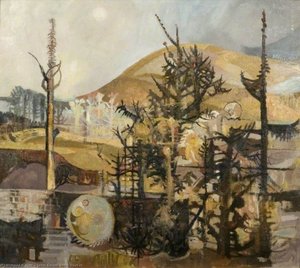
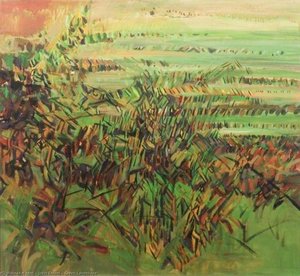
As his career unfolded, Bolam became inextricably linked to the vibrant artistic community of the Great Bardfield Group. It was within this experimental milieu that his aesthetic began to coalesce, drawing inspiration from the atmospheric depth of neo-Romantic masters such as John Piper and Graham Sutherland. Yet, while he walked in the footsteps of these luminaries, Bolam’s vision remained fiercely independent. He moved beyond mere imitation to develop a style that captured the very soul of the Chiltern Hills, transforming familiar vistas into realms of stillness and profound contemplation.
Technique and the Interplay of Light
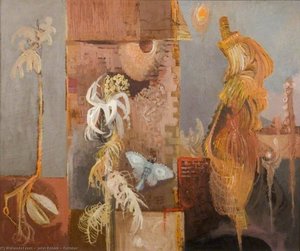
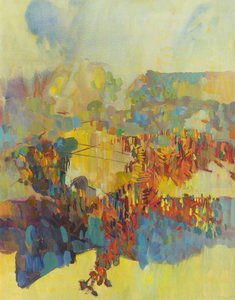
The magic of a Bolam painting often lies in its subtle, layered complexity. His technique was characterized by the delicate application of thin pigment washes, a method that allowed light to permeate the surface of the canvas, creating a luminous, almost ethereal glow. This approach enabled him to master the nuanced transitions of the English sky and the shifting shadows of the woodland. One can observe in his work an echo of the French masters; while the structural essence of his landscapes often recalls Braque, the sensitive depiction of movement and light within his compositions reveals a deep fascination with the gestural nuances found in the works of Degas.
Bolam’s ability to balance the static nature of a landscape with a sense of living energy is perhaps his greatest technical achievement. He did not merely paint scenery; he painted the atmosphere itself. Through his careful study of light and shadow, he captured the fleeting moments of a night walk or the sudden brilliance of sunlight hitting a gothic church, imbuing his subjects with an emotional resonance that transcends simple representation.
Legacy and Academic Contribution
Beyond the easel, Bolam played a pivotal role in shaping the future of British art through his dedication to education. From 1970 to 1983, he served as the Head of Art at the Cambridge College of Arts and Technology. In this capacity, he nurtured a new generation of creative minds, bringing the same passion for exploration and formal excellence to his students that defined his own practice. His academic leadership ensured that his influence extended far beyond his personal exhibitions.
The enduring significance of John Bolam is reflected in the prestigious institutions that house his work today. His paintings have been celebrated in galleries such as the Whitechapel Art Gallery, the Leicester Galleries, and the Arts Council Gallery. Today, his legacy is preserved in major collections including:
- The Fry Art Gallery, Saffron Walden, which holds a substantial collection of his work.
- Private collections belonging to notable entities such as Barclays Bank and Rank Xerox.
- Various esteemed public and private holdings across the United Kingdom.
Through his evocative depictions of the Chilterns and his mastery of light, John Bolam remains a celebrated figure, reminding us of the enduring power of the landscape to reflect the quiet complexities of the human spirit.