The Visionary Cartographer: The Life and Legacy of Luqman
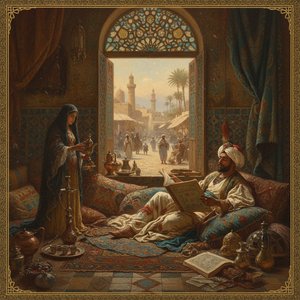
In the golden age of medieval Islamic scholarship, few names resonate with the intellectual precision and geographic brilliance of Qasim al-Husayni al-'Aridi, known more intimately to history as Luqmān. Born in the historic city of Qazvin, Iran, around 1203 CE, this remarkable polymath emerged from a background steeped in the Maliki school of jurisprudence. While his early training was rooted in the rigorous analytical traditions of Islamic law and theology, his true calling lay in the stars and the earth. Luqmān possessed a rare ability to bridge the gap between the spiritual and the scientific, transforming the abstract principles of legal logic into the tangible precision of cosmography.
The intellectual landscape of 13th-century Persia was a vibrant tapestry of cross-cultural exchange, and Luqmān stood at its very center. His education, though shrouded in the mists of time, undoubtedly provided him with a profound mastery of Arabic illuminated texts. This deep immersion in classical literature allowed him to synthesize the ancient wisdom of Greek geography with the burgeoning scientific discoveries of the Islamic world. He did not merely seek to replicate the maps of the past; rather, he sought to refine them through a lens of empirical observation and mathematical rigor.
The Sayyid Luqman Codex: A Masterpiece of Mapping
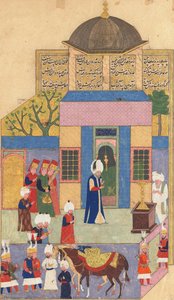
The crowning achievement of Luqmān’s career is undoubtedly the Sayyid Luqman Codex, a monumental manuscript produced circa 1283 CE. This was not merely an atlas, but a profound scientific statement. Within its pages, the geography of Persia and its surrounding territories were meticulously documented, presenting a world that felt both intimately known and scientifically measured. What set this work apart was Luqmān’s revolutionary methodology. While his contemporaries often remained tethered to the outdated Ptolemaic projections inherited from Greco-Roman traditions, Luqmān looked toward the horizon with fresh eyes.
By integrating sophisticated trigonometric calculations and incorporating firsthand data gathered from the accounts of intrepid travelers—specifically those documenting the sacred routes to Mecca—he achieved a level of accuracy that was unprecedented for his era. His maps were living documents, breathing with the movement of caravans and the precision of astronomical alignments. This synthesis of astronomy and geography allowed him to determine precise locations with a clarity that would guide navigators and scholars for generations to come.
A Lasting Impression on the Islamic World
The historical significance of Qasim al-Husayni al-'Aridi cannot be overstated. He was a pioneer who redefined the boundaries of what a cartographer could achieve, moving the discipline from mere illustration toward true scientific science. His work served as an essential cornerstone for subsequent generations of navigators, geographers, and scholars, shaping the collective understanding of the Persian landscape and the wider Islamic territories for centuries.
To study the life of Luqmān is to witness the triumph of human curiosity. His legacy remains etched in the very lines of the maps he drew, representing a moment in history when science, art, and faith converged to illuminate the unknown. Through his meticulous dedication, he ensured that the geography of his homeland would be preserved not just as a collection of borders, but as a testament to the enduring power of human intellect.