Vincenc Živný: A Chronicle of Czech Realism
Born on July 10, 1899, in Prague, Vincenc Živný emerged as a pivotal figure in the landscape of mid-20th century Czech art, his life and brushstrokes deeply intertwined with the socio-political currents of his era. His artistic journey was profoundly shaped by the rise of Socialist Realism and its subsequent evolution within the nation's cultural framework. Growing up during a period of immense transformation, Živný’s work offers a compelling window into the complexities of a society grappling with rapid industrialization and shifting ideological tides. His early training at the Prague Academy of Fine Arts (AVU) under the guidance of esteemed professors such as Jakub Obrovský and Krattner laid a rigorous academic foundation, providing him with the technical mastery that would later allow him to navigate diverse stylistic movements.
The evolution of Živny’s style was not merely a matter of personal preference but a reflection of the changing winds of European art history. Initially steeped in academic traditions, he gradually embraced the light-filled sensibilities of Impressionism and Post-Impressionism before eventually immersing himself in the tenets of Socialist Realism. This transition represented a deliberate engagement with the state-sponsored art movement that sought to depict idealized representations of collective prosperity, labor, and patriotism. However, Živný possessed an inherent sensitivity that prevented his work from becoming mere propaganda; he had a unique ability to imbue even the most straightforward portrayals of the working class with subtle nuances of human emotion and social commentary.
The Dignity of Labor and Iconic Portraits
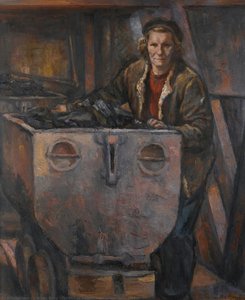
A defining moment in Živný's career arrived with his commission to paint “Portrait of Božena Živná, Miner from Kladno” (1950). This iconic work exemplifies the core principles of Socialist Realism while simultaneously revealing his unique artistic vision. The portrait captures a courageous miner, standing tall and proud, bathed in natural light that symbolizes the strength and dignity of the proletariat. Yet, beyond the formal elements, subtle details—the weariness around her eyes or the slight downturn of her mouth—suggest a deeper, more human narrative of struggle and perseverance. This capacity to find the individual within the collective became a hallmark of his most celebrated works.
His repertoire was vast, ranging from politically engaged compositions to intimate studies of everyday life. He was frequently called upon to create works for significant institutions, including competitions for the decoration of the Museum of K. Gottwald, the Museum of V. I. Lenin, and the Museum of the Czechoslovak Army in Prague. His subject matter often focused on the heroic figures of the era, including:
- Portraits of industrial workers and "shock workers" (stakhanovites)
- Political luminaries such as Klement Gottwald and Antonín Zápotocký
- Evocative landscapes like “Abandoned Quarry” and “Spring Motif near Prague”
- Quiet, contemplative still lifes, such as his “Still Life with Bananas”
Legacy and Historical Significance
As the decades progressed, Živný’s work continued to document the pulse of Czech life. While he is often categorized within the realm of engaged or political art, his true legacy lies in his ability to capture the human condition amidst monumental historical shifts. His paintings serve as a visual archive of an era defined by the tension between individual identity and state ideology. Through his meticulous attention to detail and poignant portrayals of working-class life, he bridged the gap between the rigid requirements of official art and the profound emotional truths of the people.
Vincenc Živný passed away in Prague on July 28, 1983, leaving behind a body of work that remains an essential study for anyone seeking to understand the cultural fabric of mid-century Czechoslovakia. His ability to navigate the complexities of his time—moving from the light of Impressionism to the heavy, grounded reality of Socialist Realism—ensures his place in the annals of European art history as a chronicler of both a nation's political struggle and its enduring human spirit.