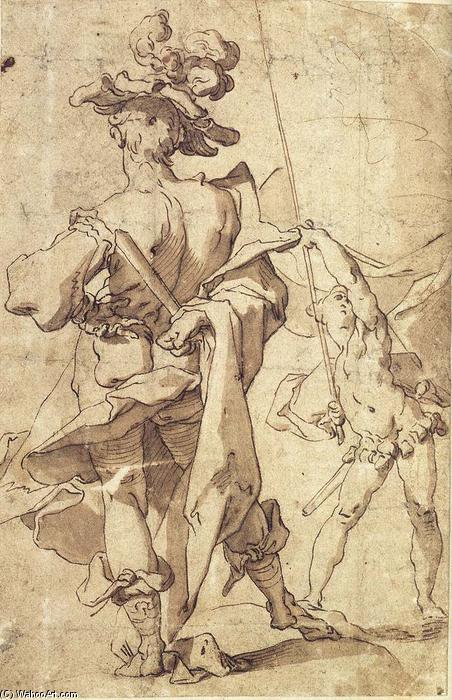
Abraham Bloemaert’s "Warrior & Young Standard-Bearer" – a dramatic black & white Mannerist drawing of power & conflict. Explore its dynamic lines, classical influence & aged texture.
Discover Abraham Bloemaert (1564-1651), a Dutch Baroque master known for dramatic history paintings, landscapes & influence on the Utrecht Caravaggisti. Explore his art!
Discover Antwerp's Museum Mayer van den Bergh – housing masterpieces of Northern Renaissance art including Brueghel’s ‘Mad Meg’ and the stunning Mayer van den Bergh Breviary, undergoing a major expansion in 2029!
Abraham Bloemaert’s Warrior and Young Standard-Bearer: A Study in Dramatic Mannerism
The artwork presented here – Abraham Bloemaert's “Warrior and Young Standard-Bearer” – is more than just a depiction of physical struggle; it’s a masterful distillation of artistic principles that encapsulate the anxieties and aspirations of the mid-16th century Dutch Republic. Measuring 270 x 171 cm, this monumental drawing offers an arresting glimpse into Bloemaert's creative process and reveals his profound engagement with the stylistic currents shaping European art at the time.
Subject Matter and Composition
At its core lies a confrontation between two figures: a powerfully built male warrior dominating a younger man bearing a standard – likely symbolizing faith or leadership. The positioning is deliberately asymmetrical, emphasizing the dominance of the central figure while simultaneously conveying a palpable sense of vulnerability in his subordinate companion. This dynamic arrangement isn’t merely aesthetically pleasing; it speaks to broader themes prevalent during Bloemaert's era—the clash between authority and resistance, piety and pragmatism—issues that resonated deeply within the turbulent political landscape of Holland. The artist’s meticulous attention to anatomical detail underscores the importance of realism within a framework of expressive distortion characteristic of Mannerism.
Stylistic Influences: Mannerist Distortion
Bloemaert's style is undeniably rooted in Mannerism, an artistic movement that reacted against the idealized forms of High Renaissance painting. Unlike its predecessors, Mannerism prioritized emotional intensity and psychological complexity over accurate representation. Bloemaert achieves this through elongated figures—a hallmark of the style—whose limbs stretch unnaturally, creating a sense of dynamism and instability. Furthermore, he employs exaggerated poses and gestures to convey emotion—fear, determination, defiance—capturing the essence of human experience with remarkable precision. The artist’s use of hatching and cross-hatching contributes significantly to the artwork's textural richness, simulating the appearance of aged parchment and lending an air of solemn contemplation to the scene.
Technique and Material Considerations
Executed in black and white chalk on paper, “Warrior and Young Standard-Bearer” exemplifies Bloemaert’s mastery of drawing technique. The artist skillfully utilizes tonal variations—ranging from deep shadows to luminous highlights—to sculpt form and create a convincing illusion of depth. Careful observation informs every stroke, demonstrating an unwavering commitment to capturing the subtleties of human anatomy and conveying movement with breathtaking fluidity. The paper itself bears visible signs of age – creases and discoloration – hinting at its provenance as a preparatory sketch or study for a larger canvas. This deliberate choice underscores Bloemaert’s artistic ethos: prioritizing expressive gesture and psychological insight over slavish adherence to photographic accuracy.
Symbolism and Emotional Resonance
Beyond its formal qualities, the artwork is laden with symbolic significance. The warrior embodies strength and dominance, while the young standard-bearer represents innocence and faith—a dichotomy that reflects the anxieties surrounding religious reform during Bloemaert’s lifetime. The dramatic lighting—originating from an unseen source above—amplifies the emotional impact of the scene, casting shadows that heighten tension and emphasizing the musculature of both figures. Ultimately, “Warrior and Young Standard-Bearer” transcends mere visual representation; it invites contemplation on themes of power, vulnerability, and spiritual conviction – emotions that continue to resonate with viewers today.
Concluding Thoughts: An Artistic Legacy
Abraham Bloemaert’s “Warrior and Young Standard-Bearer” stands as a testament to the enduring power of Mannerist art—a style characterized by its expressive distortion and psychological depth. It serves as an invaluable insight into Bloemaert's artistic vision and offers a compelling illustration of the cultural anxieties confronting Holland during the formative years of the Baroque era. Reproductions of this remarkable drawing provide collectors and interior designers alike with an opportunity to appreciate not only Bloemaert’s technical prowess but also his profound engagement with the human condition—a legacy that continues to inspire admiration and contemplation centuries after its creation.