A Vision of Veiled Sorrow
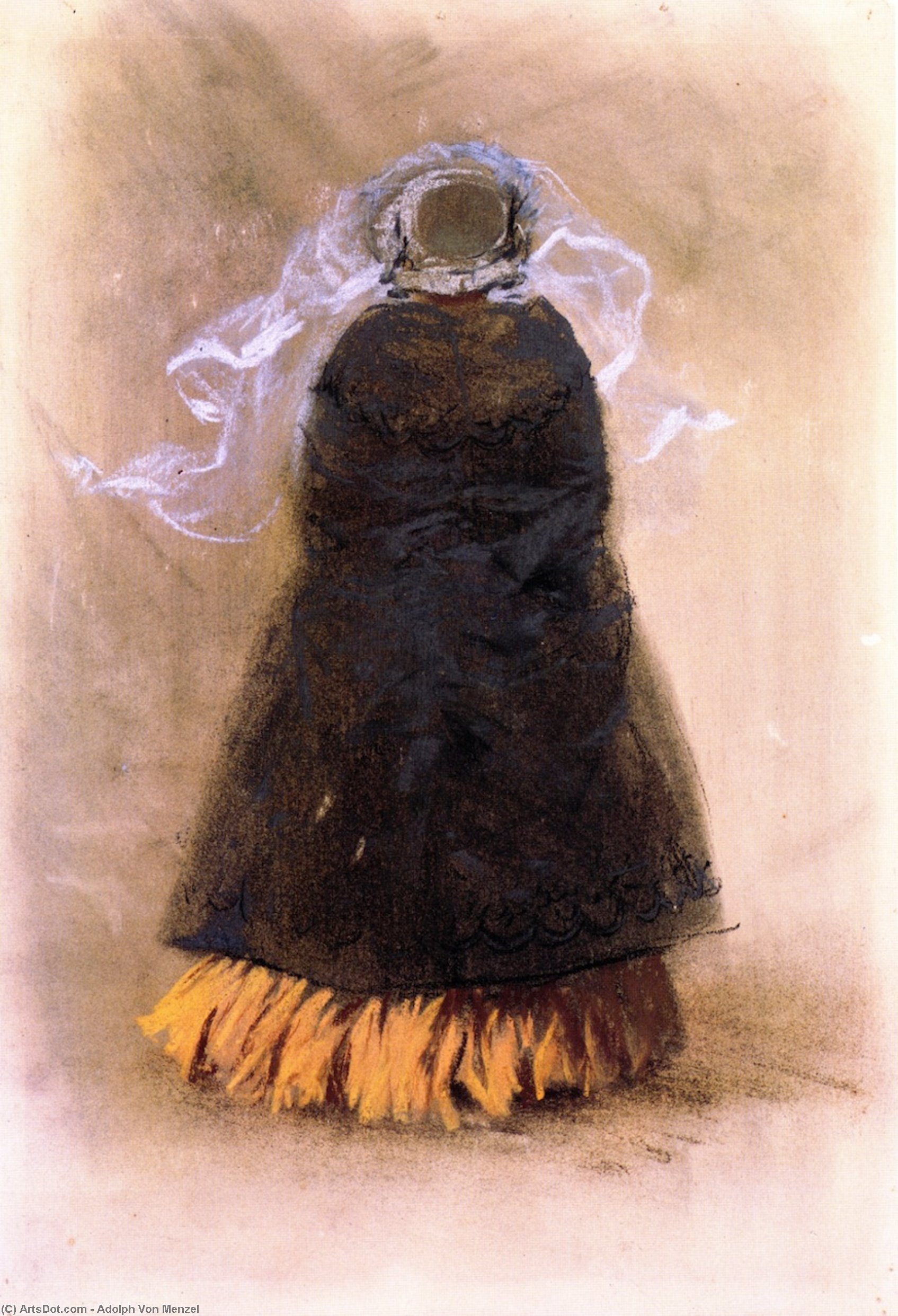
In the quiet, evocative depths of Adolph von Menzel’s Lady with Hat and Veil, Viewed from Behind, we encounter a moment suspended in time, captured with a hauntingly beautiful sensitivity. This masterpiece, dating back to 1850, transcends mere portraiture to become an atmospheric meditation on mystery and the ephemeral nature of presence. The subject, seen from behind, is shrouded in a delicate white veil that clings to her form, creating a sense of profound intimacy and distance all at once. As she stands centrally yet slightly off-center within the frame, there is a palpable feeling of imbalance, as if the weight of her unseen emotions pulls at the very composition itself. The muted palette of pale beiges, deep browns, and a sudden, soft splash of yellow from her skirt works in harmony to evoke a somber, dreamlike state that lingers in the viewer's mind long after the first glance.
The technique employed by Menzel in this work showcases a masterful command of Impressionistic sensibilities well before the movement reached its peak. Through a delicate wet-on-wet blending process, the artist allows colors to merge and soften, erasing harsh boundaries and replacing them with fluid, organic shapes. The brushstrokes are loose and expressive, lending a sense of movement to the heavy fabrics and the light, translucent veil. This layering of oil paint creates a rich, tactile texture that gives the canvas an almost ethereal, hazy quality. There is no sharp definition here; instead, the background merges seamlessly into the figure, flattening the perspective and creating a shallow space that forces the observer to focus entirely on the emotional resonance of the subject's silhouette.
Symbolism and the Art of Observation
Beyond its technical brilliance, the painting serves as a profound exploration of symbolism. The veil, a classic motif in art history, acts as a barrier between the seen and the unseen, representing themes of mourning, grief, or perhaps the concealment of one's true self. The obscured face invites the viewer to project their own narratives onto the figure, turning the painting into a mirror for human melancholy. Menzel, a master of German Realism, utilizes his background in lithography to bring an uncanny ability for detail to the textures of the clothing, yet he intentionally softens these details to prioritize atmosphere over anatomical precision. This tension between the realistic depiction of 19th-century attire and the abstract, emotional weight of the composition creates a captivating duality.
For the discerning collector or interior designer, this artwork offers more than just visual beauty; it provides a focal point of profound emotional depth. Its understated color scheme makes it an incredibly versatile piece for sophisticated spaces, capable of anchoring a room with its quiet dignity and historical gravity. Whether placed in a contemporary gallery setting or a classic study, the Lady with Hat and Veil brings with it a sense of timelessness and a whisper of the past. It is a piece that does not demand attention through loudness, but rather commands it through a subtle, irresistible pull toward its mysterious, shrouded heart.