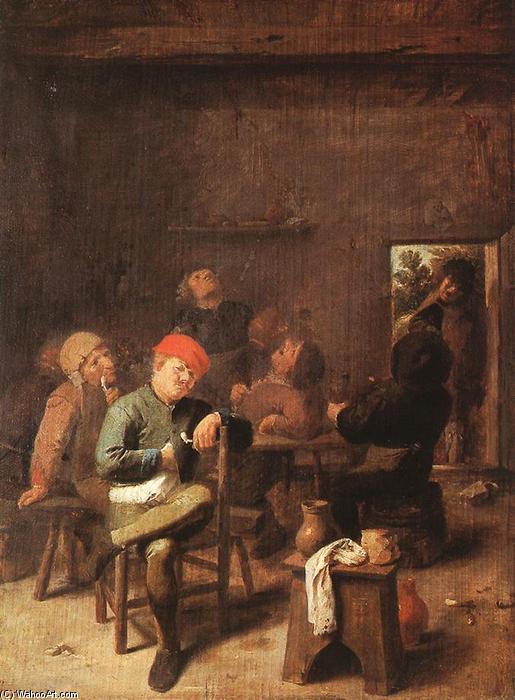
Explore Adriaen Brouwer's 'Peasants Smoking and Drinking,' a captivating genre painting capturing the realism of everyday life in 17th-century Flanders. Discover its details and artistic significance.
Discover Adriaen Brouwer (1605-1638), a Flemish Baroque painter celebrated for his lively genre scenes of peasant life, taverns, and everyday moments. Explore his art!
Discover European art history at the Alte Pinakothek in Munich! Explore Renaissance & Baroque masterpieces by Dürer, Rembrandt & Rubens within a stunning neoclassical setting.
A Fleeting Brilliance: Adriaen Brouwer’s “Peasants Smoking and Drinking”
Adriaen Brouwer's "Peasants Smoking and Drinking," painted around 1625 – 1630, stands as a cornerstone of Flemish genre painting—a genre dedicated to capturing scenes from everyday life with remarkable realism and psychological depth. Created during the turbulent Baroque period in Antwerp, Belgium, this artwork transcends mere depiction; it’s an invitation into a moment frozen in time, offering viewers a glimpse beneath the veneer of aristocratic grandeur that dominated much of European art at the time. Brouwer's tragically short life – he died in January 1638 – ironically ensured that his artistic legacy would endure, cementing his place as one of the most influential painters of his era.
The Scene Unfolds: Observation and Detail
The painting depicts a tavern interior populated by several men engaged in conversation and imbibing drink. Brouwer’s masterful technique—characterized by loose brushstrokes and subtle tonal variations—immediately distinguishes it from more polished, idealized representations prevalent during the Baroque. Unlike many artists of his time who prioritized grandeur and mythological narratives, Brouwer focused intently on portraying ordinary individuals experiencing mundane activities. The artist meticulously rendered textures – the rough fabric of clothing, the worn surfaces of tables – conveying a palpable sense of materiality that grounds the scene in reality. Notice particularly the gaze of one peasant, seemingly lost in contemplation as he puffs on his pipe; this subtle gesture speaks volumes about human psychology and Brouwer’s ability to convey emotion through visual cues.
Baroque Realism: Beyond Surface Beauty
Brouwer's stylistic approach aligns perfectly with the burgeoning Baroque interest in naturalism—a reaction against Mannerist art’s stylized forms and exaggerated poses. However, he eschewed mere imitation of nature, instead utilizing observation to illuminate human behavior and social dynamics. The inclusion of objects like a bowl, cup, vase, and bottle isn't merely decorative; they serve as props that contribute to the narrative and reinforce the atmosphere of conviviality. Brouwer’s use of chiaroscuro—the dramatic interplay between light and shadow—further enhances the painting’s impact, sculpting forms and emphasizing facial expressions with precision. This technique creates a sense of depth and immediacy, drawing viewers into the scene as if they were present within its confines.
Symbolism and Emotional Resonance
Beyond its technical brilliance, “Peasants Smoking and Drinking” carries significant symbolic weight. The act of smoking represents leisure, camaraderie, and perhaps even indulgence—activities that contrasted sharply with the moralistic pronouncements of the Catholic Church during Brouwer’s time. Yet, there's also an underlying melancholy conveyed by the figures’ expressions; they are not simply enjoying themselves but grappling with unspoken anxieties and uncertainties. Brouwer skillfully captures the complexities of human experience, reminding us that beauty can reside in the commonplace and that art possesses the power to provoke contemplation about our own lives.
A Legacy Preserved: Inspiration for Reproduction
Today, reproductions of “Peasants Smoking and Drinking” continue to inspire artists and designers alike. Its evocative depiction of human interaction—coupled with Brouwer’s masterful handling of light and texture—offers a timeless aesthetic that resonates across centuries. Consider how the painting's muted palette and realistic portrayal could be incorporated into interior spaces seeking warmth and authenticity, or how its psychological insight might inform artistic interpretations exploring themes of vulnerability and observation. Brouwer’s enduring influence testifies to the power of art to transcend time and capture the essence of human existence.