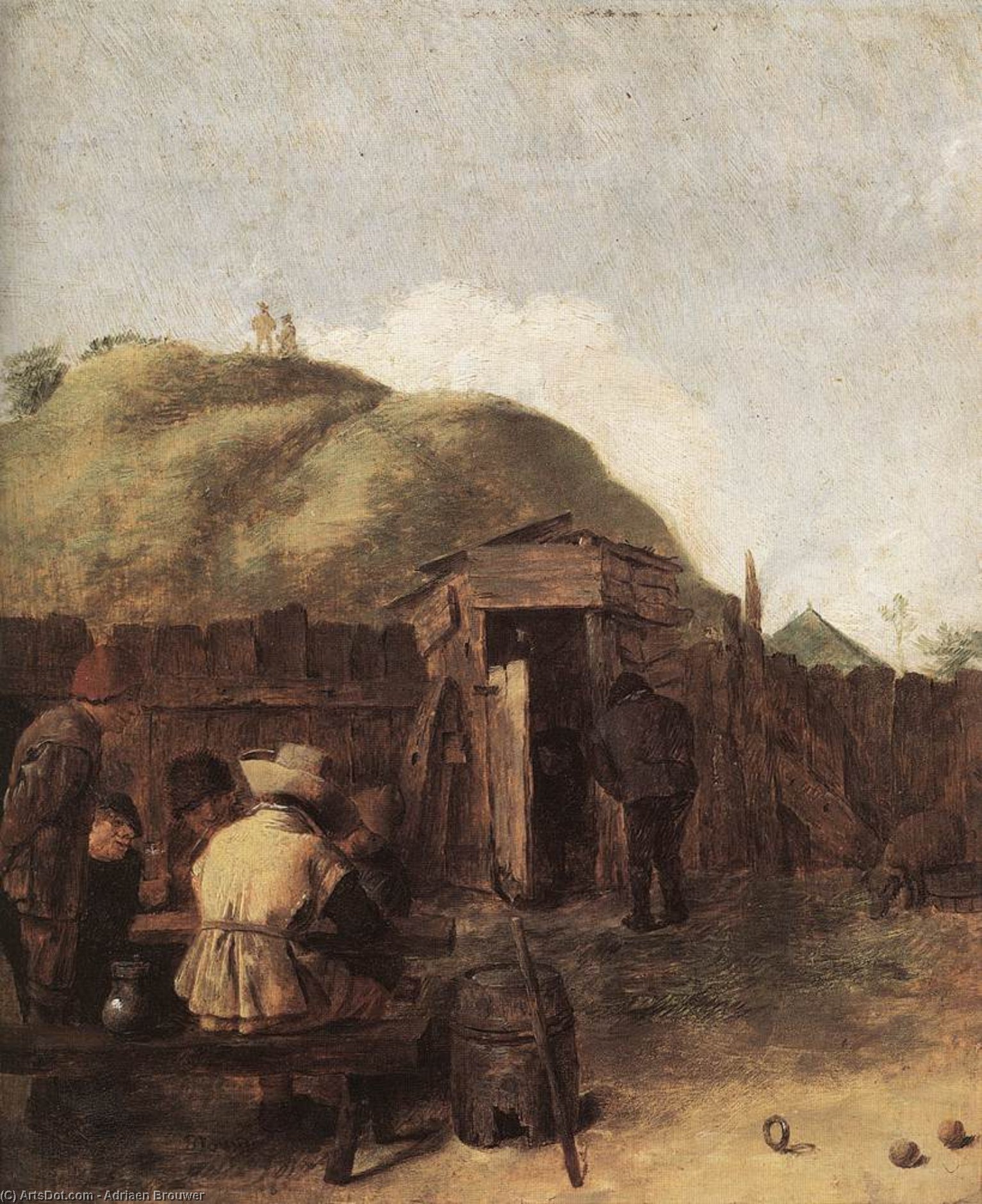
Seated Drinkers by Adriaen Brouwer – A Snapshot of Flemish Society
Adriaen Brouwer’s “Seated Drinkers,” completed around 1635, stands as a quintessential example of Dutch Baroque genre painting—a genre that sought to depict everyday life with remarkable realism and psychological depth. Hanging proudly in the Musées Royaux des Beaux-Arts in Brussels, Belgium, this unassuming canvas transcends its modest dimensions (25 x 21 cm) to offer a window into the social dynamics of Antwerp during Brouwer’s turbulent lifetime.
A Composition Steeped in Observation
The painting captures three men seated around a table, engaged in conversation—likely fueled by drink and tobacco. Brouwer's masterful technique employs oil paint on oak, utilizing subtle gradations of brown and grey to create an atmosphere of quiet intimacy punctuated by carefully placed highlights of red and yellow. The artist’s meticulous attention to detail is evident in the rendering of textures – from the rough surface of the wooden fence glimpsed in the background to the tactile quality of the table cloth—demonstrating Brouwer's commitment to portraying reality with uncompromising accuracy.
More Than Just a Scene: Symbolism and Social Commentary
Beyond its visual beauty, “Seated Drinkers” carries significant symbolic weight. Brouwer deliberately positioned the figures on the periphery of society – laborers and craftsmen – reflecting the anxieties surrounding moral decline prevalent in Antwerp’s bourgeois circles. The painting serves as a commentary on social hierarchies and challenges viewers to contemplate notions of virtue and vice. The inclusion of a jug suggests indulgence, while the posture of one figure hints at contemplation—elements that contribute to the painting's complex psychological narrative.
A Masterpiece Reflecting Brouwer’s Artistic Vision
Critics have noted parallels between Brouwer’s artistic endeavors and his personal life, highlighting his unwavering fascination with theatrical performances. This passion for capturing human behavior is brilliantly realized in “Seated Drinkers,” where Brouwer succeeds in conveying the subtle interplay of emotions among the characters. The painting's understated elegance—a testament to Brouwer’s refined sensibilities—continues to captivate audiences today.
Historical Context and Legacy
Created during Brouwer’s brief but influential career, “Seated Drinkers” exemplifies the Baroque preoccupation with portraying human experience in its rawest form. It aligns perfectly with the broader artistic movement of its time, which sought to depict scenes from daily life alongside moralizing narratives. Brouwer's work cemented his reputation as a pioneer of genre painting and profoundly impacted subsequent generations of artists—a legacy that ensures “Seated Drinkers” remains an enduring symbol of Flemish Baroque artistry.