A Solitary Soul’s Contemplation: Adriaen van der Werff's *Sainte Madeleine Méditante*
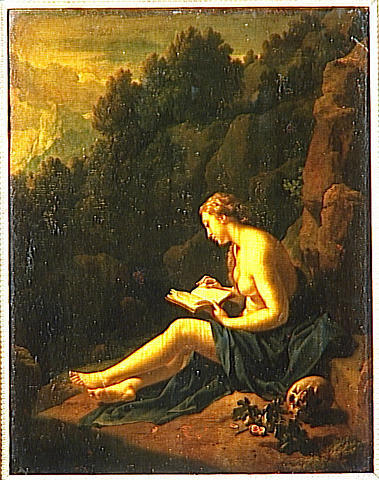
Adriaen van der Werff’s *Sainte Madeleine Méditante dans la solitude* (Saint Mary Magdalene Meditating in Solitude) is a profoundly moving Baroque masterpiece, capturing a moment of intense introspection and spiritual searching. Painted around 1707-1725, this work transcends mere portraiture to become a poignant meditation on mortality, repentance, and the enduring power of faith. The painting’s strength lies not just in its technical brilliance – the masterful use of chiaroscuro, the meticulous rendering of textures, and the subtle modeling of form – but also in its ability to evoke a powerful emotional response from the viewer.
At first glance, the scene presents a seemingly simple tableau: Saint Mary Magdalene, identified by her iconic blue drapery and partially revealed nudity—a deliberate symbol referencing her past transgression and subsequent penance—sits amidst a rugged, rocky landscape. She is absorbed in reading a book, a gesture that immediately invites us to contemplate her inner world. However, the painting’s true power resides in the dramatic interplay of light and shadow, orchestrated by van der Werff's signature Baroque technique. A strong, directional light source, originating from the left, dramatically illuminates Magdalene’s face, her hands holding the book, and a small portion of her garment, while plunging the background into deep, enveloping darkness. This stark contrast heightens the sense of isolation and intensifies the emotional weight of the scene.
The Language of Symbolism: Skull, Foliage, and Mortality
Van der Werff doesn’t shy away from incorporating potent symbolic elements that enrich the painting's narrative depth. The strategically placed skull at the bottom right corner is a clear *memento mori*, a stark reminder of death’s inevitability—a common motif in Baroque art designed to prompt reflection on the brevity of life and the importance of spiritual preparation. The scattered foliage, rendered with visible brushstrokes that suggest both decay and resilience, further reinforces this theme. The juxtaposition of these elements – the vibrant figure of Magdalene against the backdrop of mortality – creates a compelling tension, forcing the viewer to confront fundamental questions about existence and redemption.
Furthermore, Magdalene’s posture—hunched over her book with an expression of deep thought—is laden with meaning. Her vulnerability, suggested by her nudity, is not presented as shame but rather as humility before God. The act of reading symbolizes a quest for knowledge, understanding, and ultimately, spiritual enlightenment. It speaks to the transformative power of faith and the possibility of finding solace in solitude.
Technique and Artistic Craftsmanship
*Sainte Madeleine Méditante* is a testament to van der Werff’s exceptional technical skill and his deep understanding of Baroque painting principles. The artist employs a layered approach, building up the image through careful application of oil paint—a technique that allows for rich color saturation, subtle gradations of tone, and remarkable textural detail. The smooth skin tones achieved through glazing techniques create an illusion of lifelike realism, while the rough, uneven surfaces of the rocks convey their tactile presence. The flowing lines defining Magdalene’s body and clothing contrast sharply with the angularity of the landscape, creating a dynamic visual balance.
The flattened perspective, characteristic of classical painting, contributes to the overall sense of depth, though it's achieved through atmospheric perspective—the gradual darkening and reduction in detail as elements recede into the background. Overlapping elements – rocks positioned in front of foliage – further enhance this illusion of space. Van der Werff’s meticulous attention to detail, combined with his masterful use of light and shadow, results in a painting that is both visually stunning and emotionally resonant.
A Window into the Baroque Era
*Sainte Madeleine Méditante dans la solitude* offers a captivating glimpse into the artistic and intellectual landscape of the Dutch Golden Age. Painted during the height of the Baroque period, it reflects the era’s fascination with dramatic emotion, religious themes, and the exploration of human psychology. The painting's enduring appeal lies in its ability to transcend time and connect with viewers on a deeply personal level, prompting contemplation about life, death, faith, and the search for meaning—themes that continue to resonate today.