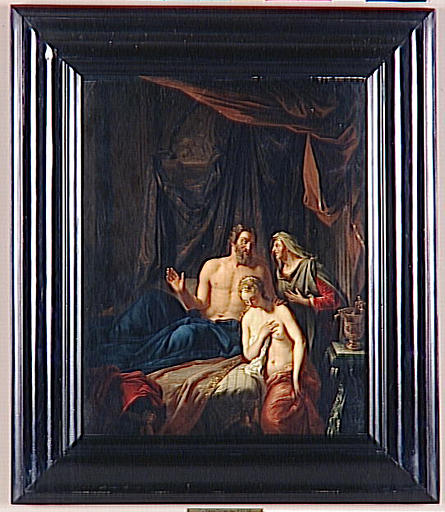
Adriaen van der Werff’s “Sarah Presenting Agar to Abraham”: A Baroque Drama of Faith and Lineage
Adriaen van der Werff's "Sarah Presenting Agar to Abraham," a captivating work from the late 17th century, offers more than just a biblical scene; it’s a meticulously crafted tableau brimming with psychological depth, dramatic lighting, and an astute understanding of human emotion. Painted during the height of Dutch Baroque artistry, this oil on canvas depicts a pivotal moment in the Old Testament narrative – Sarah's decision to provide her aging husband Abraham with a handmaiden, Hagar, to secure an heir. Van der Werff doesn’t simply illustrate a story; he renders it with a profound sensitivity to gesture, expression, and the subtle interplay of light and shadow, creating an image that resonates with both historical significance and timeless human drama.
The composition itself is a masterclass in Baroque technique. A clear triangular structure anchors the scene: Abraham, positioned at the apex, commands attention with his dignified bearing; Sarah, to his right, embodies a complex blend of concern and resignation; and Hagar, lower down, conveys vulnerability and a quiet dignity. This deliberate arrangement draws the viewer’s eye through the carefully orchestrated space, which is defined by draped fabrics – rich in texture and color – and architectural elements that subtly suggest the confines of Abraham's household. The artist skillfully employs linear perspective to create a sense of depth within this intimate setting, layering figures and drapery to achieve a convincing illusion of spatial recession.
A Symphony of Color and Light
Van der Werff’s palette is dominated by warm, earthy tones – deep reds, browns, and golds—contrasted against the cooler blues and greens of the background. This creates a dramatic chiaroscuro effect, highlighting key areas like Abraham's face and torso, drawing attention to their expressions and gestures. The realistic rendering of flesh tones adds to the painting’s naturalism, while the subtle use of light not only sculpts the figures but also imbues the scene with an atmosphere of solemnity and introspection. Note particularly how the light catches the folds of Hagar's garment, revealing the texture of the fabric and adding a tactile quality to the image.
Symbolism and Emotional Resonance
"Sarah Presenting Agar to Abraham" is rich in symbolic meaning. Beyond the literal depiction of a biblical event, the painting explores themes of faith, family dynamics, and the complexities of inheritance. Sarah’s expression—a mixture of sorrow and acceptance—suggests the weight of her decision and its potential consequences. Hagar's posture and gaze convey vulnerability and a quiet strength, highlighting her position as a woman dependent on the generosity (and ultimately, the judgment) of Abraham. The act of presenting Hagar is not merely a transaction; it’s a fraught moment laden with implications for lineage, social status, and the very future of Abraham's family.
Van der Werff’s Baroque Vision
As a leading figure in Dutch Baroque painting, Van der Werff masterfully employed techniques characteristic of the era. His meticulous attention to detail—evident in the rendering of fabrics, skin textures, and architectural elements—is combined with an expressive use of light and shadow to create a dramatic and emotionally charged scene. The influence of Eglon van der Neer, his mentor, is particularly evident in Van der Werff’s exceptional skill at depicting drapery, which here contributes significantly to the painting's overall sense of realism and grandeur. The work stands as a testament to Van der Werff’s ability to seamlessly blend historical narrative with psychological insight, solidifying his place among the most celebrated artists of his time.
ArtsDot offers exquisite hand-painted reproductions of “Sarah Presenting Agar to Abraham,” allowing you to bring this iconic masterpiece into your home or office. Each reproduction is created by skilled artisans using traditional techniques and high-quality materials, ensuring that it captures the essence of Van der Werff’s original vision with stunning accuracy and detail.