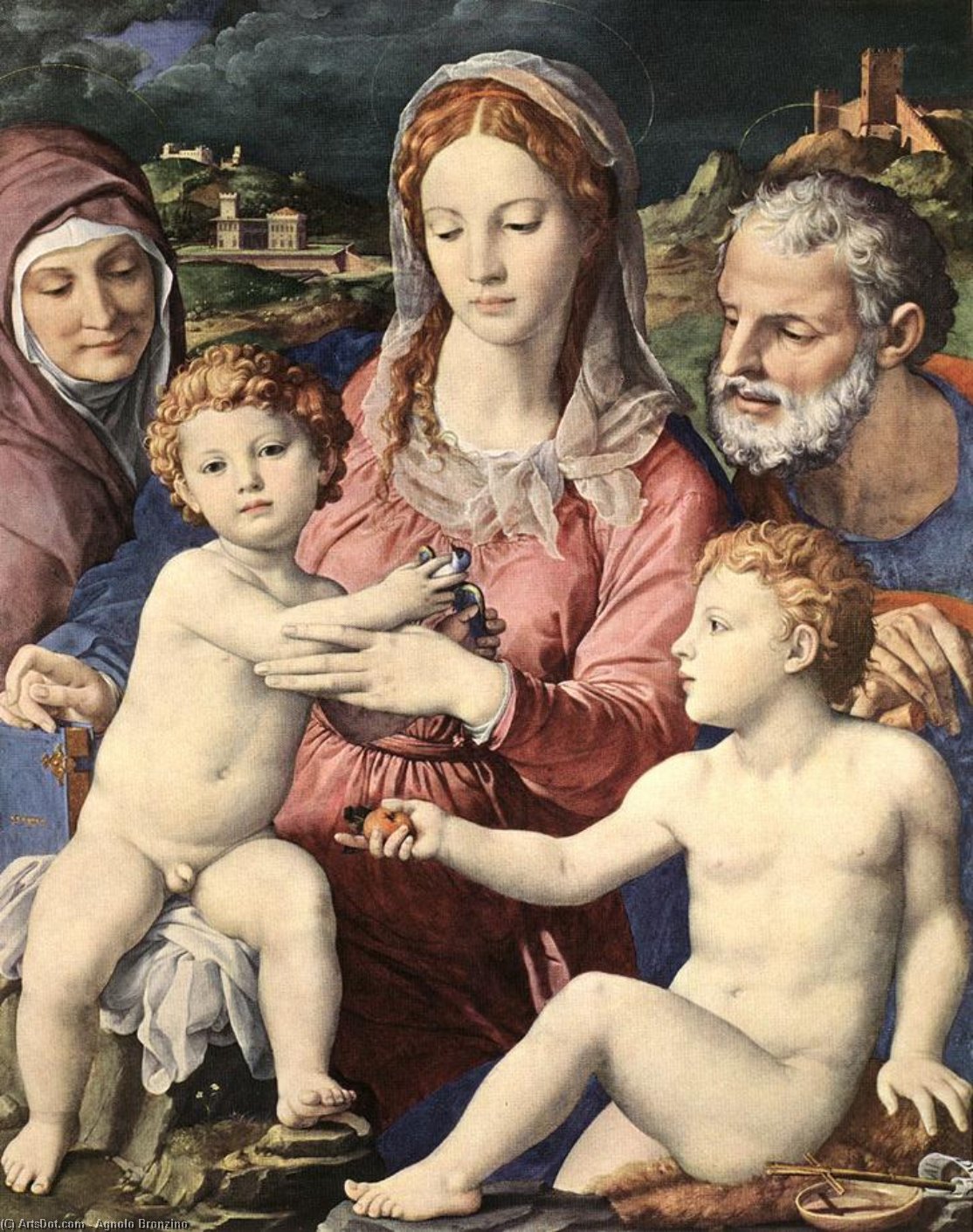
A serene 1540 painting of the Holy Family by Agnolo Bronzino, depicting Mary cradling Jesus and Joseph standing protectively behind them – a masterpiece of Renaissance elegance.
Explore the refined elegance of Agnolo Bronzino, Florentine Mannerist master & court painter to the Medici. Discover his iconic portraits and allegorical works.
Explore Vienna's artistic soul at the Kunsthistorisches Museum! Discover masterpieces by Raphael, Rembrandt, Vermeer & ancient treasures from Egypt to Rome.
A Glimpse into Florentine Mannerism: Agnolo Bronzino’s Holy Family
The painting “Holy Family” by Agnolo Bronzino, completed in 1534, stands as a testament to the refined aesthetic sensibilities of Renaissance Florence during its twilight years. More than just a depiction of biblical figures—Mary cradling Jesus and Joseph—it embodies the core tenets of Mannerism, an artistic movement that prioritized elegance, psychological complexity, and subtle distortions over the idealized beauty championed by earlier generations. Bronzino’s masterful execution captures not merely what is seen but what is felt, inviting viewers into a moment of quiet contemplation amidst opulent surroundings.
Style and Technique: A Calculated Distortions
Bronzino's approach diverges dramatically from the humanist ideals prevalent in his time. Unlike Michelangelo or Leonardo da Vinci who sought to convey emotion through expressive gestures and dynamic compositions, Bronzino favored a deliberately restrained style characterized by meticulous detail and a disconcerting stillness. The figures are rendered with unnervingly smooth surfaces—a technique achieved through layering thin glazes of pigment—creating an illusion of depth that defies naturalism. Observe how the drapery folds subtly exaggerate their contours, contributing to an overall sense of artificial perfection. This calculated distortion wasn’t intended to shock or provoke but rather to heighten the viewer's awareness of form and color, pushing boundaries of representation.
Historical Context: The Shadow of Michelangelo
Florence in 1534 was grappling with profound religious and political upheaval following the Sack of Rome in 1527—an event that shook the foundations of papal authority and fueled anxieties about artistic patronage. Bronzino’s commission reflects this climate, aligning him firmly within the humanist circle yet subtly distancing himself from Michelangelo's monumental grandeur. While Michelangelo wrestled with colossal sculptures like David, striving for heroic proportions and conveying palpable emotion, Bronzino focused on capturing a serene familial tableau—a deliberate choice that speaks to the anxieties of his era regarding stability and moral virtue. The painting’s quiet dignity serves as an antidote to the turbulent times, presenting an idealized vision of domestic harmony.
Symbolism: Beyond Simple Narrative
The Holy Family itself is laden with symbolic significance. Mary embodies piety and maternal devotion—a cornerstone of Christian iconography—while Joseph represents steadfastness and protection. The inclusion of three children underscores the importance of lineage and continuity within the family unit. Furthermore, consider the carefully positioned objects – the bowl, cup, and spoon – which are not merely props but symbols of nourishment and communion. They reinforce the painting’s central theme: a celebration of familial love and spiritual grace. Bronzino's subtle use of color—primarily muted reds and golds—adds to this symbolic richness, conveying warmth and prestige.
Emotional Impact: A Moment Frozen in Time
Ultimately, “Holy Family” transcends its narrative content to evoke a profound emotional response. The stillness of the scene invites viewers to linger on the faces of the figures, capturing fleeting expressions of tenderness and concern. Bronzino’s masterful rendering captures not just physical likeness but also psychological nuance—a feat rarely achieved in Mannerist art. It's a painting that speaks to universal themes of family, faith, and beauty, reminding us of the enduring power of art to convey emotion and inspire contemplation. Like the Holy Spirit Church in Sopron, Hungary, Bronzino’s masterpiece exemplifies how artistic excellence can elevate our understanding of human experience.