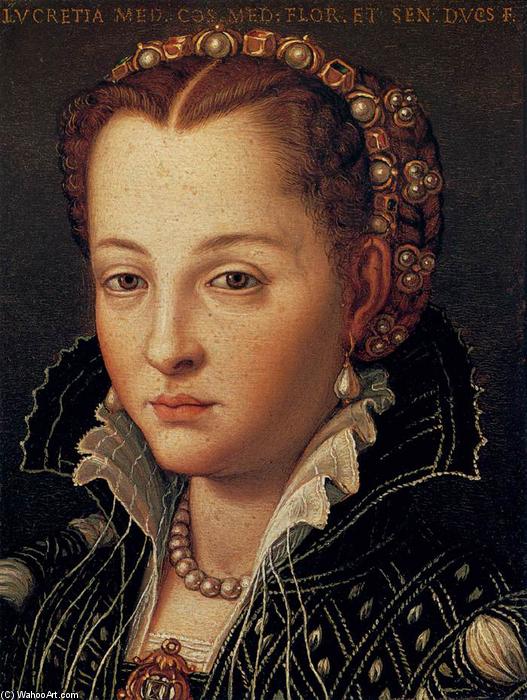
Agnolo Di Domenico, Del Mazziere, Agnolo, Agnolo Di Domenico, Called Del Mazziere, Agnolo Di Domenico, Called Del Mazziere (Master Of Santo Spirito)
A Portrait of Regal Grace: Agnolo Bronzino’s Lucrezia di Cosimo
Agnolo Bronzino's “Lucrezia di Cosimo,” completed in 1555, stands as a quintessential emblem of Florentine Mannerism—a style characterized by refined elegance, stylized forms, and an unsettling stillness that transcends mere representation. More than just a depiction of a young woman, it’s a carefully constructed tableau designed to convey status, piety, and the pervasive influence of humanist ideals within the opulent court of Florence under Cosimo I.
- Subject Matter: The portrait portrays Lucrezia di Cosimo, daughter of Eleonora Gonzaga and Cosimo I de’ Medici—a prominent figure in Florentine aristocratic society. Her youthful beauty is rendered with meticulous detail, emphasizing her delicate features and serene gaze.
- Style & Technique: Bronzino's mastery lies in his ability to achieve an almost sculptural quality through precise modeling and subtle shading. The artist eschews the expressive dynamism favored by earlier Renaissance painters like Raphael or Michelangelo, opting instead for a cool composure that reflects the Mannerist preoccupation with intellectual contemplation rather than emotional fervor.
- Composition & Color Palette: The dark background serves to heighten the luminosity of Lucrezia’s face and gown—a deliberate tactic employed to draw the viewer's eye directly to her expression. Bronzino utilizes a restrained palette dominated by muted golds, browns, and creams, reflecting the aristocratic taste for understated grandeur.
Historical Context: The Medici Patronage of Art
Florence during Cosimo I’s reign was at the zenith of its artistic prowess—fueled by immense wealth derived from trade and shrewd political maneuvering. Bronzino benefited enormously from this patronage, becoming one of the most prolific portraitists of his time and securing commissions from influential families like the Medici themselves. This commission reflects the broader humanist movement that championed reason and observation alongside classical ideals – a trend powerfully evident in Lucrezia’s pose and attire.
- Influence of Raphael: Bronzino's style bears unmistakable traces of Raphael, whom he admired greatly—particularly his mastery of illusionistic perspective and idealized beauty. However, unlike Raphael’s harmonious compositions, Bronzino deliberately disrupts visual conventions to convey a sense of psychological complexity.
- Symbolism & Iconography: The crown or adornment atop Lucrezia's head symbolizes her royal lineage and signifies the importance of piety within Florentine aristocratic culture. The pearl necklace—a common motif in portraits of noblewomen—represents purity and virtue, reinforcing the idealized image presented by Bronzino.
Emotional Impact & Legacy
“Lucrezia di Cosimo” transcends mere visual representation; it communicates a profound stillness that invites contemplation. The woman’s gaze—directed outwards but seemingly unfocused—suggests an inner life preoccupied with thought and reflection—a characteristic trait of Mannerist portraiture. Bronzino's work continues to fascinate art historians and collectors alike, lauded for its technical brilliance and its ability to capture the elusive essence of Renaissance aristocratic identity. It remains a testament to Bronzino’s enduring legacy as one of Florence’s most influential artists.