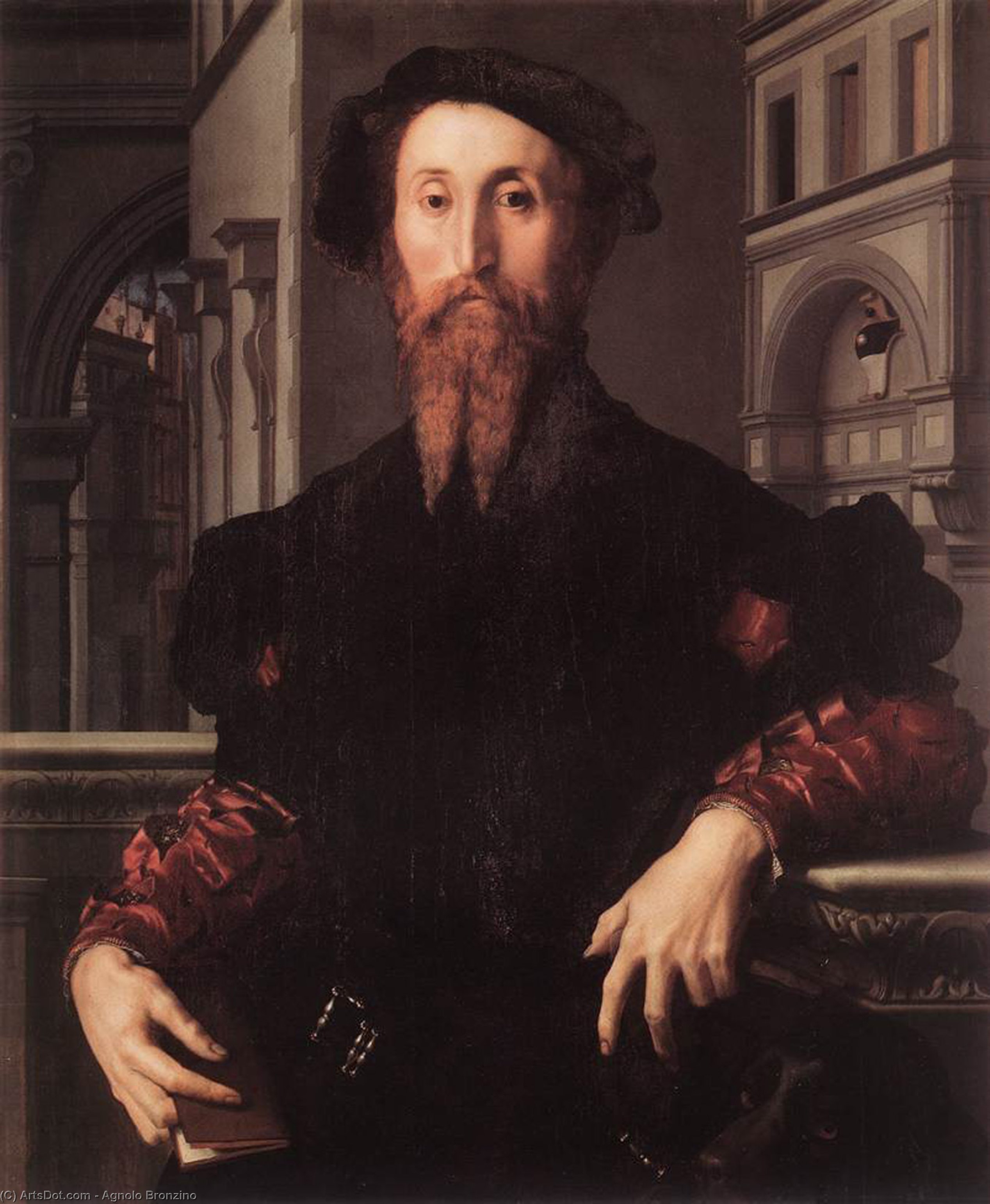
Portrait of Bartolomeo Panciatichi: A Florentine Masterpiece of Reserved Elegance
Agnolo Bronzino’s “Portrait of Bartolomeo Panciatichi,” painted in 1540, is more than just a likeness; it's a meticulously crafted distillation of Renaissance ideals – a testament to the power of portraiture as both documentation and carefully constructed symbolism. This captivating work, now housed within the Uffizi Gallery in Florence, offers a rare glimpse into the refined world of Florentine nobility during the height of the Medici’s influence, revealing a masterful command of technique and an astute understanding of human psychology.
The subject himself, Bartolomeo Panciatichi, was a prominent figure – a humanist scholar, diplomat, and politician deeply embedded within Florence's intricate social fabric. Born in France to a merchant family with strong ties to the Medici court, he later became a trusted advisor to Cosimo I de’ Medici, serving as a key link between Florence and France. The portrait captures him at the peak of his influence, radiating an aura of quiet authority and understated wealth. Bronzino doesn't offer us a boisterous celebration of triumph; instead, he presents a carefully controlled image of dignified composure.
A Study in Mannerist Precision
Bronzino’s style is undeniably Mannerist – a movement that prioritized elegance, refinement, and intellectualism over the emotional fervor of the High Renaissance. This portrait exemplifies these characteristics with remarkable precision. The composition is strikingly formal, dominated by strong vertical lines that draw the eye towards Panciatichi's face and figure. Notice the meticulous rendering of textures: the velvet drape, the folds of his clothing, the subtle sheen on his skin – each element is treated with painstaking detail, creating a sense of tactile realism. The use of color is restrained yet sophisticated, relying on rich, deep tones that enhance the portrait’s overall elegance.
Technically, Bronzino employed a technique known as “stiacciato,” where he applied thin layers of paint to create subtle gradations and smooth transitions. This method contributes significantly to the portrait's polished surface and luminous quality. The artist’s brushwork is remarkably controlled, almost sculptural in its precision – a hallmark of his style. The elongated figure, characteristic of Mannerism, subtly emphasizes Panciatichi’s status and intellectual prowess, while the carefully arranged background—a cityscape receding into the distance—provides context without distracting from the central subject.
Symbolic Layers and Courtly Intrigue
Beyond its technical brilliance, “Portrait of Bartolomeo Panciatichi” is laden with symbolic meaning. The pose itself – leaning casually against a balustrade – suggests both confidence and detachment. The inclusion of the family coat of arms on his attire subtly reinforces his noble lineage. Notably, a young puppy appears at the bottom right, adding an element of playful charm to the otherwise austere scene. This small detail hints at Panciatichi’s role as a father and protector.
Furthermore, the portrait reflects the broader cultural context of Renaissance Florence – a period marked by political intrigue, artistic innovation, and a renewed interest in classical ideals. Bronzino served as the court painter to Cosimo I, and his portraits were commissioned not merely to document likenesses but also to project an image of power, sophistication, and intellectual refinement. The portrait is thus a carefully constructed statement about status, wealth, and the values prized by the Florentine elite.
A Timeless Masterpiece
“Portrait of Bartolomeo Panciatichi” remains a captivating work of art, offering a window into the world of Renaissance Florence and demonstrating Bronzino’s unparalleled skill as a portraitist. Its meticulous detail, elegant composition, and subtle symbolism continue to fascinate viewers today, solidifying its place as one of the most important works in the Uffizi Gallery's collection. Reproductions capture only a fraction of the original’s depth and nuance, but they offer an accessible way to appreciate this enduring masterpiece.