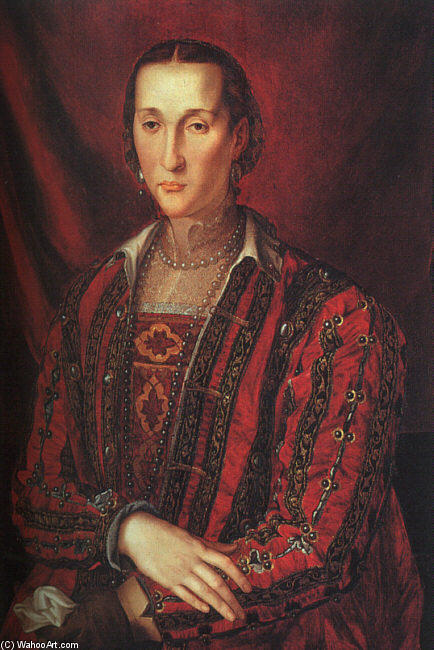
A Portrait Steeped in Dignity: Agnolo Bronzino’s Eleanora di Toledo
The Florentine court of Philip II held an undeniable fascination for artists, and none captured the essence of aristocratic refinement quite like Agnolo Bronzino. His portrait of Eleanora di Toledo, commissioned around 1560, stands as a testament to the Mannerist style—a movement that prioritized elegance, restraint, and psychological complexity over the exuberant exuberance of High Renaissance ideals. More than just a likeness, it’s an embodiment of status, power, and carefully cultivated composure.
- Subject Matter: Eleanora di Toledo was the wife of Philip II, King of Spain, and a prominent figure in European diplomacy. Bronzino skillfully rendered her as a woman of considerable influence, conveying not merely physical beauty but also an inner serenity that spoke volumes about her position within the royal household.
- Style: Bronzino’s Mannerist approach distinguishes itself from its predecessor through elongated proportions and subtle distortions—techniques designed to heighten visual impact rather than faithfully represent reality. The pose is deliberately static, conveying a sense of dignified stillness that reflects Eleanora's regal bearing.
- Technique: Bronzino employed oil paint on canvas, utilizing meticulous layering and glazing techniques to achieve an unparalleled level of luminosity and textural detail. He skillfully manipulated light and shadow to sculpt the figure’s form, creating a palpable illusion of volume—a hallmark of Mannerist artistry. The artist's mastery is evident in the subtle gradations of color and the delicate rendering of fabric folds.
The painting’s historical context illuminates its significance beyond mere aesthetic appreciation. Florence under Philip II was experiencing a period of artistic patronage, fueled by royal ambition and a desire to elevate Florentine culture on the European stage. Bronzino's commission underscores this dynamic—a deliberate effort to portray Eleanora as an ideal queen, reflecting the values of nobility and intellectual sophistication that were prized during the Renaissance.
Symbolism: The muted palette—dominated by reds and golds—is laden with symbolic meaning. Red signifies royal authority and passion, while gold represents wealth and divine grace. These colors are carefully deployed to reinforce Eleanora’s status as a ruler worthy of admiration and respect. Furthermore, the drapery surrounding Eleanora is rendered with meticulous precision, mirroring classical ideals of beauty and harmony—a deliberate allusion to the artistic traditions of antiquity.
Emotional Impact: Despite its formal restraint, Bronzino's portrait possesses an undeniable emotional resonance. The gaze of Eleanora meets the viewer’s eye with a quiet confidence that transcends mere visual representation. It speaks to a deeper understanding of human psychology—a subtle suggestion of inner contemplation and dignified resilience. This enduring quality ensures that the painting continues to captivate audiences centuries after its creation, serving as a timeless emblem of aristocratic grace and intellectual prowess.
Ultimately, Bronzino’s Eleanora di Toledo transcends the boundaries of portraiture; it is an exquisitely crafted meditation on beauty, power, and the artful manipulation of visual language—a masterpiece that exemplifies the pinnacle of Mannerist achievement.