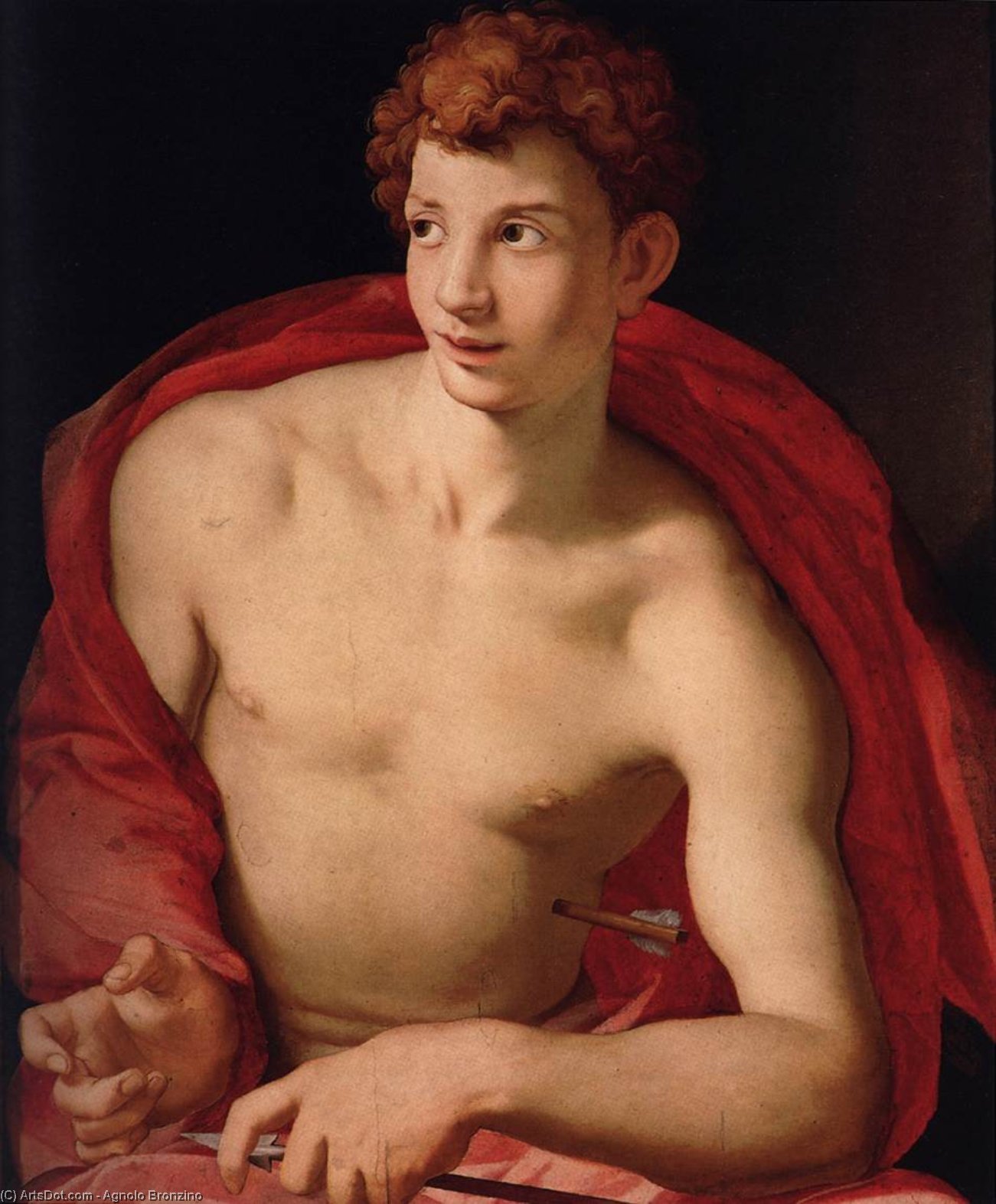
Agnolo Bronzino’s St. Sebastian: A Study in Reserved Elegance
The painting of St. Sebastian, attributed to Agnolo Bronzino around 1525-28, is not a dramatic depiction of martyrdom but rather a masterful study in controlled emotion and refined beauty—a hallmark of the Florentine Mannerist style. Far removed from the turbulent expressions often associated with scenes of suffering, this particular St. Sebastian embodies an almost unsettling composure, inviting contemplation on the nature of faith, sacrifice, and the very essence of Renaissance portraiture. The work resides within the esteemed collection of the Museo Thyssen-Bornemisza in Madrid, a testament to its enduring artistic merit.
Bronzino’s approach diverges significantly from the emotionally charged realism prevalent in earlier Italian painting. He eschews the dramatic gestures and heightened colors characteristic of the High Renaissance, instead favoring a cool palette dominated by muted blues, browns, and ochres. The figure is rendered with an almost sculptural precision—the smooth, polished surfaces of his skin, the carefully draped fabric, all contribute to a sense of idealized perfection. The composition itself is remarkably restrained; the subject occupies a relatively small portion of the canvas, framed by dark, undefined backgrounds that heighten the sense of isolation and vulnerability. This deliberate sparseness forces the viewer’s attention directly onto the figure, amplifying its impact.
Technical Mastery and Mannerist Influence
Examining the painting's technique reveals Bronzino’s meticulous attention to detail and his deep understanding of oil paint. He employs a layering method known as *sfumato*, subtly blurring edges and creating an atmospheric haze that softens the forms and contributes to the overall sense of serenity. The rendering of light is particularly noteworthy—it appears diffused and almost ethereal, casting subtle shadows across the figure’s body and emphasizing its contours. This technique, combined with Bronzino's mastery of *disegno* (drawing), ensured a remarkable level of anatomical accuracy and compositional balance.
Bronzino’s work is profoundly influenced by Pontormo, his former teacher, yet he transcends mere imitation. While sharing Pontormo’s penchant for elongated figures and complex compositions, Bronzino tempers the emotional intensity with an almost detached elegance. The influence of Andrea del Sarto, a master of realism, can also be detected in the painting's careful attention to detail and its subtle use of color. The overall effect is a synthesis of these diverse influences—a uniquely refined style that would become synonymous with the Florentine Mannerist movement.
Symbolism and Context
The subject matter itself, St. Sebastian, a Roman soldier martyred for his Christian faith, carries significant symbolic weight. Traditionally depicted as being shot with arrows, the painting subtly avoids overt displays of violence. Instead, it focuses on the figure’s internal state—his quiet acceptance of fate and his unwavering devotion to God. The arrow wounds are present but understated, serving primarily as a reminder of his sacrifice rather than a source of dramatic pathos.
Painted during the height of Cosimo I de' Medici’s reign in Florence, this portrait reflects the powerful patronage system that fueled artistic innovation during the Renaissance. Bronzino was commissioned to create numerous portraits for the Medici court, and this painting exemplifies his ability to capture the essence of his subjects—their status, their power, and their inner lives—with remarkable skill and sophistication. The work’s placement within a series of courtly portraits underscores its function as both a personal tribute to Cosimo I and a demonstration of Bronzino's artistic prowess.
A Legacy of Reserved Beauty
St. Sebastian by Agnolo Bronzino stands as a compelling example of the Florentine Mannerist style—a period characterized by elegance, refinement, and an emphasis on formal beauty. It is not a painting that shouts for attention; rather, it invites quiet contemplation and rewards careful observation. The figure’s serene expression, combined with Bronzino's masterful technique, creates an image of enduring power and grace—a testament to the artist’s exceptional talent and his profound understanding of human psychology.