A Poignant Encounter with Innocence
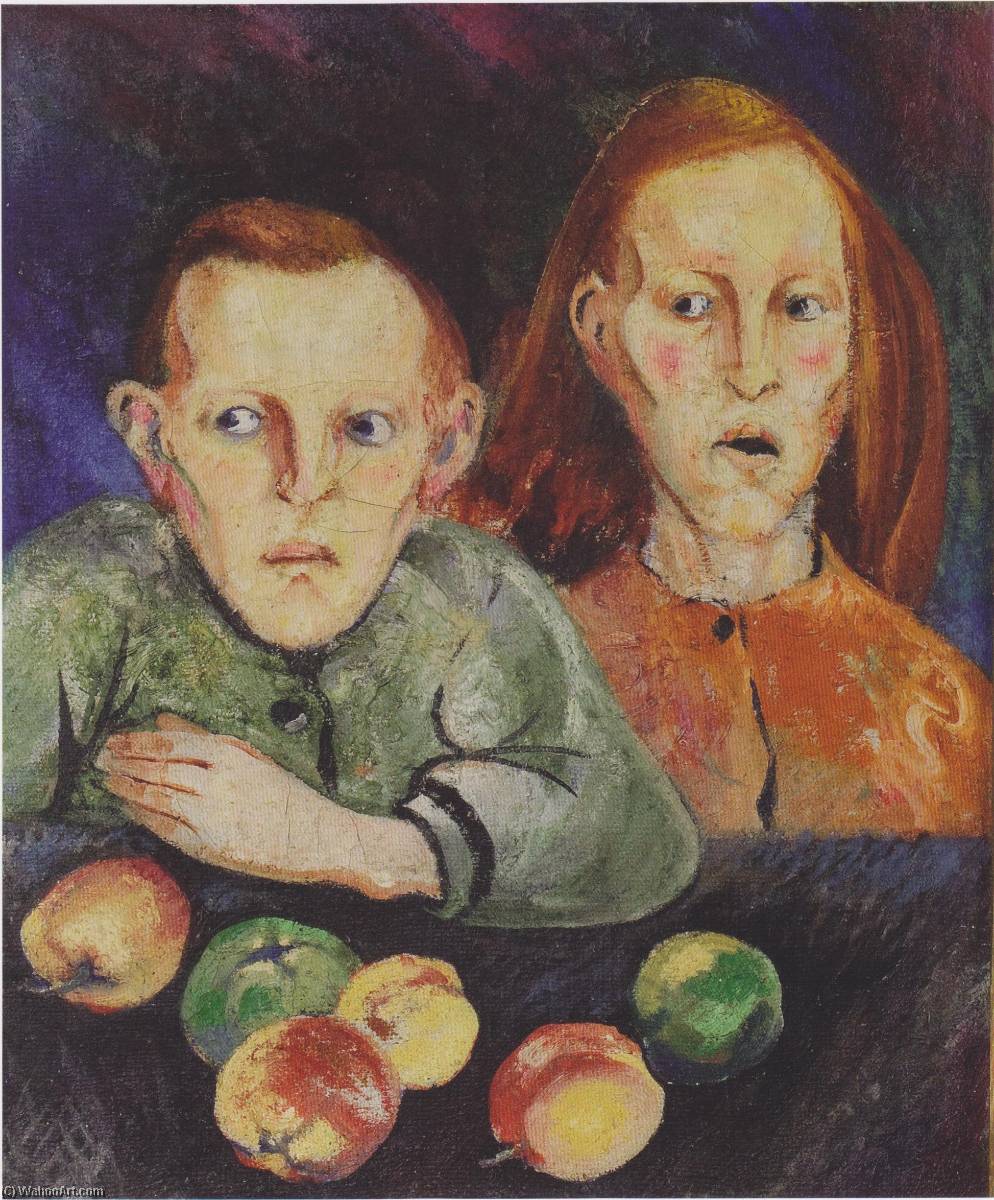
In the tender yet unsettling masterpiece Hungry Children from Vienna, painted in 1919 by the Norwegian Expressionist Aksel Waldemar Johannessen, we are invited into a moment of raw, unshielded humanity. The painting presents a striking portrait of two children, a boy and a girl, seated side by side upon a simple bench. There is an immediate, visceral connection established as they gaze directly at the viewer; their eyes, filled with a mixture of curiosity and a haunting vulnerability, demand our attention. The boy, captured in a moment of spontaneous expression, holds his mouth open—perhaps in a gesture of surprise, a silent plea, or a playful mimicry of hunger. This candidness breaks the fourth wall, transforming the observer from a mere spectator into a witness to their quiet existence.
The composition is masterfully anchored by the presence of scattered apples resting upon the table before them. These fruits are not merely still-life elements but serve as vital narrative anchors. Some apples lie close to the children’s reaching hands, while others recede into the background, a technique that creates a profound sense of depth and spatial reality within the frame. The arrangement suggests a bounty that is tantalizingly present yet perhaps out of reach, adding a layer of tension to the scene. Through this careful placement, Johannessen guides the eye through the canvas, ensuring that the viewer’s gaze lingers on both the subjects' faces and the symbolic objects that define their immediate environment.
Expressionism and the Weight of History
To understand the emotional gravity of this work, one must look toward the turbulent era in which it was conceived. Created in the wake of the First World War, the painting breathes the atmosphere of a Europe grappling with scarcity and social upheaval. Johannessen, an artist whose soul was deeply rooted in the struggles of the Norwegian working class, utilizes the language of Expressionism to convey more than just a visual likeness. His brushwork and color palette evoke a sense of realism that is heightened by emotional truth. The painting does not shy away from the concept of hunger—not just as a physical sensation, but as a social condition. The title itself, referencing Vienna, evokes a city that was navigating profound political and economic instability during this period.
For the discerning collector or interior designer, this piece offers a sophisticated blend of historical depth and aesthetic versatility. The artwork possesses a unique ability to anchor a room with its somber yet captivating narrative. Its muted tones and evocative subject matter make it an ideal centerpiece for spaces that value storytelling and emotional resonance, such as a private study, a curated gallery wall, or a refined living area. As a high-quality reproduction, this painting serves as a window into the early 20th century, bringing the rediscovered brilliance of Johannessen into the modern home, where its themes of resilience and childhood innocence can continue to inspire and provoke thought for generations to come.