A Moment Suspended in Time
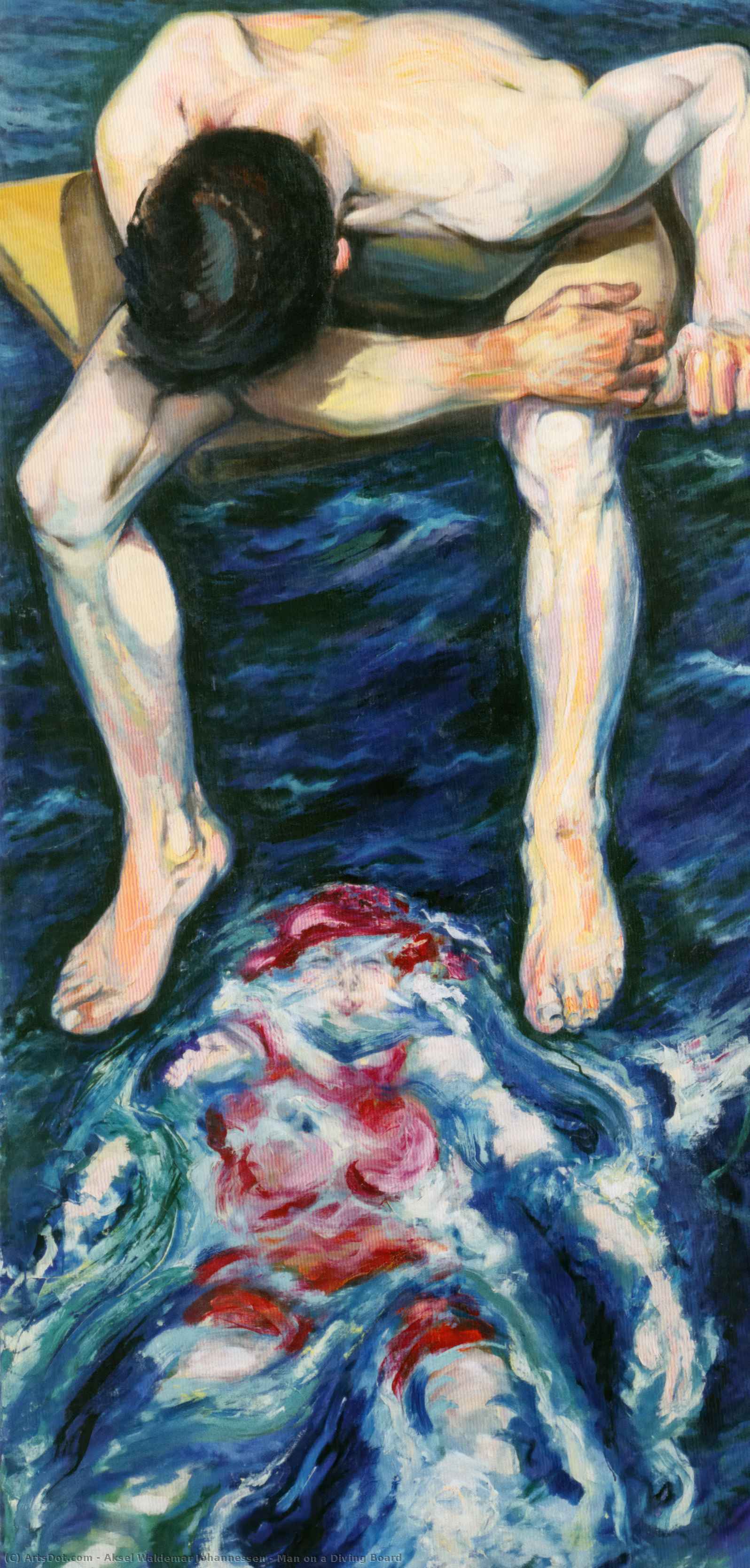
In the quiet, introspective masterpiece Man on a Diving Board, Norwegian artist Aksel Waldemar Johannessen invites us into a singular moment of profound stillness amidst the movement of life. Painted in 1912, this evocative oil on canvas captures more than just a summer afternoon; it captures the very essence of human hesitation and contemplation. The central figure, a man poised at the edge of a wooden diving board, stands with his back to the viewer, his gaze turned toward an unseen horizon. This positioning creates an immediate sense of intimacy, as if we are sharing in his private thought process. His shirtless frame and dark, ankle-length trousers suggest a casual, leisurely setting, yet his posture carries a weight that transcends the simple act of preparing for a swim. There is a palpable tension in his stillness, a breath held before the inevitable plunge into the unknown.
The technique employed by Johannessen is nothing short of mesmerizing, utilizing the rich, tactile possibilities of oil paint to breathe life into the elements. The water below is not merely a surface but a living, swirling entity, rendered with rhythmic patterns that suggest both depth and turbulence. Through masterful brushwork, the artist creates a sense of motion within the stillness, where ripples and splashes dance beneath the man's feet, hinting at the energy waiting to be unleashed. The color palette is a sophisticated study in cool tones; deep blues and crisp whites dominate the composition, evoking the refreshing chill of a Norwegian summer day and the vastness of an open sky. This deliberate use of color serves to heighten the serene yet slightly melancholic atmosphere that permeates the work.
The Intersection of Expressionism and Social Reality
To understand the depth of this painting, one must look toward Johannessen’s unique place in the history of Norwegian Expressionism. While many of his contemporaries focused on the purely decorative or the overtly political, Johannessen possessed a rare ability to weave social nuance into personal, psychological landscapes. Though the scene depicts a moment of recreation—a hallmark of the growing importance of leisure in early 20th-century society—there is an underlying gravity that reflects his background. Having grown up in the industrial shadows of Oslo’s Hammersborg district, Johannessen brought a sensitivity to the human condition that prevents this painting from becoming mere escapism. The man on the board becomes a symbol of the individual facing the vast, unpredictable currents of life, much like the swirling waters beneath him.
For the discerning collector or interior designer, Man on a Diving Board offers an unparalleled opportunity to introduce a piece of historical soul into a modern space. The painting’s ability to command attention through its quiet intensity makes it a perfect focal point for rooms designed for reflection and calm. Whether placed in a sunlit gallery or a sophisticated study, the work’s interplay of light and shadow provides a constant source of visual intrigue. Owning a high-quality reproduction of this work is not merely about acquiring decor; it is about preserving a fragment of Norwegian art history and bringing the timeless, evocative spirit of Johannessen’s vision into the contemporary home.