The Weight of Silence: Exploring Akseli Gallen-Kallela’s ‘Boy with a Crow’
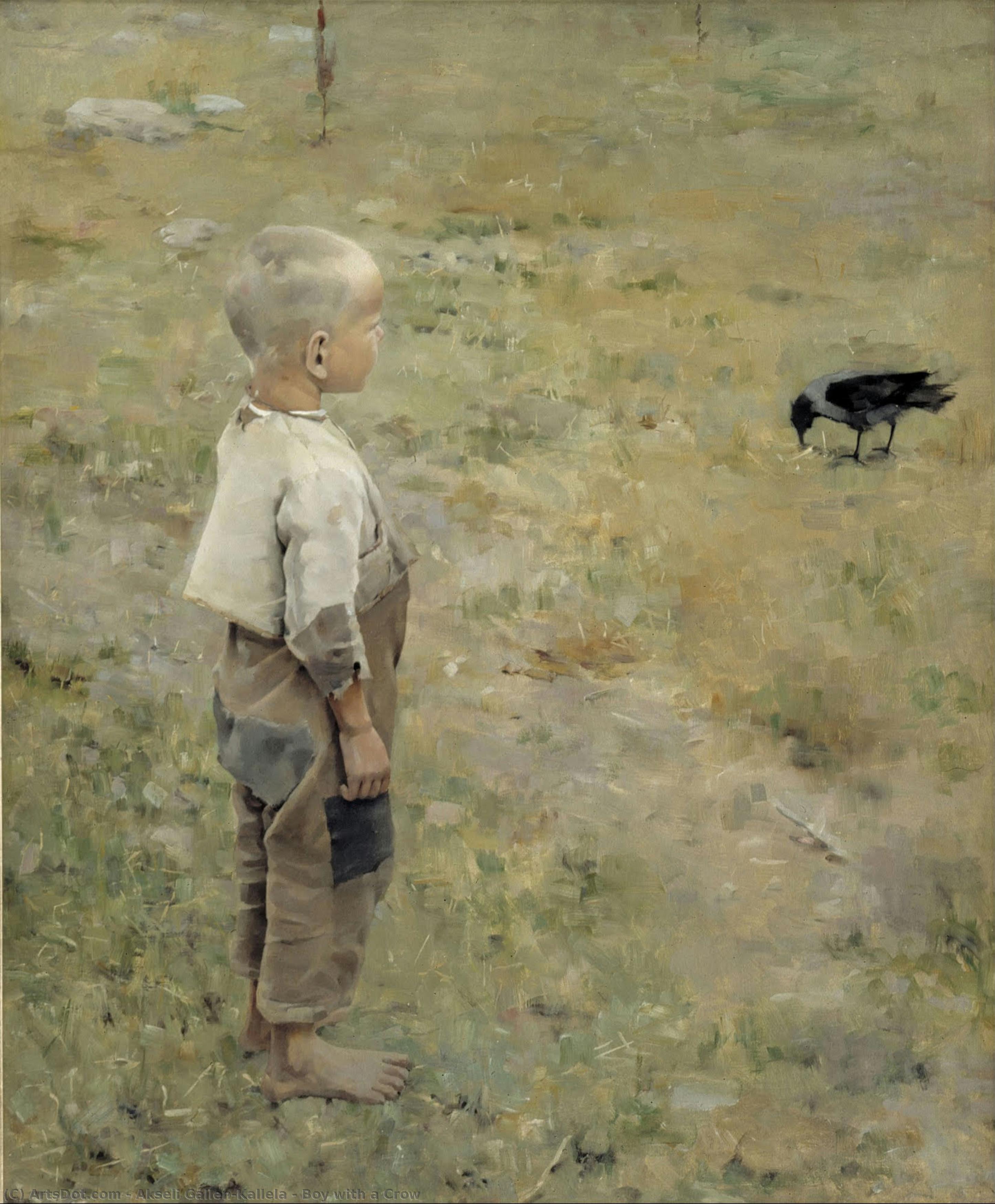
Akseli Gallen-Kallela's “Boy with a Crow,” painted in 1884, isn’t merely a portrait; it’s a carefully constructed tableau brimming with quiet observation and subtle symbolism. Initially dismissed by some as overly sentimental, a closer examination reveals a profound meditation on childhood, loneliness, and the burgeoning Finnish national identity of the late 19th century. The painting captures a young boy, likely around nineteen years old, standing in a grassy field, his posture suggesting both contemplation and a slight detachment. His hands rest casually on his hips, directing his gaze towards an unseen point – perhaps a distant bird, or simply the vastness of the landscape. This deliberate ambiguity is central to the work’s enduring power.
Gallen-Kallela's stylistic choices are deeply rooted in the Parisian realism that was then dominating European art circles. However, he skillfully blended this influence with elements of Finnish folklore and a nascent national romanticism. The boy’s attire – simple peasant clothing – immediately anchors him within a rural context, while his gaze hints at a deeper connection to the land. Notably, Gallen-Kallela drew inspiration from Jules Bastien-Lepage, a French painter known for his realistic depictions of figures set against evocative landscapes. This Parisian training provided Gallen-Kallela with technical proficiency and an understanding of light and shadow, but he ultimately used these tools to express distinctly Finnish themes.
The Symbolism of the Crow
The presence of the crow is arguably the most compelling element of the painting. It’s not a dramatic, menacing bird; rather, it sits perched near the boy's shoulder, seemingly observing him with an unnerving stillness. Traditionally, crows have been associated with intelligence, prophecy, and even death – potent symbols that resonate deeply within Finnish culture. In this context, the crow could represent the weight of unspoken thoughts, the burden of childhood solitude, or perhaps a foreshadowing of future challenges. Gallen-Kallela himself offered a charming anecdote: he believed the boy was attempting to tame the bird by sprinkling salt on its tail feathers – a gesture suggesting an attempt to control the unknown and impose order upon chaos.
The choice of the crow is particularly significant given the painting’s creation during a period of intense national awakening in Finland. The country, then under Russian rule, was grappling with questions of identity and independence. Symbols like the crow – associated with both the wildness of nature and the potential for transformation – offered a way to articulate these complex emotions. Gallen-Kallela's work became a visual embodiment of this national yearning, subtly conveying a sense of resilience and quiet determination.
Craftsmanship and Technique
“Boy with a Crow” is executed in oil on canvas, demonstrating Gallen-Kallela’s mastery of color and texture. The brushstrokes are loose and expressive, creating a sense of immediacy and capturing the fleeting quality of light. The artist skillfully employs atmospheric perspective to render the background – a hazy expanse of grass and distant trees – which draws attention to the boy as the focal point of the composition. Note the delicate rendering of the boy’s clothing, the subtle variations in tone that suggest the texture of fabric, and the careful observation of his facial features.
The painting's dimensions are 72 x 86 cm, a relatively modest size that contributes to its intimate feel. This scale allows for an intense focus on the subject, inviting viewers to contemplate the boy’s thoughts and emotions. The work was created in 1884, a pivotal year for Gallen-Kallela as he transitioned from his early studies in Paris to establishing himself as a leading Finnish artist.
A Legacy of National Identity
“Boy with a Crow” remains one of Gallen-Kallela’s most celebrated works and a cornerstone of Finnish art history. It's more than just a portrait; it’s a poignant reflection on childhood, loneliness, and the search for identity within a rapidly changing nation. The painting’s enduring appeal lies in its ability to evoke a sense of quiet contemplation and invite viewers to interpret its symbolism through their own experiences. Reproductions of this evocative piece continue to resonate with audiences today, serving as a powerful reminder of Finland's rich artistic heritage.