A Glimpse into the Heart of a Nation – The Enigmatic “Mother”
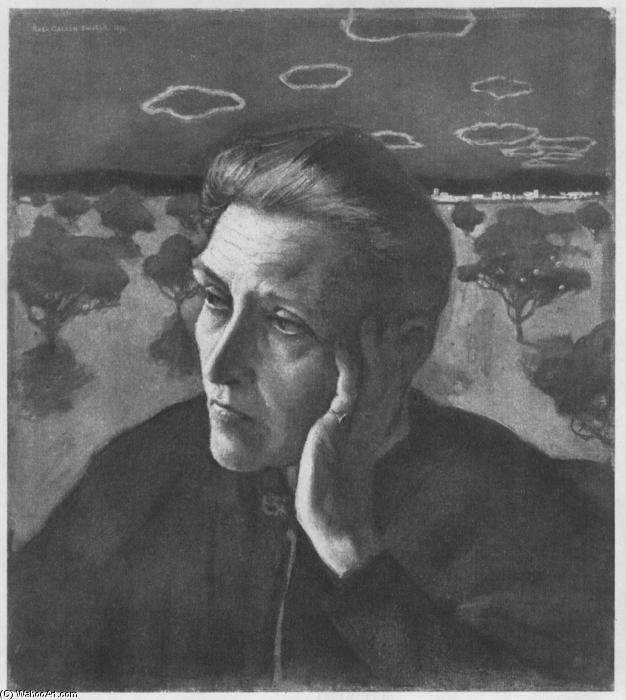
Akseli Gallen-Kallela’s “Mother,” painted in 1896, isn't merely a portrait; it’s a distilled essence of Finnish identity and a poignant exploration of maternal sorrow. Rendered in the stark beauty of grayscale, the artwork immediately draws the viewer into a world of quiet contemplation. The composition centers on a woman’s face – not dramatically posed or idealized, but presented with an arresting directness that invites intimate scrutiny. Her gaze, directed slightly to her left, speaks volumes without uttering a word, hinting at introspection and perhaps a deep-seated melancholy. Behind her, a stylized landscape—trees silhouetted against a cloudy sky—functions less as a setting and more as a symbolic echo of the woman’s inner world, mirroring the emotional depth conveyed by her expression.
The deliberate monochrome palette is crucial to the work's impact. It strips away superficiality, forcing us to focus entirely on tonal variations and subtle textures. The artist masterfully employs layering and brushstrokes – visible yet controlled – to create a sense of volume and depth within the grayscale spectrum. Notice how the darker tones recede into the background, subtly emphasizing the woman’s face as if drawing our attention directly to her emotional state. This technique, combined with diffused lighting emanating from an unseen source, creates a dramatic interplay of highlights and shadows that amplifies the portrait's haunting beauty.
Symbolism Woven into the Monochrome
“Mother” is deeply rooted in Finnish folklore and national identity, reflecting Gallen-Kallela’s commitment to portraying his homeland through a distinctly symbolic lens. The landscape itself—a simplified representation of Finnish forests and skies—holds significant meaning. It's not a realistic depiction but rather an evocative shorthand for the natural world, intertwined with the woman’s emotional experience. The stylized trees, rendered with slightly more defined edges than the face, suggest a connection to nature, perhaps representing resilience or enduring strength. The overall mood is undeniably somber, evoking feelings of weariness and quiet sadness – emotions that resonate deeply within the Finnish psyche, shaped by centuries of hardship and a profound connection to their land.
A Masterclass in Texture and Technique
Gallen-Kallela’s technical skill is evident in his meticulous rendering of skin texture. The subtle variations in tone and delicate brushstrokes create the illusion of realistic wrinkles, pores, and the play of light on the woman's face. This attention to detail elevates the portrait beyond a simple likeness, transforming it into a study of human vulnerability. The background trees are treated with a looser application of paint, creating a textural contrast that further emphasizes the smoothness of the subject’s skin. It’s a testament to his ability to balance meticulous observation with expressive brushwork – a hallmark of both Symbolism and early Modernism.
Echoes of Symbolism and Finnish Identity
“Mother” firmly places Gallen-Kallela within the context of Symbolist art, characterized by its emphasis on emotional expression and simplified forms. However, it also carries distinct influences from Art Nouveau’s flowing lines and organic shapes, particularly in the stylized landscape. Considering his deep connection to Finnish culture—a nation striving for self-definition at the time—the portrait can be interpreted as a meditation on motherhood, resilience, and the enduring spirit of Finland. It's a work that invites contemplation long after the initial viewing, prompting us to consider the complex emotions embedded within its grayscale depths and the powerful symbolism it embodies.