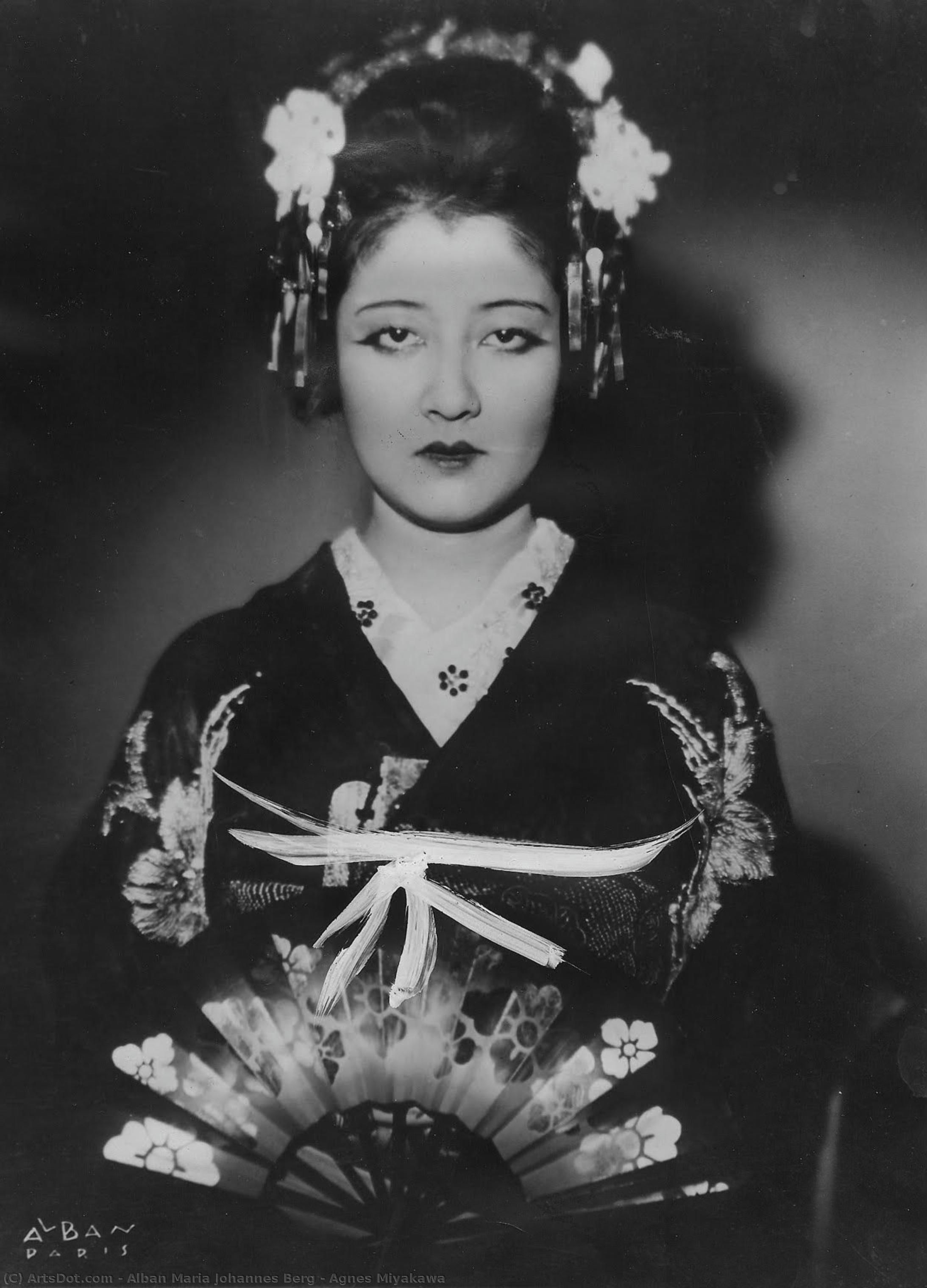
Alban Berg’s ‘Agnes Miyakawa’ is a striking black and white photograph depicting Sacramento Japantown resident Agnes Miyakawa, created around 1931. It showcases Berg's meticulous attention to detail in capturing her likeness and conveying a sense of poise within a classic studio setting.
Explore Alban Berg's masterpiece – Agnes Miyakawa, a haunting black and white portrait capturing the elegance
Agnes Miyakawa – Alban Maria Johannes Berg’s Portrait of Elegance
Sacramento Japantown native Agnes Miyakawa (1911-1995) embarked on a journey of artistic exploration, leaving her hometown to pursue singing studies in Paris. This formative experience profoundly shaped her life and career, culminating in a celebrated operatic debut at the Opera Comique in 1931. Her performance as Cio-Cio San in Madame Butterfly captivated audiences and critics alike, establishing her as a luminary of opera and cementing her legacy as one of the most influential vocalists of her era. Miyakawa continued to perform internationally across Japan, Los Angeles, and beyond, showcasing her versatility and unwavering dedication to her craft. Furthermore, she graced the silver screen and radio waves, broadening her artistic reach and solidifying her position within the cultural landscape of the mid-20th century.
- Subject Matter: The artwork presents a portrait photograph of Agnes Miyakawa, capturing her likeness with meticulous detail. Her gaze directs towards the viewer, fostering a connection that speaks to both confidence and introspection.
- Style: The image embodies the stylistic conventions of early 20th-century portrait photography—formal, poised, and prioritizing accuracy in representation. It reflects the aesthetic sensibilities prevalent during Schoenberg’s time.
Composition & Visual Elements
The photograph's composition is centered around Miyakawa’s figure, placing her directly at the frame’s midpoint. This deliberate arrangement emphasizes her presence and conveys a sense of stability. The blurred background serves to isolate Miyakawa, highlighting her face and upper body—the focal point of the image. Notably, Miyakawa holds an open fan partially obscuring her lower torso, introducing visual interest and subtly framing her posture.
- Color Palette: Utilizing a grayscale palette with varying shades of black, white, and gray, the photograph achieves tonal richness without resorting to color. The careful gradation from deep shadows to bright highlights underscores the artist’s mastery of light and texture.
- Lines & Shapes: Soft lines dominate the image, particularly in Miyakawa's face and hair—a testament to the photographer's skill in capturing subtle nuances of form. The fan introduces curved lines that contrast with the more structured elements of her kimono, adding dynamism to the composition.
Technical Considerations & Artistic Technique
The photograph was produced using traditional darkroom processes—developing and printing techniques honed over decades. These methods ensured optimal tonal accuracy and preserved the image's inherent character. The photographer skillfully employed lighting, diffusing it gently to illuminate Miyakawa’s features without creating harsh shadows—a hallmark of studio portraiture.
- Texture: The photograph captures a range of textures—the smoothness of Miyakawa’s skin, the intricate patterns on her kimono (rendered as tonal variations), and the delicate texture of the flowers adorning her hair. These textural elements contribute to the artwork's immersive quality.
Symbolism & Emotional Resonance
The image evokes a sense of formality, grace, and perhaps a hint of melancholy—resonances that align with the historical context surrounding Madame Butterfly and Miyakawa’s artistic journey. Her unwavering gaze conveys strength and conviction, symbolizing resilience and determination amidst personal challenges.