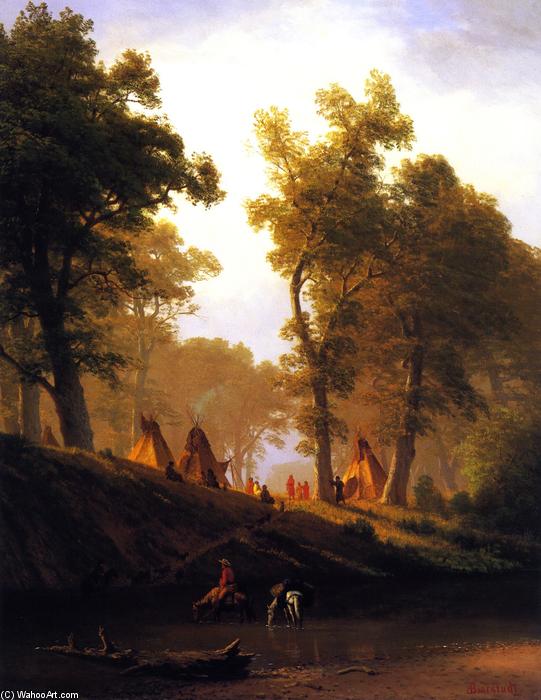
Albert Bierstadt’s *The Wolf River, Kansas* (1859) captures the American sublime with Luminist mastery, depicting fur traders and Native Americans amidst towering pines under a breathtaking sky. A cornerstone of the Hudson River School, this expansive panorama invites you to experience its majestic beauty.
A Pioneer's Vision of the American Sublime
Albert Bierstadt’s *The Wolf River, Kansas*, completed in 1859, stands as a cornerstone of the Hudson River School movement and embodies its core aesthetic principles. More than just a depiction of a landscape—a meticulously rendered panorama of Missouri’s Wolf River Valley—it's an ambitious attempt to capture the overwhelming grandeur and spiritual significance of the American wilderness.
Technical Mastery: Luminism at Its Finest
Bierstadt, deeply influenced by European Romantic painters like Caspar David Friedrich, approached his subject with a profound understanding of light and atmosphere. Employing luminist techniques—characterized by soft, diffused illumination—he skillfully blended layers of oil paint to create an illusionistic depth that surpasses mere representation. The artist’s meticulous attention to detail is evident in every brushstroke, capturing the textures of bark, foliage, and water with remarkable accuracy.
Historical Context: Expansion and Romantic Idealism
Painted during a period of intense westward expansion fueled by Manifest Destiny, *The Wolf River* reflects the prevailing optimism about America’s destiny as a nation. However, Bierstadt wasn't merely celebrating progress; he wrestled with the moral implications of colonization. The scene portrays a group of fur traders engaging in peaceful commerce alongside Kaw Native Americans—a deliberate juxtaposition intended to convey both beauty and unease regarding the encroaching influence of European settlers on Indigenous lands.
Symbolism: Majesty and Spiritual Resonance
The towering pines dominating the composition symbolize resilience and permanence, mirroring the enduring spirit of the American frontier. The expansive sky—painted with breathtaking luminosity—represents divine majesty and evokes a sense of awe in the viewer. Bierstadt’s masterful use of color contributes to this emotional impact, conveying not just visual splendor but also an underlying spiritual yearning for connection with nature.
Emotional Impact: Capturing the Sublime
*The Wolf River,* like many Hudson River School paintings, aims to elicit a feeling known as “the sublime”—a paradoxical blend of terror and delight—produced by confronting overwhelming natural forces. Bierstadt’s depiction inspires contemplation on humanity's place within the vastness of creation, prompting viewers to consider the profound beauty and humbling power of the wilderness.