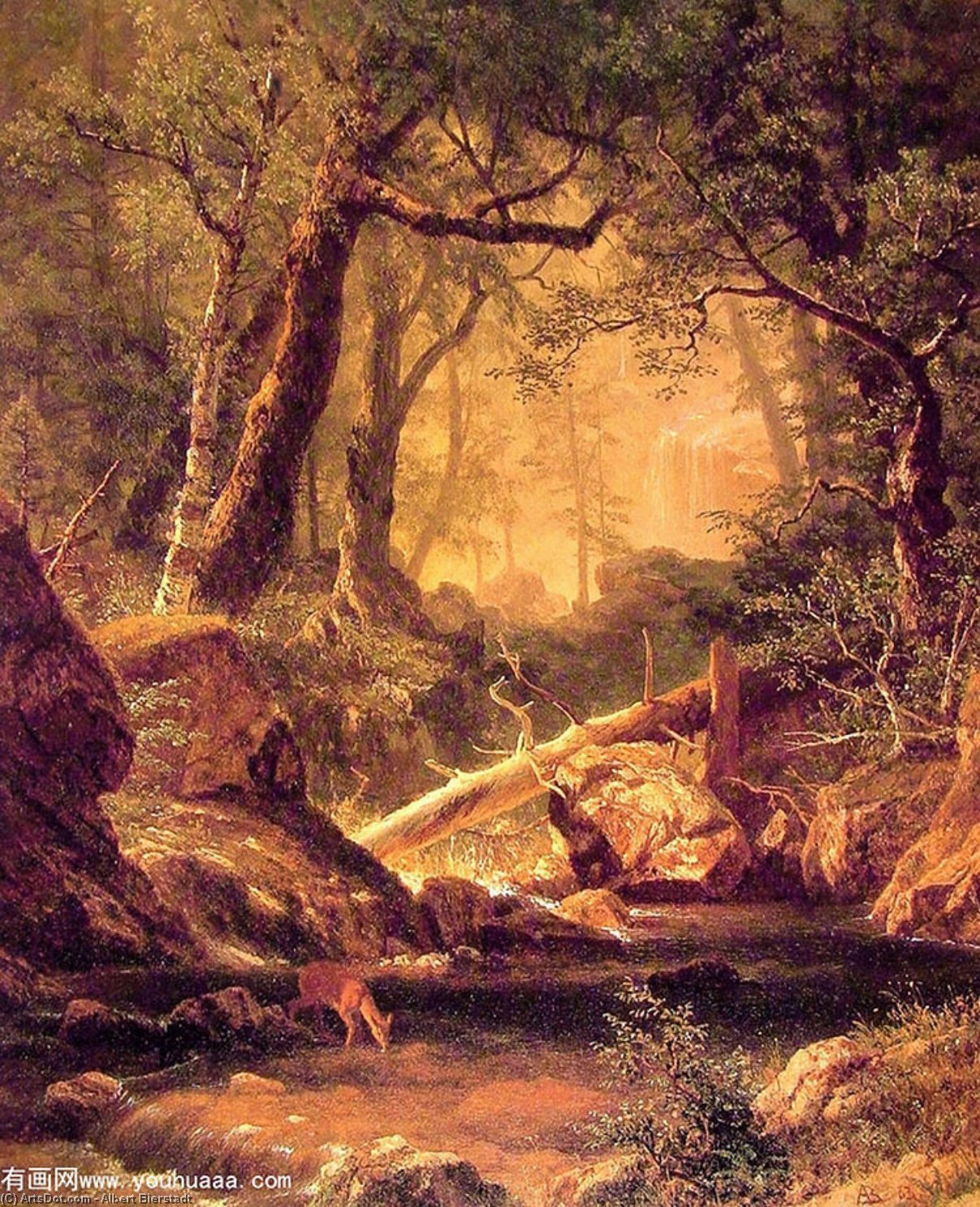
A Symphony of Light and Wilderness: Albert Bierstadt’s “White Mountains, New Hampshire”
Albert Bierstadt's "White Mountains, New Hampshire," painted in 1863, is more than just a landscape; it’s a profound meditation on the relationship between humanity and the untamed beauty of the American West. Executed during his peak period as a leading figure of the Hudson River School, this artwork exemplifies Bierstadt's masterful ability to capture not merely the visual grandeur of nature, but also its spiritual resonance. Measuring 47 x 38 cm, the painting invites viewers into a serene scene dominated by the towering White Mountains of New Hampshire, a region that would become synonymous with his artistic vision.
- Subject Matter: The composition centers on a pristine river winding through a dense forest, flanked by imposing granite boulders and a tapestry of evergreen trees.
- Key Elements: Two graceful deer stand poised at the water’s edge, their presence adding a touch of tranquility and highlighting the harmonious coexistence between wildlife and wilderness. A dog is strategically placed near the center, further emphasizing the scene's peaceful narrative.
The Hudson River School and Romantic Ideals
Bierstadt was a pivotal figure in the Hudson River School, a movement of American landscape painters who sought to elevate nature painting beyond mere topographical representation. Inspired by the Romantic ideals prevalent at the time – particularly the concept of the “sublime” – Bierstadt aimed to evoke awe and wonder in his viewers through meticulously rendered scenes of vast wilderness. His work reflects a growing national identity, celebrating the grandeur of America’s natural resources as symbols of its potential and spirit.
His training in Düsseldorf, Germany, profoundly shaped his artistic approach. He absorbed the technical precision and atmospheric perspective championed by German Romantic painters, translating these skills to the American landscape with remarkable skill. This fusion of European technique and a distinctly American subject matter is what makes Bierstadt’s work so compelling.
Technique and Artistic Detail
"White Mountains, New Hampshire" showcases Bierstadt's exceptional command of light and color. He employed a layering technique – *sfumato* – to create subtle gradations in tone and atmosphere, mimicking the effects of sunlight filtering through the forest canopy. The meticulous detail evident in the rendering of individual leaves, rocks, and animal forms demonstrates his dedication to realism, while simultaneously conveying an idealized vision of nature’s splendor. Note the careful use of warm hues—ochres, browns, and golds—to capture the golden light reflecting off the water and foliage, creating a sense of warmth and inviting the viewer into the scene.
Symbolism and Emotional Impact
Beyond its aesthetic beauty, "White Mountains" carries symbolic weight. The deer, often associated with grace, gentleness, and innocence, represent the unspoiled wilderness itself. The river symbolizes life’s flow and the passage of time. The painting's overall mood is one of profound peace and serenity, inviting contemplation on the power and majesty of nature. It speaks to a desire for escape from the pressures of urban life and offers a glimpse into a world untouched by human intervention – a sentiment that resonated deeply with audiences during the 19th century.