A Vision of Scientific Eminence
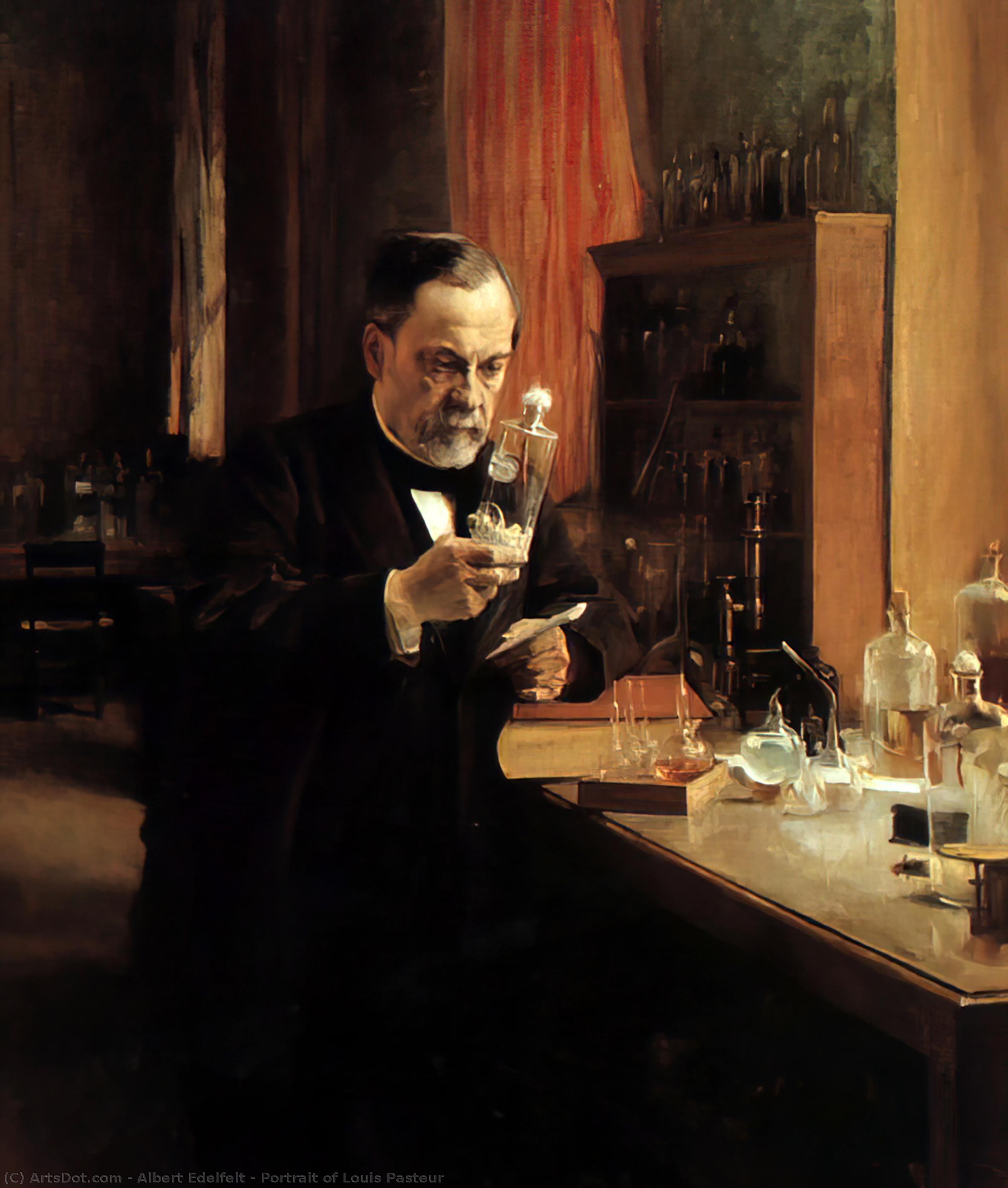
In the quiet, focused atmosphere of a late nineteenth-century laboratory, Albert Edelfelt captures more than just a man; he captures the very essence of an intellectual revolution. His Portrait of Louis Pasteur is a profound meditation on the dawn of modern microbiology, presenting the legendary French chemist not as a distant icon, but as a figure deeply immersed in the tactile reality of his work. The painting serves as a window into a moment where scientific inquiry meets artistic mastery, inviting the viewer to witness the intense concentration and the heavy weight of discovery that defined Pasteur’s life. Through Edelfelt's lens, we see the pioneer surrounded by the tools of his trade—glassware, vials, and experimental apparatus—each element contributing to a narrative of relentless pursuit and the quiet dignity of scientific labor.
The emotional resonance of the piece lies in its ability to bridge the gap between the observer and the observed. There is an intimate, almost reverent quality to the way Edelfelt renders the laboratory setting, transforming a space of clinical study into a sanctuary of human intellect. For collectors and enthusiasts of historical portraiture, this work offers a rare opportunity to possess a piece that embodies the spirit of the Belle Époque—a period characterized by an unshakeable belief in progress and the power of human reason. The painting does not merely depict a subject; it evokes the atmosphere of an era where every drop of liquid in a test tube held the potential to change the course of medical history.
Mastery of Impressionistic Realism
Technically, Edelfelt achieves a breathtaking balance between Impressionistic vibrancy and Academic precision. Utilizing the rich, luminous qualities of oil on canvas, the artist employs a technique that allows for both meticulous anatomical accuracy and a soft, atmospheric light. One can observe the subtle gradations of color in Pasteur’s skin tones, which catch the ambient light of the lab, creating a lifelike warmth that breathes life into the portrait. The brushstrokes, while grounded in realism, possess a certain fluidity and texture—particularly in the rendering of the laboratory glassware and the fabric of Pasteur's attire—that lends the composition a sense of movement and vitality.
This sophisticated approach to light and shadow, often referred to as chiaroscuro, serves to direct the viewer's eye toward the subject's thoughtful expression. The interplay of light reflecting off the glass bottles on the table creates a rhythmic pattern of highlights that guides us through the depth of the room. For those looking to integrate such a masterpiece into a curated interior, the painting offers a versatile elegance. Its muted, earthy palette and sophisticated textures make it an ideal centerpiece for a study, a library, or a formal gallery space, providing a sense of historical gravity and intellectual sophistication to any environment.
A Legacy Captured in Pigment
Beyond its aesthetic brilliance, the portrait is steeped in profound symbolism. The laboratory environment acts as a metaphor for the human mind's capacity to unravel the mysteries of the natural world. Every bottle and vial serves as a visual testament to Pasteur’s tireless research into germ theory and vaccination. Edelfelt, a Finnish master who found his greatest acclaim in the heart of Paris, understood that to paint Pasteur was to paint the very foundation of modern hygiene and public health. The composition captures a moment of stillness within a life of constant motion, suggesting that true scientific breakthroughs are born from moments of profound, solitary reflection.
Owning a high-quality reproduction of this work is an invitation to celebrate the enduring legacy of human curiosity. It is a piece designed for those who appreciate art that tells a story—a story of courage, dedication, and the transformative power of knowledge. Whether displayed as a tribute to scientific history or as a cornerstone of classical decor, Edelfelt’s Portrait of Louis Pasteur remains an eternal emblem of achievement, reminding us that even in the smallest laboratory, the greatest revolutions begin.