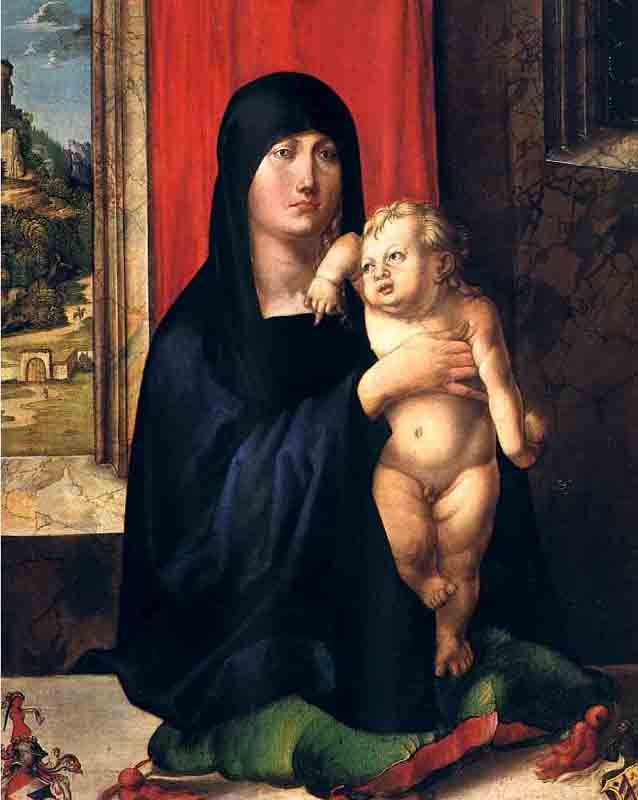
Experience the timeless beauty of Albrecht Dürer’s ‘A Blank AL Child Window,’ a poignant portrait capturing the Virgin Mary and child in a stunning blue and red devotional scene, reflecting the artist's masterful style from the German Renaissance.
A Blank Canvas of Devotion: Exploring Dürer’s Unfinished Window
Before us lies an extraordinary testament to Albrecht Dürer's genius – a blank AL Child Window, an incomplete masterpiece that speaks volumes about the artist’s process and his profound engagement with religious iconography. This remarkable piece, dating from around 1506-1508, offers a rare glimpse into the evolution of a work in progress, inviting viewers to contemplate not just the intended image but also the very act of creation itself. Dürer, at the height of his artistic powers during the German Renaissance, was driven by an almost obsessive desire for perfection, meticulously planning and executing each detail before ultimately deeming it insufficient. This particular window, likely commissioned for a private chapel or noble residence, embodies this relentless pursuit – a testament to Dürer’s unwavering standards and innovative approach to religious art.
- Subject Matter: The composition depicts a poignant scene of maternal devotion, immediately recognizable as an interpretation of the Virgin Mary cradling the infant Jesus. This subject matter was central to Northern European devotional practices during the early 16th century, reflecting the profound piety and artistic skill prevalent in the region.
- Technical Brilliance: Dürer’s mastery of woodcut technique is immediately apparent. The image, originally conceived as a meticulously crafted woodcut panel, showcases his unparalleled ability to render intricate detail with astonishing precision. The crisp lines, subtle tonal variations achieved through careful layering and scraping, and the delicate rendering of fabric and hair are hallmarks of Dürer's exceptional skill.
Symbolism and Context within the Renaissance
The “blank” nature of this window is itself a crucial element of its significance. It’s not merely an unfinished work; it represents a deliberate choice, a moment of critical evaluation by Dürer himself. The scene's symbolism resonates deeply with the religious and philosophical currents of the High Renaissance. Mary’s posture, her gaze directed towards the infant Jesus, evokes themes of humility, grace, and divine love – virtues highly valued during this period. Furthermore, the inclusion of the window itself—a recurring motif in Northern European art—symbolizes a portal to heaven, reinforcing the spiritual dimension of the artwork. The presence of two secondary figures, subtly rendered, likely represents angels or other celestial beings, adding layers of complexity and reinforcing the narrative’s sacred context.
- The Window as Iconography: Windows in churches and private chapels served not only to illuminate but also to narrate biblical stories and reinforce religious beliefs. Dürer's window would have been a focal point for devotion, inviting contemplation and fostering a connection with the divine.
- Dürer’s Innovation: Dürer was pushing the boundaries of woodcut technique, experimenting with new methods to achieve greater realism and expressive power. This window exemplifies his desire to elevate woodcuts beyond mere illustration, transforming them into works of art worthy of comparison with oil paintings.
Emotional Impact and Artistic Legacy
Despite its incomplete state, the “A Blank AL Child Window” possesses a remarkable emotional resonance. The serene expression on Mary’s face, coupled with the tenderness of her embrace, evokes a powerful sense of peace and reverence. Dürer's meticulous attention to detail imbues the scene with an almost palpable sense of humanity, inviting viewers to connect with the timeless themes of faith, love, and compassion. This piece stands as a poignant reminder of Dürer’s artistic process – his relentless pursuit of perfection, his profound understanding of human emotion, and his enduring legacy as one of the greatest artists in history. Its blankness encourages contemplation on the creative journey itself, making it a truly unique and thought-provoking work of art.
Reproductions Available