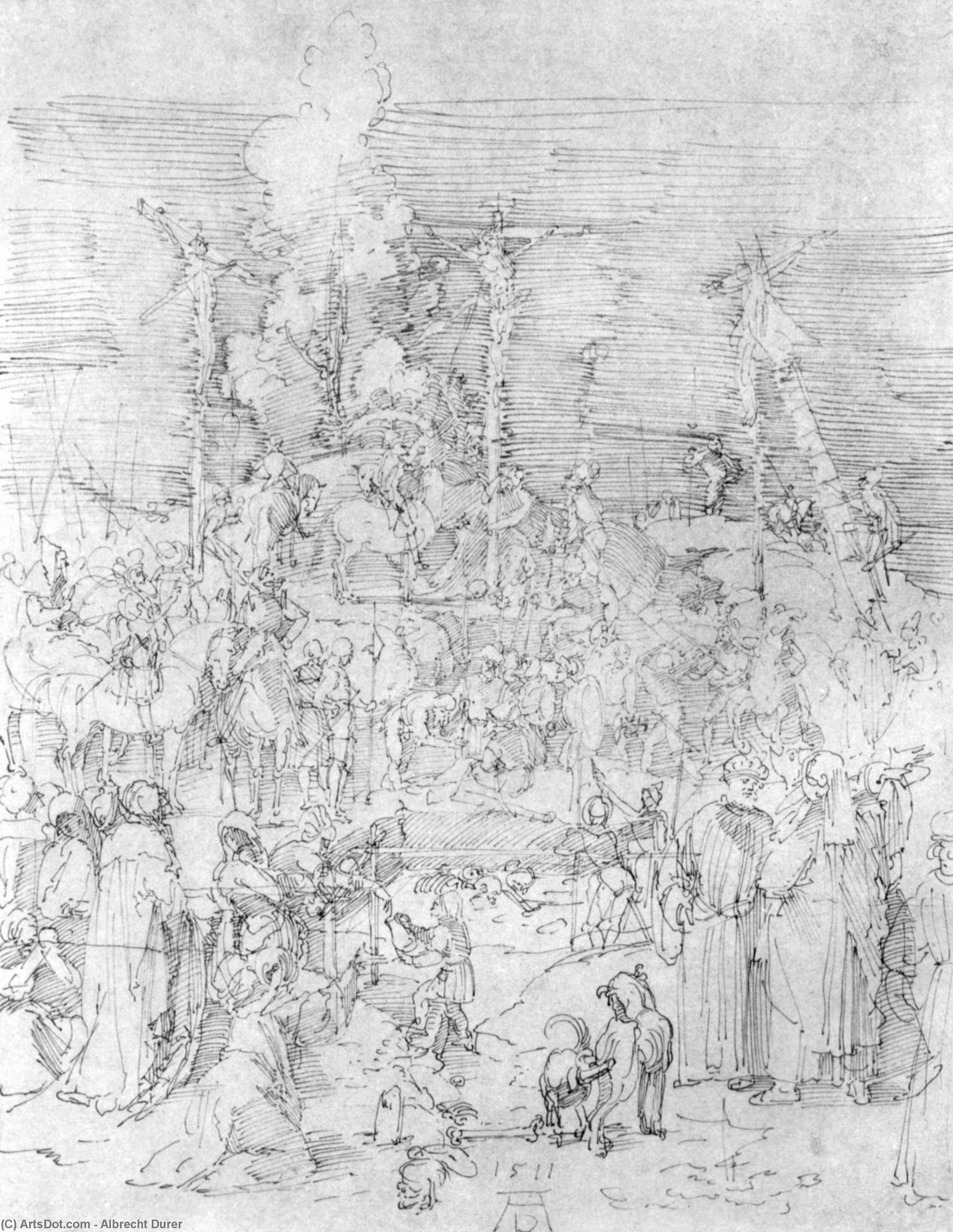
Albrecht Dürer’s meticulously detailed pen and ink ‘Calvary’ captures the poignant scene of Christ's crucifixion in a classic Northern Renaissance style. This dramatic monochrome drawing showcases Dürer’s mastery, offering a powerful depiction of grief and sacrifice – discover this timeless masterpiece.
A Chronicle in Ink: Albrecht Dürer’s ‘Calvary’
Albrecht Dürer's 'Calvary,' a meticulously rendered pen and ink drawing, isn't merely an image of the crucifixion; it is a profound meditation on faith, suffering, and the human condition. Executed with the characteristic precision that defined the Northern Renaissance master, this artwork transports us directly to the chaotic heart of the biblical narrative – the moment Christ hangs upon the cross. Dürer’s genius lies not just in his technical skill, but in his ability to imbue a scene of immense sorrow and spiritual weight with an almost palpable energy. The drawing's monochrome palette, achieved through masterful hatching and cross-hatching, amplifies this emotional intensity, stripping away any distraction from the raw drama unfolding before us.
The Anatomy of Detail: Technique and Style
- Line as Sculpture: Dürer’s technique is fundamentally sculptural. He treats line not just as a means of representation, but as an independent element – a tool for building form, creating texture, and manipulating light. The varying weights of the lines, from delicate whispers to bold declarations, contribute significantly to the drawing's dynamic quality.
- Hatching and Cross-Hatching: The extensive use of hatching—closely spaced parallel lines—and cross-hatching—intersecting sets of lines—is central to Dürer’s method. These techniques are skillfully deployed to model volume, simulate the textures of clothing, skin, and architectural surfaces, and create subtle tonal variations that evoke a sense of depth and atmosphere.
- A Northern Renaissance Vision: ‘Calvary’ exemplifies Dürer's distinctive style – a synthesis of realism and expressive line work, deeply rooted in the traditions of Northern European art. His meticulous attention to detail, combined with his profound understanding of human anatomy and emotion, elevates this drawing beyond a simple depiction of an event to a powerful statement about faith and mortality.
Symbolism and Emotional Resonance
The composition itself is deliberately unsettling, mirroring the emotional turmoil surrounding Christ’s death. The densely packed figures – Roman soldiers, grieving onlookers, and biblical characters – create a sense of claustrophobia and urgency. The lack of a clear focal point directs our attention to the central cross, a potent symbol of sacrifice and redemption. Dürer masterfully captures the raw emotion of the scene: the anguish on the faces of the mourners, the stoicism of the soldiers, and the profound sorrow that permeates the entire composition. This isn't a sanitized depiction of religious iconography; it’s an honest portrayal of human suffering and spiritual yearning.
A Window into History
'Calvary' was created during a pivotal moment in European history – the High Renaissance, where artists were grappling with new ideas about perspective, anatomy, and representation. Dürer’s work reflects this intellectual ferment while simultaneously upholding the traditions of Northern European art. Executed around 1500, it stands as a testament to his mastery of technique and his profound understanding of human emotion. The drawing's enduring power lies in its ability to connect us with one of humanity’s oldest and most poignant stories – a story that continues to resonate across cultures and generations.