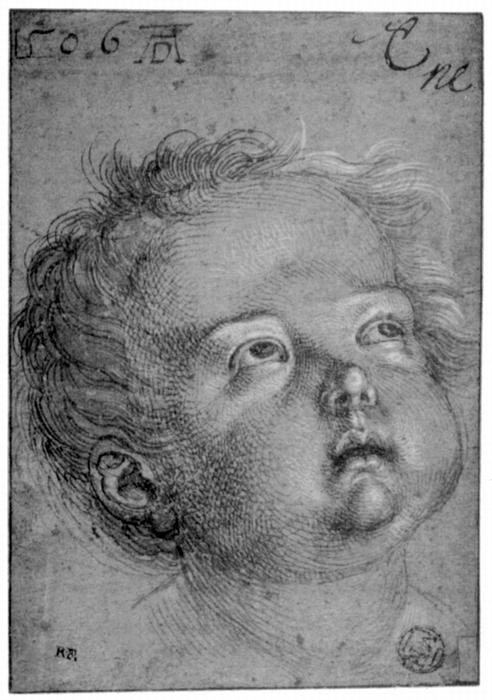
A Study in Innocence: Albrecht Dürer’s *Child's Head*
Albrecht Dürer’s Child’s Head is more than just a drawing; it’s a poignant meditation on childhood, rendered with the meticulous precision that defined the artist’s extraordinary career. Executed around 1524, this monochrome study captures the delicate vulnerability of youth with an intensity rarely seen in Renaissance portraiture. The artwork immediately draws the viewer into its quiet contemplation, inviting us to consider the fleeting nature of time and the inherent beauty found within a simple subject – a child’s face.
Technical Mastery: Dürer's Silverpoint Technique
Dürer’s skill is immediately apparent in the execution. The piece was created using silverpoint, a technique perfected by the artist himself. This involved applying molten silver to paper with a stylus, creating incredibly sharp lines and tonal gradations that are simply unattainable with charcoal or graphite alone. The resulting image possesses an almost metallic sheen, adding to its ethereal quality. Observe the dense cross-hatching – each stroke deliberately placed to build up form and create a palpable sense of texture. The artist’s hand is undeniably present in every line, revealing the immense labor involved in achieving this level of realism. This technique was favored by Dürer for its permanence and ability to capture subtle nuances of light and shadow, characteristics that would become hallmarks of his artistic style.
Renaissance Ideals: Symbolism and Emotional Resonance
The composition itself is laden with symbolic weight. The child’s upward gaze, directed towards the left, suggests a sense of wonder and curiosity – qualities often associated with innocence and potential. The slight pensive expression hints at a deeper contemplation, perhaps reflecting on the world around them or contemplating their own future. This isn't merely a portrait; it’s an exploration of human emotion rendered through the cold medium of silverpoint. Dürer was deeply interested in humanist ideals, exploring themes of morality and spirituality within his work. This drawing can be interpreted as a reminder of our own childhood experiences and the enduring power of youthful imagination.
Historical Context and Artistic Influence
Created during a period of immense artistic innovation, Child’s Head reflects Dürer's profound engagement with Renaissance ideals. His work stands as a testament to his mastery of observation, anatomical accuracy, and the expressive potential of line. Dürer was deeply influenced by classical antiquity, striving for realism in his depictions of the human form – a pursuit evident in the careful modeling of the child’s features. This drawing is part of a larger body of work that cemented Dürer's legacy as one of the most influential artists of the Northern Renaissance, profoundly impacting generations of subsequent painters and printmakers.