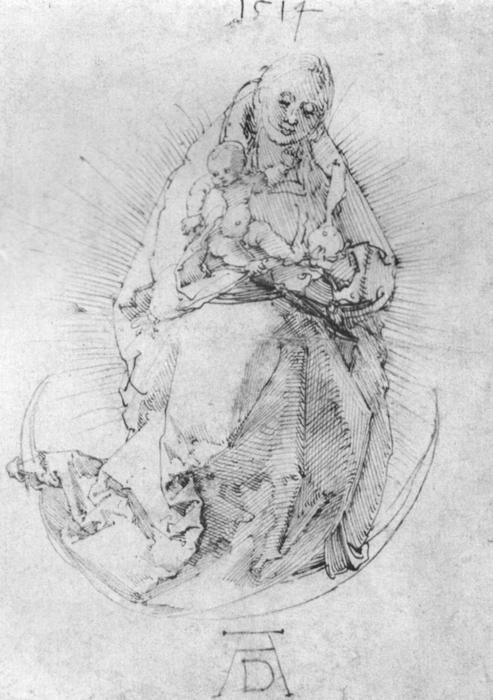
Experience Albrecht Dürer’s ‘Crescent Madonna,’ a meticulously detailed monochrome drawing of the Virgin Mary and Child within a crescent moon, showcasing Northern Renaissance artistry and evoking serenity. Discover this iconic piece and bring its timeless beauty into your collection.
A Lunar Embrace: Albrecht Dürer's Crescent Madonna
Albrecht Dürer’s “Crescent Madonna” is not merely an image of the Virgin Mary and Child; it’s a profound meditation on faith, protection, and the divine feminine rendered with the unparalleled precision that defined the Northern Renaissance master. Executed in monochrome pen and ink, this drawing possesses a haunting beauty born from Dürer's meticulous observation and masterful command of line. The artwork immediately draws the eye to the central figures – Mary, seated with serene dignity, cradling the infant Jesus – framed by the evocative shape of a crescent moon. This isn’t a casual inclusion; the crescent, a potent symbol throughout art history, represents not just the lunar cycle but also the Virgin's purity and her connection to the heavens, suggesting a protective embrace from above.
Technical Mastery: Dürer’s Signature Style
- Line as Sculpture: Dürer’s technique is fundamentally about line. The drawing’s power resides in the sheer density and variety of lines – fine, precise strokes that build up tonal values through extensive hatching and cross-hatching. This creates a remarkable illusion of volume and texture, particularly evident in the drapery which appears to ripple with movement despite its static pose.
- Hatching and Cross-Hatching: The artist’s skillful use of these techniques is central to the work's impact. Hatching, achieved by parallel lines, establishes the basic forms, while cross-hatching – intersecting lines – adds depth and complexity, creating a rich tapestry of light and shadow that dramatically enhances the sense of three-dimensionality.
- Precision and Control: The drawing demonstrates Dürer’s extraordinary control over his tools. Whether utilizing metalpoint or a quill (the exact medium remains debated amongst scholars), he achieved an astonishing level of detail, reflecting his dedication to anatomical accuracy and realistic representation – hallmarks of the Northern Renaissance style.
Symbolism and Emotional Resonance
Beyond its technical brilliance, “Crescent Madonna” is rich in symbolic meaning. The intimate pose of Mary holding Jesus conveys a timeless message of maternal love and tenderness, while the halo-like circle surrounding them reinforces their sacred status. The composition itself – centered around the figures within the crescent – creates a sense of contained serenity and reverence. Dürer’s ability to imbue a religious icon with such profound emotional depth is a testament to his artistic genius. The drawing speaks to universal themes of faith, protection, and the enduring bond between mother and child, resonating across centuries.
A Window into the Renaissance
Created during Dürer’s formative years in Nuremberg (1471-1528), this drawing exemplifies the artistic innovations of the Northern Renaissance. Dürer's work represents a shift away from the predominantly Italian influence, embracing a more realistic and emotionally charged approach to religious art. The meticulous detail, combined with a heightened sense of drama and psychological depth, established Dürer as one of the most influential artists of his time – a legacy that continues to inspire awe and admiration today. This reproduction offers a direct connection to this pivotal moment in artistic history.