A Masterpiece of Devotion and Detail
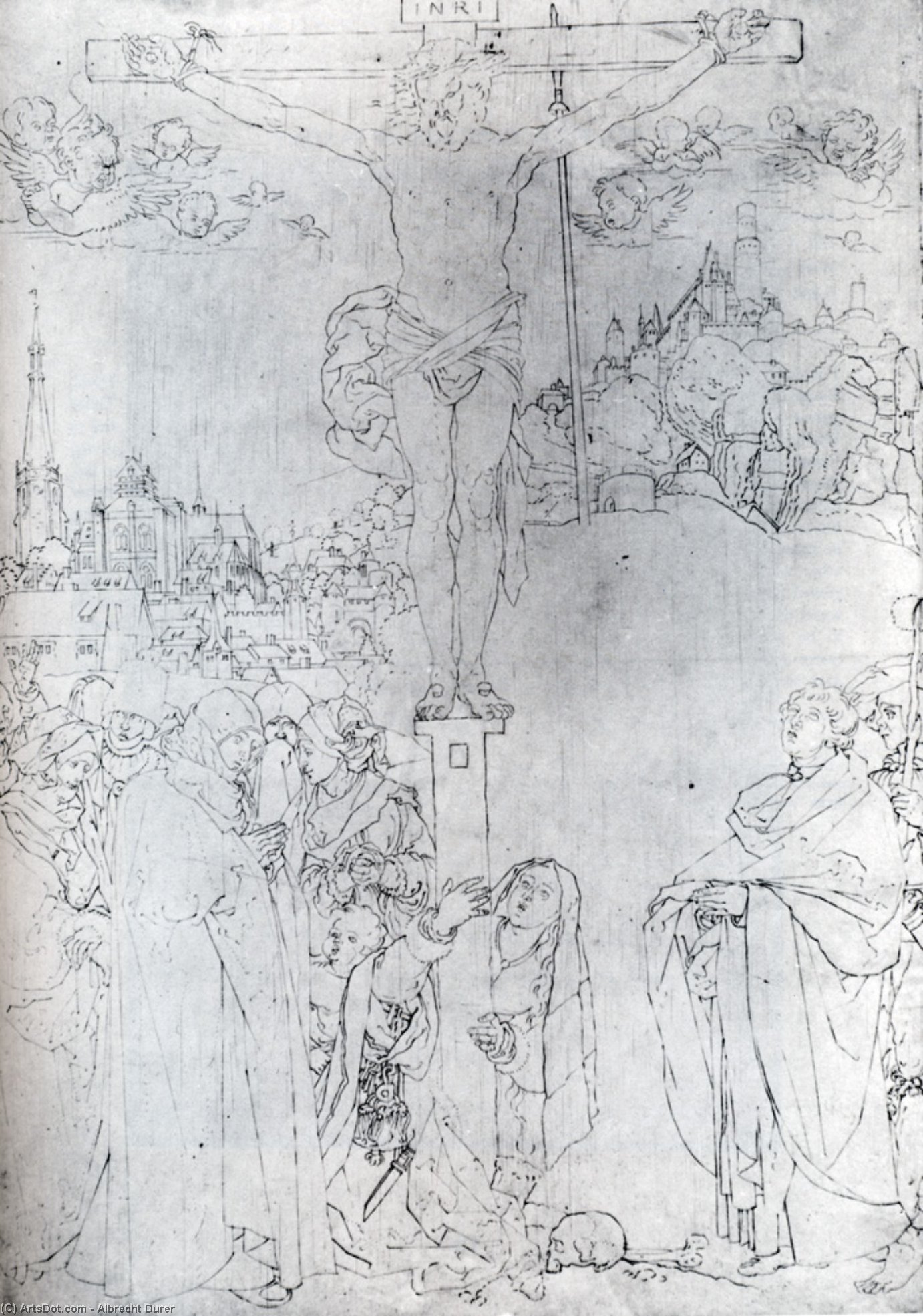
In the quiet, meticulous strokes of Albrecht Dürer’s Crucifixion With Many Figures, we encounter one of the most profound expressions of the Northern Renaissance. Created in 1523, this black and white pen and ink drawing is far more than a mere religious illustration; it is a breathtaking window into a moment of cosmic sorrow and divine sacrifice. Dürer, a master who bridged the gap between medieval mysticism and Renaissance humanism, utilizes the stark contrast of ink on paper to command the viewer's attention. The composition is vertically oriented, drawing the eye upward toward the central figure of Christ, whose suffering serves as the emotional and spiritual anchor for the entire sprawling tableau.
The sheer complexity of the scene is staggering. As your eyes wander through the intricate landscape, you discover a world teeming with life and grief. The foreground is populated by a dense, carefully arranged group of mourners, angels, and attendants, each rendered with such precision that their individual anguish feels palpable. Behind this human drama, the skyline of Jerusalem rises in a series of sharp, geometric spires and architectural marvels, providing a sense of historical weight and depth. This interplay between the intimate, weeping figures and the grand, distant cityscape creates a powerful linear perspective, pulling the observer into the very heart of the crucifixion.
The Alchemy of Line and Light
Technically, this work stands as a testament to Dürer’s unparalleled command over the medium of pen and ink. Eschewing the luxury of color, the artist relies entirely on the rhythmic dance of hatching and cross-hasting to build form, volume, and texture. Through varying line weights, he breathes life into the heavy folds of drapery, the delicate skin of the mourners, and the cold, hard surfaces of the distant architecture. This technique creates a rich tonal range that mimics the play of light and shadow, casting deep, dramatic shadows that emphasize the physical weight of the cross and the emotional gravity of the event.
For the discerning collector or interior designer, this piece offers an unparalleled sense of sophistication. The monochromatic palette lends it a timeless, classical elegance that integrates seamlessly into both traditional galleries and modern, minimalist spaces. It is a work that demands contemplation, inviting anyone who views it to lose themselves in its fine details. Whether displayed as a focal point in a study or as part of a curated collection of Renaissance masters, a high-quality reproduction of this drawing brings with it an aura of intellectual depth and historical prestige.
Symbolism and the Eternal Echo
Beyond its technical brilliance, the Crucifixion With Many Figures is a dense tapestry of Christian symbolism. Every element is imbued with meaning: the cross itself stands as the ultimate emblem of redemption; the weeping figures serve as mirrors for human sorrow; and the presence of angels signifies the intersection of the earthly and the divine. Dürer’s ability to weave these symbols into a realistic, almost tangible scene ensures that the spiritual message remains accessible and deeply moving even centuries after its creation.
To possess a reproduction of this work is to hold a piece of the German Renaissance spirit. It is an invitation to experience the meticulous craftsmanship of Nuremberg’s greatest son and to surround oneself with an artwork that captures the very essence of human resilience and spiritual hope. This drawing does not merely depict a historical event; it evokes an eternal emotion, making it a profound addition to any collection dedicated to the heights of human artistic achievement.