A Timeless Meditation on Mortality: Albrecht Dürer’s “Death and Wife”
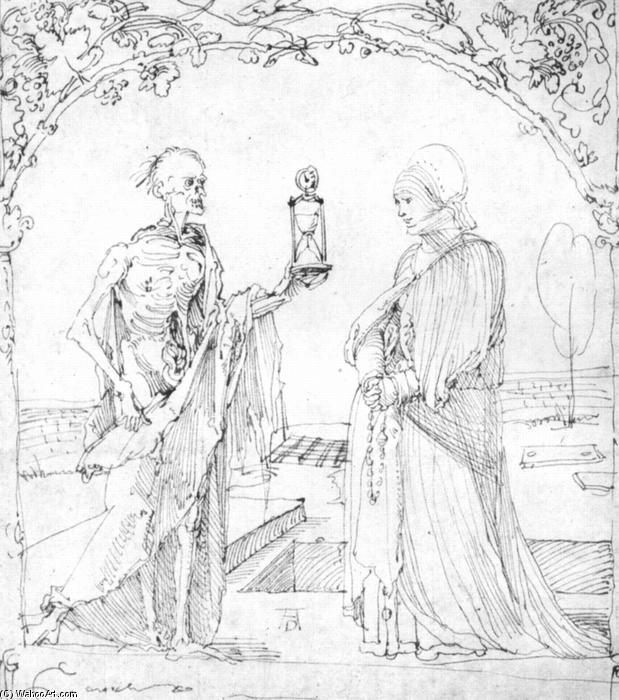
Albrecht Dürer's "Death and Wife," a hauntingly beautiful black and white drawing, transcends mere illustration; it is a profound meditation on the human condition – specifically, our relationship with mortality. Executed in the style of the Northern Renaissance, this work, likely created around 1503, captures a moment of poignant interaction between two iconic figures: Death, rendered as a skeletal figure presenting an hourglass, and a woman, representing life itself. The composition, centered within an archway of intricately detailed foliage, immediately draws the viewer into a world where symbolism reigns supreme.
- The Figures: Dürer’s meticulous attention to anatomical detail is evident in both figures. Death, depicted with rough, irregular lines suggesting bone and decay, embodies the inevitable approach of finality. The woman, conversely, is portrayed with smoother, more consistent linework, hinting at a fragile beauty and an attempt to resist the encroaching darkness.
- The Hourglass: This central object is not merely decorative; it’s a potent symbol of time's relentless passage – the very essence of mortality. The hourglass visually represents the dwindling moments of life, relentlessly flowing towards its end.
- Architectural Framing: The archway formed by intertwining branches and leaves serves as more than just a backdrop. It creates an enclosed space, intensifying the sense of intimacy between Death and the woman, and reinforcing the theme of enclosure associated with death.
Renaissance Technique: A Masterclass in Pen and Ink
Dürer’s mastery is immediately apparent in the execution of this drawing. The technique employed – primarily pen and ink on paper or parchment – showcases a sophisticated understanding of tonal variation and texture. Precise linework, combined with hatching and cross-hatching, creates a remarkable illusion of depth and volume. Notice how thicker lines define the main forms—Death’s robust frame and the woman's flowing garments—while finer lines meticulously render details like facial features, foliage, and fabric folds. This careful layering of lines generates a rich surface quality that invites close inspection.
- Hatching and Cross-hatching: These techniques are crucial to achieving Dürer’s signature style. Hatching involves creating parallel lines to build up tone, while cross-hatching uses intersecting lines to create darker areas and a greater sense of depth.
- Limited Palette, Maximum Impact: The monochromatic palette—a testament to the medium's capabilities—amplifies the emotional impact of the scene, focusing attention on form, line, and shadow.
Symbolism and Historical Context
"Death and Wife" is deeply rooted in the intellectual currents of the Renaissance, a period marked by a renewed interest in classical antiquity and a burgeoning humanist perspective. Dürer, like many artists of his time, was fascinated by symbolism – using visual metaphors to convey complex ideas. The pairing of Death and Life isn't simply a depiction of an event; it’s a reflection on the fundamental duality of human existence. Dürer’s work aligns closely with the artistic conventions of the era, particularly those exemplified by his contemporary, Hans Holbein the Younger, though Dürer’s meticulous detail and profound symbolism distinguish him as a truly singular figure.
The drawing's creation coincides with a period of significant personal reflection for Dürer, marked by anxieties about his own mortality and a desire to grapple with existential questions. This emotional intensity is palpable in the work’s somber mood and its unflinching portrayal of death – a subject often avoided in art during this time.
A Legacy of Beauty and Reflection
"Death and Wife" remains a powerful testament to Albrecht Dürer's genius. Its enduring appeal lies not only in its technical brilliance but also in its profound exploration of timeless themes: life, death, and the passage of time. This hand-painted reproduction captures the essence of this iconic artwork, offering an opportunity to own a piece of art history that continues to resonate with viewers centuries later.