The Weight of an Empire: Albrecht Dürer’s Masterpiece
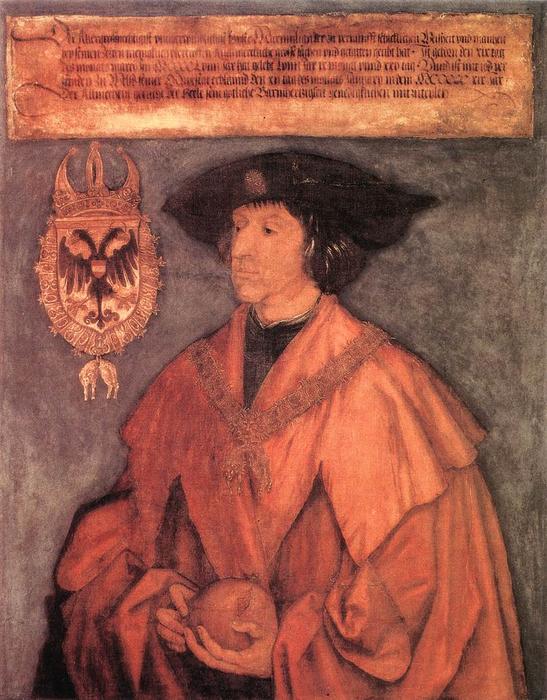
Albrecht Dürer's “Portrait of the Emperor Maximilian I,” completed in 1519, is more than just a likeness; it’s a carefully constructed embodiment of power, ambition, and a subtle undercurrent of melancholy. Executed in rich black chalk on paper, this intimate portrait transcends its simple format to offer a profound glimpse into the mind of one of Europe's most influential figures – Maximilian I, Holy Roman Emperor. Dürer, already establishing himself as a leading artist of the German Renaissance, masterfully captures not merely the outward appearance of the emperor but also hints at the burdens and complexities inherent in his position.

The portrait immediately draws the eye to Maximilian’s face – a study in controlled severity. His gaze, directed downwards and slightly averted, speaks volumes about his contemplative nature, suggesting a man wrestling with weighty decisions and perhaps even a sense of isolation. The subtle lines etched around his eyes and mouth hint at years spent navigating treacherous political landscapes and bearing the responsibility of an empire. The composition is remarkably balanced; Maximilian occupies a significant portion of the frame, yet there’s a deliberate space around him, creating a sense of dignified reserve. Dürer's use of chiaroscuro – the dramatic contrast between light and shadow – further emphasizes this effect, highlighting the emperor’s features while simultaneously shrouding him in an aura of solemnity.
A Renaissance Ruler: Context and Symbolism
To fully appreciate “Portrait of the Emperor Maximilian I,” it's crucial to understand its historical context. The portrait was commissioned during a period of immense political upheaval in Europe, marked by the rise of powerful nation-states and shifting alliances. Maximilian I, a shrewd diplomat and military strategist, had consolidated Habsburg power through strategic marriages and relentless warfare, transforming his family into one of the most influential dynasties in Christendom. The image itself is laden with symbolism. The emperor’s attire – the crimson robe trimmed with gold, the black hat, and the sphere he holds – are all emblems of imperial authority. The sphere, a recurring motif in Renaissance art, represents the world under his dominion, reflecting Maximilian's ambition to control both the political and spiritual realms.
The pomegranate hanging from his belt is another significant detail. While interpretations vary, it’s often linked to the myth of Persephone, representing the emperor’s reign over a vast and fertile empire – a metaphor for prosperity and abundance. Even the subtle details, such as the intricate embroidery on his robe and the delicate folds of his garments, demonstrate Dürer's meticulous attention to detail and his mastery of capturing texture and form.
The Technique of a Master: Dürer’s Craftsmanship
Dürer’s technical skill is evident in every stroke of the black chalk. He employed a technique known as “point tournant,” where he varied the pressure on his stylus to create subtle gradations of tone and texture. This allowed him to achieve remarkable realism, capturing the nuances of Maximilian's facial features with astonishing accuracy. The portrait’s monochrome palette – limited to shades of black and white – further emphasizes the emperor’s solemnity and timelessness. Dürer was a pioneer in printmaking, and this portrait exemplifies his innovative approach to the medium. He meticulously prepared the paper, ensuring its quality and surface texture, and used a specialized press to achieve sharp, detailed impressions.
A Legacy of Power and Reflection
“Portrait of the Emperor Maximilian I” remains one of Dürer’s most enduring masterpieces. It's not merely a portrait; it’s a psychological study, a historical document, and a testament to the artist’s extraordinary skill. The image continues to resonate with viewers today, inviting us to contemplate the complexities of power, ambition, and the human condition. Reproductions of this iconic work offer an exceptional opportunity to bring this profound piece of art into any space, serving as a constant reminder of a pivotal figure in European history and a master artist’s unparalleled vision.