The Essence of Renaissance Precision
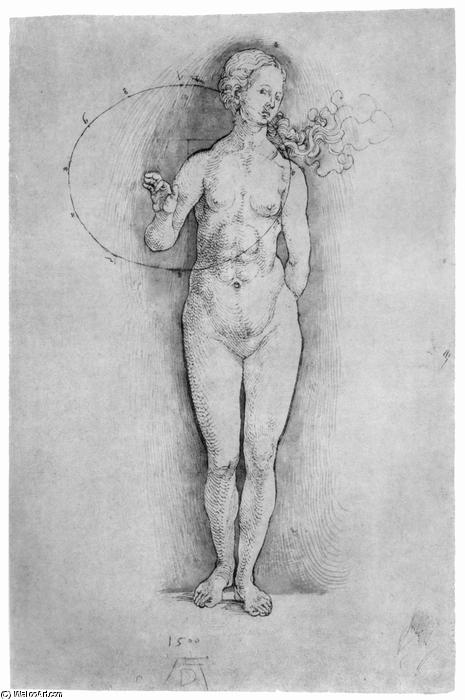
In the quiet, meticulous lines of Albrecht Dürer’s Female Nude, one finds the very heartbeat of the Northern Renaissance. This monochrome engraving is far more than a mere study of the human form; it is a profound dialogue between anatomical truth and classical idealism. As the eye wanders across the textured surface, it encounters a figure that seems to emerge from the shadows of history, rendered with a level of detail that defies the simplicity of its medium. Dürer, a master who bridged the gap between the artisan traditions of Nuremberg and the intellectual heights of the Italian Renaissance, utilizes every stroke of his engraving tool to breathe life into the stillness of paper and ink.
The composition is anchored by a striking sense of balance, where the soft, organic curves of the female silhouette contrast beautifully against the rugged, geometric textures of the background. A singular, circular element arches above the figure’s head, acting as a celestial halo that elevates the subject from a simple anatomical study to something much more transcendent. This subtle use of geometry suggests a connection to the eternal, perhaps hinting at the divine perfection found in the classical muses or the goddess Venus herself. The interplay of light and shadow, achieved through masterful hatching and cross-hatching, creates a palpable three-dimensionality, making the skin appear supple and the surrounding environment feel tangibly real.
A Masterclass in Line and Light
To behold this work is to witness the technical zenith of the engraving technique. Dürer’s ability to manipulate light through nothing but black ink on paper is nothing short of miraculous. By varying the density and direction of his lines, he simulates a spectrum of tones that mimic the soft glow of skin and the coarse grit of stone. This meticulous approach creates an emotional depth that resonates with the viewer; there is a sense of profound intimacy in the way the light grazers the figure's form, inviting a moment of quiet contemplation.
For the discerning collector or interior designer, this piece offers a timeless elegance that transcends modern trends. Its monochromatic palette provides a sophisticated focal point that complements both minimalist contemporary spaces and richly detailed classical interiors. A high-quality reproduction of this masterpiece allows the subtle nuances of Dürer’s hand to be appreciated in any setting, bringing with it an aura of intellectual rigor and historical prestige. It is not merely a decoration, but an invitation to engage with one of the most significant eras of human creativity, capturing a moment where science, art, and spirituality were inextricably entwined.