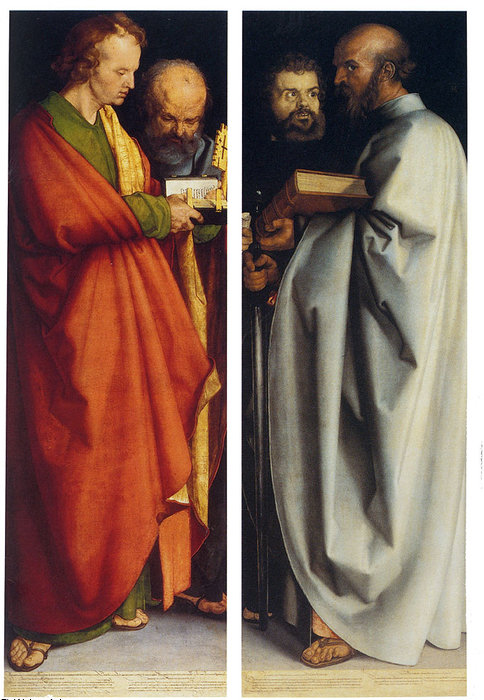
Experience Albrecht Dürer’s masterful ‘Four Apostles,’ a captivating Renaissance painting depicting four figures in contemplative study. This iconic artwork showcases Dürer's meticulous detail and profound artistic vision – discover or own this timeless masterpiece.
A Moment of Scholastic Reflection: Albrecht Dürer's "Four Apostles"
Albrecht Dürer’s “Four Apostles,” a captivating depiction of religious contemplation, offers a profound glimpse into the heart of the German Renaissance. Painted around 1506, this work transcends a simple portrait; it is an exploration of faith, learning, and the very essence of human connection within a deeply symbolic framework. The scene unfolds within a modestly furnished room – a space deliberately devoid of opulent grandeur – emphasizing the focus on intellectual discourse rather than material wealth. Four figures, rendered with Dürer’s characteristic precision and emotional depth, are engaged in what appears to be a fervent discussion, their postures suggesting both seriousness and animated debate. The inclusion of books is not merely decorative; it underscores the apostles' role as disseminators of knowledge and interpreters of scripture – central tenets of their faith.
Technical Mastery and Dürer’s Innovation
- Oil on Panel: Dürer masterfully employed oil paint on a wooden panel, a technique he pioneered in Northern Europe. This allowed for the subtle gradations of tone and color that define his work, providing an unprecedented level of realism and luminosity previously unseen in religious art.
- Detailed Rendering: The apostles are depicted with meticulous attention to anatomical detail, reflecting Dürer’s deep study of human form – a hallmark of his artistic approach. His use of cross-hatching and stippling creates a remarkable sense of texture, particularly evident in the folds of their robes and the surfaces of the books.
- Linear Perspective: While not employing strict mathematical perspective as would become fashionable later, Dürer demonstrates an intuitive understanding of spatial recession, creating a believable depth within the confined space of the room.
Symbolism and Religious Context
The painting’s symbolism is rich with religious significance. The four apostles – likely representing Matthew, John, Andrew, and Peter (though precise identification remains debated) – are central figures in Christian theology. Their gathering suggests a moment of communal reflection on the teachings of Christ, preparing for his eventual return. The books they hold symbolize knowledge, wisdom, and the written word as divine revelation. The red robe worn by one apostle may represent martyrdom or sacrifice, adding another layer to the scene’s spiritual weight. Dürer was deeply influenced by humanist thought, which emphasized human potential and the importance of intellectual pursuits alongside religious devotion.
Dürer's Legacy and Emotional Impact
“Four Apostles” stands as a testament to Albrecht Dürer’s genius – a master of both technical skill and profound artistic vision. His work profoundly influenced the course of Northern Renaissance art, setting new standards for realism, detail, and emotional expression. The painting's quiet intensity invites viewers to contemplate themes of faith, learning, and human connection. It is a powerful reminder of the enduring quest for knowledge and understanding that has shaped Western civilization. A hand-painted reproduction captures not just an image, but the very spirit of Dürer’s artistic legacy – a timeless expression of human aspiration and spiritual yearning.