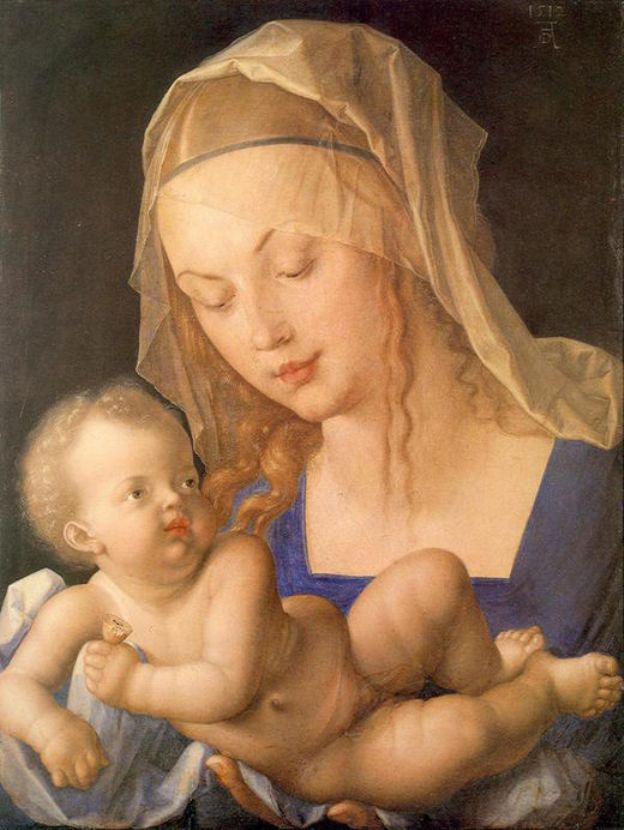
A Timeless Reverie: Dürer's Madonna and Child with a Pear
Albrecht Dürer’s “Madonna and Child with a Pear” is more than just a depiction of the Virgin Mary and her son; it’s a profound meditation on faith, innocence, and the delicate beauty of the natural world. Executed in the mid-16th century, during the apex of the German Renaissance, this painting embodies Dürer's mastery of detail, his deep understanding of human anatomy, and his unwavering commitment to capturing the spiritual essence of his subjects. The scene unfolds with a quiet intimacy, drawing the viewer into a moment of serene contemplation – a hallmark of Dürer’s artistic vision.
- Subject Matter: The central focus is undeniably Mary, rendered with an almost ethereal grace. Her flowing hair and simple blue gown evoke a sense of timelessness, while her tender gaze upon the infant Jesus speaks volumes about maternal devotion.
- The Pear: A seemingly unassuming detail – the pear offered to the Madonna – carries significant symbolic weight. In Renaissance iconography, the pear represents innocence, purity, and fertility, aligning perfectly with the themes of motherhood and divine grace.
- Secondary Figures: The presence of two additional figures, positioned subtly in the background, adds layers of complexity to the narrative. These figures may represent Joseph, Mary’s husband, or perhaps angels observing this sacred moment.
Dürer's Masterful Technique – A Symphony of Detail
Dürer was renowned for his meticulous technique, and “Madonna and Child with a Pear” is a testament to his unparalleled skill. Executed in oil on panel, the painting showcases an astonishing level of detail—from the delicate folds of Mary’s gown to the individual strands of her hair. His use of sfumato, a subtle blurring effect achieved through layers of translucent paint, creates a soft, atmospheric quality that enhances the sense of realism and depth. The artist's precise hatching and cross-hatching techniques contribute to the three-dimensionality of the figures, imbuing them with a palpable sense of life.
- Oil on Panel: Dürer’s preference for oil paints allowed him to build up layers of color gradually, achieving a richness and luminosity that was unattainable with tempera.
- Perspective & Anatomy: The painting demonstrates a sophisticated understanding of linear perspective, creating a believable spatial environment. Furthermore, Dürer's anatomical studies are evident in the accurate rendering of Mary’s form – a testament to his dedication to scientific observation.
Historical Context and Symbolism
Dürer created “Madonna and Child with a Pear” during a period of immense artistic and intellectual ferment. The Renaissance was flourishing across Europe, fueled by a renewed interest in classical antiquity and a desire to explore the human condition. Dürer’s work reflects this spirit of inquiry, blending Christian iconography with humanist ideals. The painting's symbolism is deeply rooted in medieval and early Renaissance traditions, yet it also possesses a distinctly personal quality – a reflection of Dürer’s own spiritual beliefs and artistic sensibilities.
- German Renaissance: This work exemplifies the unique characteristics of the German Renaissance, characterized by its emphasis on religious piety, meticulous craftsmanship, and a profound connection to nature.
- Iconographic Significance: The composition adheres to established iconographic conventions, yet Dürer subtly deviates from tradition, imbuing the scene with his own artistic vision.
Emotional Impact and Artistic Legacy
"Madonna and Child with a Pear" continues to resonate with viewers centuries after its creation. Its serene beauty, coupled with its profound symbolism, evokes a sense of peace, reverence, and wonder. Dürer’s ability to capture the emotional essence of his subjects—the tenderness between mother and child, the divine grace of Mary—is what elevates this painting beyond mere representation. It remains a powerful testament to the enduring legacy of one of the greatest artists of the Renaissance.