A Masterpiece of Intimacy: Dürer’s Quiet Devotion
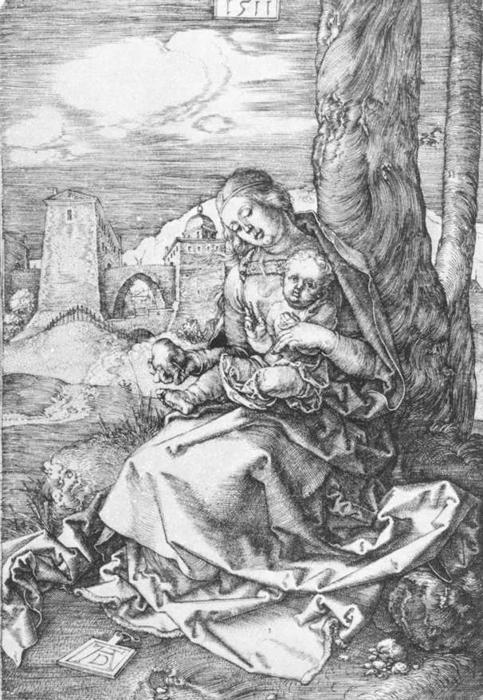
In the vast landscape of the German Renaissance, few works capture the profound intersection of divine grace and earthly tenderness as exquisitely as Albrecht Dürer’s “Madonna with the Pear.” Created in 1511, this breathtaking engraving transcends the boundaries of mere religious iconography to offer a deeply personal meditation on motherhood. At first glance, the viewer is drawn into a moment of quiet domesticity, where the Virgin Mary sits cradling the Christ Child amidst a landscape that feels both vast and intimately close. There is no grand, sweeping drama here; instead, Dürer invites us into a sanctuary of stillness, where the weight of the world seems to pause in reverence to the bond between mother and child.
The composition is anchored by a striking verticality, provided by a rugged tree trunk that frames the right side of the scene, grounding the ethereal figures in the tangible textures of the natural world. In the distance, a soft, atmospheric cityscape emerges through the haze, providing a sense of depth and suggesting that this sacred moment exists within the context of human civilization. This juxtaposition of the eternal and the everyday is what makes the piece so enduringly poignant for the modern observer.
The Alchemy of Line and Light
To behold this engraving is to witness the pinnacle of technical mastery. Dürer, a virtuoso of the burin and needle, utilized the painstaking technique of engraving on paper to achieve a level of detail that remains staggering even centuries later. Through the masterful application of hatching and cross-hatching, he breathes life into inanimate surfaces. One can almost feel the rough, weathered bark of the tree, the delicate softness of the infant’s skin, and the heavy, intricate folds of the Madonna’s drapery.
The artist’s ability to manipulate light is nothing short of miraculous. By varying the density and direction of his fine lines, Dürer creates a sophisticated play of shadow and illumination that emerges from the monochromatic surface. Light appears to descend from the upper left, casting gentle shadows that define the volume of the figures and bestow them with a sculptural presence. For collectors and designers, this technical brilliance translates into a work of immense visual texture, making it a centerpiece capable of adding profound intellectual and aesthetic depth to any curated space.
Symbolism and the Soul of the Renaissance
Beyond its formal beauty, “Madonna with the Pear” is a dense tapestry of symbolic meaning. The titular pear, held within the scene, serves as more than just a simple fruit; in the iconographic language of the era, such elements often alluded to the sweetness of Christ or the eventual sacrifice of the flesh. Every element—from the protective posture of the Virgin to the vulnerable gaze of the child—is a deliberate choice intended to evoke a sense of pietas, or religious devotion.
There is an underlying note of melancholy woven into the composition, a subtle foreshadowing of the Passion that adds a layer of emotional complexity. This tension between the joy of new life and the inevitability of sacrifice is what gives the work its haunting, soulful quality. For those seeking to adorn their homes with art that speaks to the human condition, this reproduction offers more than decoration; it provides a window into the profound spiritual and emotional inquiries of the Renaissance mind, making it an incomparable choice for any serious connoisseur of fine art.