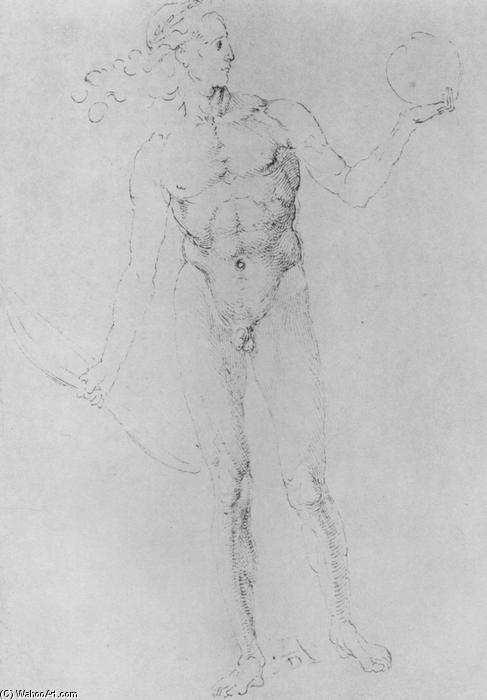
A Study in Divine Form: Albrecht Dürer’s ‘Male Nude (Apollo Poynter)’
Albrecht Dürer's ‘Male Nude (Apollo Poynter)’ is more than just a sketch; it’s a profound meditation on the human form, rendered with the meticulous precision and intellectual rigor that defined the artist’s extraordinary career. Executed in black and white, this preparatory drawing, likely conceived around 1506, offers an intimate glimpse into Dürer's creative process – a testament to his unwavering dedication to anatomical accuracy and his deep engagement with classical ideals. The image depicts a powerfully built male figure, poised in a contrapposto stance that speaks of both strength and grace, instantly evoking the spirit of Apollo, the Greek god of light and music. The drawing’s stark monochrome palette – a symphony of grays ranging from delicate highlights to rich shadows – amplifies the dramatic effect, forcing the viewer to confront the raw beauty and inherent power of the human body.
- Renaissance Realism: Dürer's mastery is immediately apparent in his ability to capture the nuances of musculature and bone structure. The drawing exemplifies the Renaissance emphasis on realism, a shift away from stylized representations towards an accurate depiction of the natural world.
- Classical Influence: The pose itself – reminiscent of ancient Greek sculptures – reflects Dürer’s profound admiration for classical antiquity. He sought to emulate the idealized forms of the Greeks and Romans, believing them to be the pinnacle of artistic achievement.
- Technical Brilliance: The drawing showcases Dürer's unparalleled skill in dry media techniques, particularly charcoal or silverpoint on paper. The delicate lines, achieved through careful layering and shading, create a remarkable sense of volume and texture.
Technique and Materials – A Window into the Artist’s Studio
Dürer's choice of materials speaks volumes about his working method. The use of charcoal or silverpoint—a technique involving drawing with heated metal rods on prepared paper—allowed for a remarkably subtle range of tones, far surpassing the capabilities of watercolor or tempera. Evidence of reworking is visible throughout the drawing – areas where lines have been erased and redrawn, demonstrating Dürer’s iterative approach to composition and detail. This wasn't simply about creating an image; it was about refining an idea, pushing the boundaries of his technical skill.
- Charcoal or Silverpoint: These dry media offered unparalleled control over line weight and tonal variation, crucial for achieving Dürer’s signature realism.
- Paper Preparation: The paper itself would have been carefully prepared – often with a ground layer to ensure even ink absorption and prevent smudging.
- Erasing and Redrawing: The visible evidence of erasing and reworking highlights the painstaking process involved in creating Dürer’s drawings, emphasizing his commitment to perfection.
Symbolism and Emotional Resonance – Beyond Anatomical Study
'Male Nude (Apollo Poynter)’ transcends a mere anatomical study; it's imbued with symbolic weight. The figure’s pose, mirroring the iconic contrapposto stance of classical sculptures, immediately connects him to the tradition of heroic representation. The inclusion of a circular object – potentially a mirror or shield – adds another layer of meaning, suggesting themes of self-reflection and divine protection. While rooted in anatomical precision, the drawing resonates with the emotional power associated with Apollo: beauty, strength, intellect, and artistic inspiration. Dürer’s ability to infuse such profound concepts into a seemingly simple preparatory sketch is a testament to his genius.
A Legacy of Artistic Innovation
Dürer's ‘Male Nude (Apollo Poynter)’ stands as a pivotal work in the history of art, representing a synthesis of classical ideals, Renaissance humanism, and unparalleled technical skill. Its enduring appeal lies not only in its exquisite execution but also in its profound exploration of the human form – a timeless meditation on beauty, strength, and the divine spark within us all. This drawing offers a rare opportunity to connect with one of the most influential artists of the Renaissance, a legacy that continues to inspire awe and admiration centuries later.