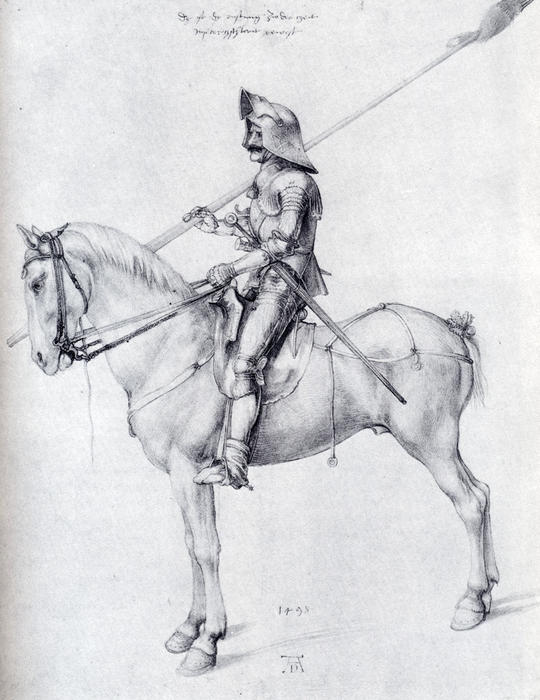
A Knight's Resolve: Albrecht Dürer’s ‘Man in Armor on Horseback’
Albrecht Dürer’s “Man in Armor on Horseback,” executed in 1498, stands as a cornerstone of Northern Renaissance art – a testament to the artist’s unparalleled skill in rendering detail and imbuing his work with profound symbolic weight. This meticulously crafted drawing, depicting a knight poised for action, transcends mere portraiture; it's an exploration of power, protection, and the very essence of human endeavor. The artwork’s monochromatic palette – shades of gray, white, and black – immediately evokes a sense of timelessness, transporting the viewer back to the heart of the 15th century while simultaneously amplifying the dramatic impact of the scene.
Technical Mastery: Dürer's Precise Hand
- Line Work: The foundation of this piece lies in Dürer’s extraordinary command of line. Each stroke is deliberate, precise, and executed with a level of control rarely seen before or since. Hatching and cross-hatching are deployed with masterful precision to build up tonal values, creating an illusion of three-dimensionality that seems almost impossibly realistic for a drawing made solely with pen and ink on paper.
- Texture Rendering: Dürer doesn’t simply depict the armor; he captures its very materiality. The metallic sheen of the plate is achieved through subtle variations in line density, while the horse's coat is rendered with rough, textured strokes that convey both strength and vulnerability.
- Perspective & Depth: While not employing strong linear perspective, Dürer skillfully utilizes size variation and overlapping forms to create a convincing sense of depth. The greater detail lavished upon the knight and his steed draws the eye into the composition, anchoring the viewer within the scene.
Symbolism and Narrative: A Portrait of Power
More than just a depiction of a warrior, “Man in Armor on Horseback” is laden with symbolic meaning. The armored knight represents protection, authority, and military prowess – qualities highly valued during the Renaissance period. The horse itself, a symbol of nobility and strength, further reinforces this message. The inclusion of two secondary figures in the background hints at a narrative context, perhaps a ceremonial procession or a historical event, adding layers of intrigue to the composition. Dürer’s meticulous attention to detail suggests an intention to capture not just a likeness but also the spirit and status of the subject.
Historical Context: The Dawn of Renaissance Realism
Created in 1498, this drawing represents a pivotal moment in the development of Northern Renaissance art. Dürer’s work reflects the growing emphasis on realism and naturalism that characterized the era, influenced by classical ideals and a renewed interest in human anatomy. His apprenticeship under Michael Wolgemut exposed him to the latest artistic trends, including illuminated manuscripts and woodcut illustration, shaping his distinctive style – one defined by its meticulous detail, precise line work, and profound understanding of human form. This piece exemplifies Dürer’s ambition to bridge the gap between art and science, striving for an objective representation of the world around him.
Emotional Impact: A Sense of Foreboding
Despite its formal grandeur, “Man in Armor on Horseback” evokes a subtle sense of foreboding. The knight’s poised stance, combined with the intensity of his gaze and the powerful presence of his steed, creates an atmosphere of controlled tension. The monochromatic palette further contributes to this effect, lending the scene a solemn and contemplative quality. This artwork is not merely a depiction of strength; it's an exploration of human vulnerability within a world defined by conflict and uncertainty.