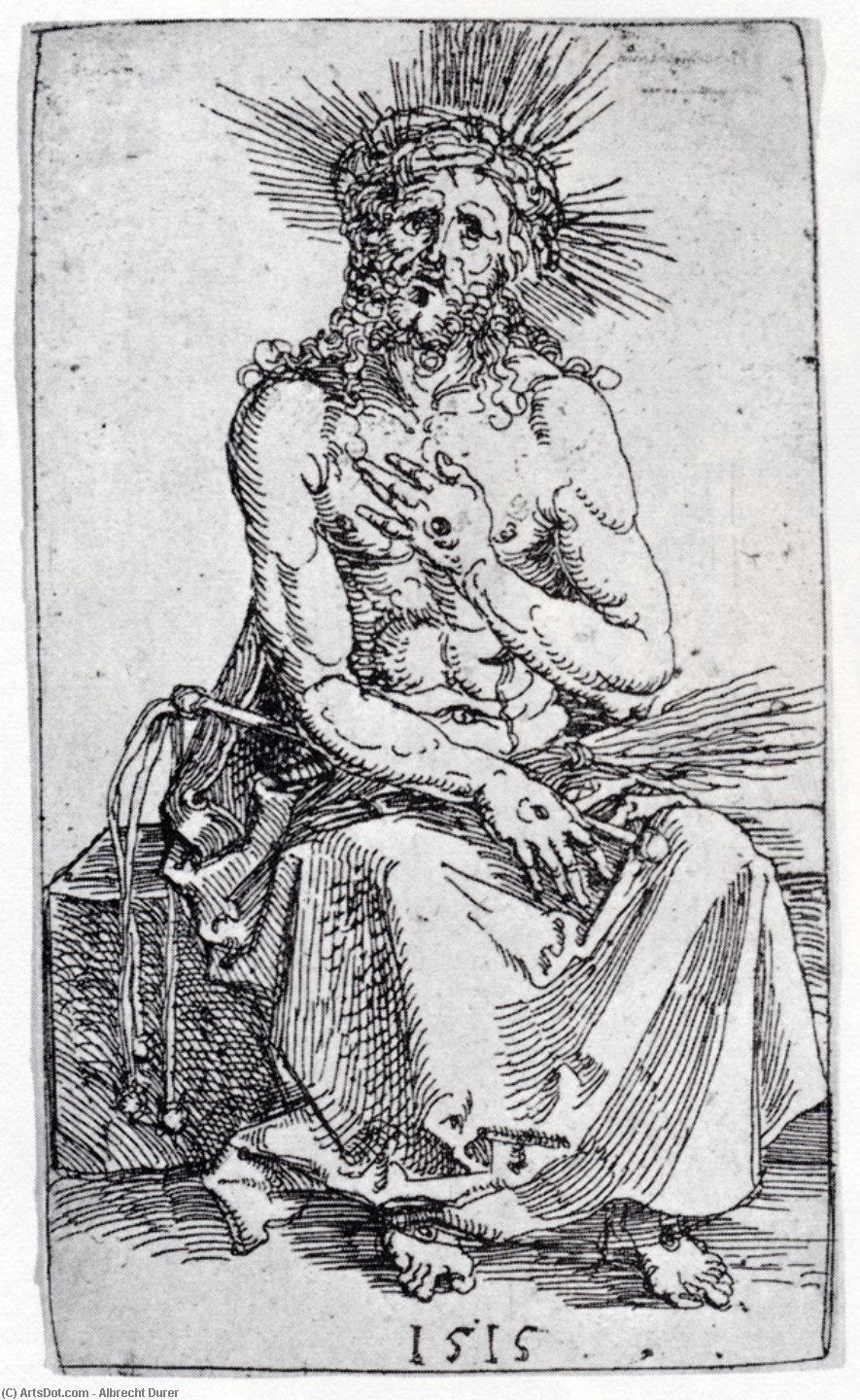
A Meditation in Monochrome: The Soul of Dürer’s Man of Sorrows
In the quiet, shadowed corridors of the Northern Renaissance, few images possess the haunting intimacy of Albrecht Dürer’s 1515 etching, Man of Sorrows, Seated. This is not merely a depiction of religious suffering; it is a profound psychological encounter. As the viewer approaches this masterwork, they are met with the heavy, palpable presence of a figure caught in a moment of eternal, quiet agony. Dürer, a titan of German art, moves beyond the mere documentation of Christ’s Passion to create a spiritual mirror, inviting us to reflect upon our own vulnerabilities and existential grief. The artwork serves as a window into an era of profound religious transformation, where the boundaries between the divine and the human were being redrawn through the meticulous precision of printmaking.
The technical brilliance of this piece lies in Dürer’s experimental mastery of the etching needle. During this period, Dürer was revisiting the possibilities of acid-etched lines on metal, moving away from the rigid certainty of engraving to embrace a more fluid, expressive texture. Through the sophisticated use of hatching and cross-hatching, he builds a world out of nothing but black ink and white paper. The light seems to emerge from within the figure itself, catching the sharp, jagged edges of the crown of thorns and illuminating the weary contours of Christ’s face. Every fine line, achieved through the delicate interplay of pressure and acid, contributes to a sense of three-dimensional weight, making the seated figure feel as though he occupies the very space in front of the observer.
Symbolism and the Language of Suffering
Every element within this minimalist composition is heavy with theological and emotional significance. The central figure sits upon a humble, unadorned block, a choice that strips away the grandeur of kings to emphasize the raw, universal nature of humility and sacrifice. His hands, clasped tightly in front of his chest, draw the eye toward the center of his torment, acting as a focal point for the viewer's empathy. The crown of thorns, rendered with aggressive, radiating strokes, serves as a sharp, geometric contrast to the organic, flowing textures of his hair and beard, symbolizing the piercing nature of betrayal and physical pain.
The monochrome palette—a stark arrangement of blacks, greys, and whites—strips away the distraction of color to focus the mind entirely on form and emotion. This lack of chromatic vibrance reinforces the somber, introspective tone of the work, making it an ideal centerpiece for spaces designed for contemplation or quiet study. For the collector or interior designer, this piece offers a sophisticated gravity; it is an artwork that does not shout for attention but commands respect through its silent, enduring strength. It brings a sense of historical depth and intellectual rigor to any curated collection, acting as a timeless anchor in a modern setting.
An Enduring Legacy for the Discerning Collector
To possess a high-quality reproduction of Man of Sorrows, Seated is to hold a piece of the Northern Renaissance's very heart. Dürer’s ability to translate complex spiritual narratives into the language of fine line work remains unparalleled. This etching transcends its historical origins, offering a timeless aesthetic that complements both classical and contemporary interiors. Whether placed in a gallery-style library or as a focal point in a minimalist living space, the artwork provides an atmosphere of profound dignity and intellectual depth. It is more than a decoration; it is an invitation to pause, to breathe, and to engage with one of the most poignant expressions of human emotion ever captured on paper.