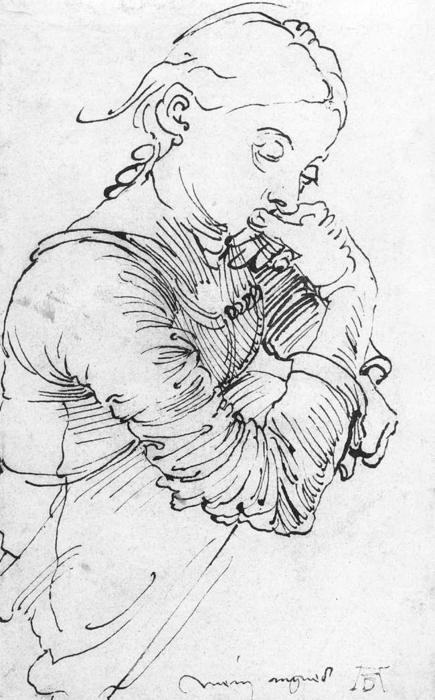
Mein Agnes: A Portrait of Quiet Contemplation
Albrecht Dürer’s “Mein Agnes,” created in 1494, isn't merely a portrait; it’s a profound distillation of human emotion captured with an astonishingly delicate hand. This black and white sketch, now residing within the Albertina Museum in Vienna, offers a rare glimpse into the life of Agnes Dürer, the wife of one of the Renaissance’s most celebrated artists. More than just a depiction of a woman, it's a study in introspection, a moment frozen in time that speaks volumes about the complexities of marriage and the quiet beauty of everyday existence.
The drawing itself is remarkably intimate – a young Agnes, likely around eighteen years old, sits at a table, her head resting pensively on her right hand. Her gaze is averted, suggesting a private thought or perhaps a moment of melancholy. Dürer’s masterful use of hatching and cross-hatching creates an incredible sense of texture, mimicking the drape of her clothing and the softness of her hair. The lines aren't bold declarations; instead, they are subtle whispers that build volume and depth, drawing the viewer into the scene with a gentle invitation.
The Renaissance Context: Marriage and Artistic Patronage
To fully appreciate “Mein Agnes,” it’s crucial to understand the context of its creation. Dürer returned to Nuremberg in 1494 after an extended journey through Italy, a period that profoundly shaped his artistic vision. He had married Agnes Frey just weeks before, a union arranged by their families and reflecting the prevailing social norms of the time. Marriage was often viewed as a strategic alliance, but for Dürer, it also provided him with a model – a muse, in essence – to capture on paper. The arrangement highlights the role of women within Renaissance society, not just as wives and mothers, but as subjects worthy of artistic representation.
Furthermore, Dürer’s return coincided with the rise of wealthy patrons like Emperor Maximilian I, who commissioned elaborate artworks for his court. This patronage fueled a flourishing art market and encouraged artists to experiment with new techniques and styles. Dürer's ability to blend traditional Northern European realism with Italian Renaissance influences – evident in his meticulous observation of anatomy and perspective – made him one of the most sought-after artists of his era.
Technique and Symbolism: A Masterclass in Line
The technical brilliance of “Mein Agnes” lies primarily in Dürer’s command of line. He employs a technique known as *hatching*, layering parallel lines to create tonal variations, and *cross-hatching*, intersecting lines to build darker areas. This method allows him to render the subtle nuances of light and shadow with remarkable precision, giving the figure a tangible presence. The simplicity of the materials – paper and ink – belies the complexity of his execution; it’s a testament to Dürer's extraordinary skill.
Beyond its technical merits, “Mein Agnes” is rich in symbolism. The posture itself—head resting on hand—suggests contemplation, perhaps even sadness or vulnerability. It’s a quiet moment of introspection, offering a poignant contrast to the grand narratives often depicted in Renaissance art. The sketch's intimacy and directness are particularly striking, representing a departure from the more formal portraiture conventions of the period.
Emotional Resonance: A Window into the Human Heart
“Mein Agnes” is not simply a beautiful drawing; it’s an emotionally resonant work that invites viewers to connect with the subject on a deeply personal level. Dürer's ability to capture a fleeting moment of human emotion—a hint of melancholy, a suggestion of inner thought—is truly remarkable. The sketch possesses a timeless quality, reminding us of the universal experiences of love, loss, and introspection.
Reproductions of “Mein Agnes” offer an accessible way to experience this masterpiece firsthand. Whether displayed in a private residence or a public gallery, this intimate portrait continues to captivate audiences with its quiet beauty and profound emotional depth—a testament to the enduring legacy of Albrecht Dürer’s artistic genius.