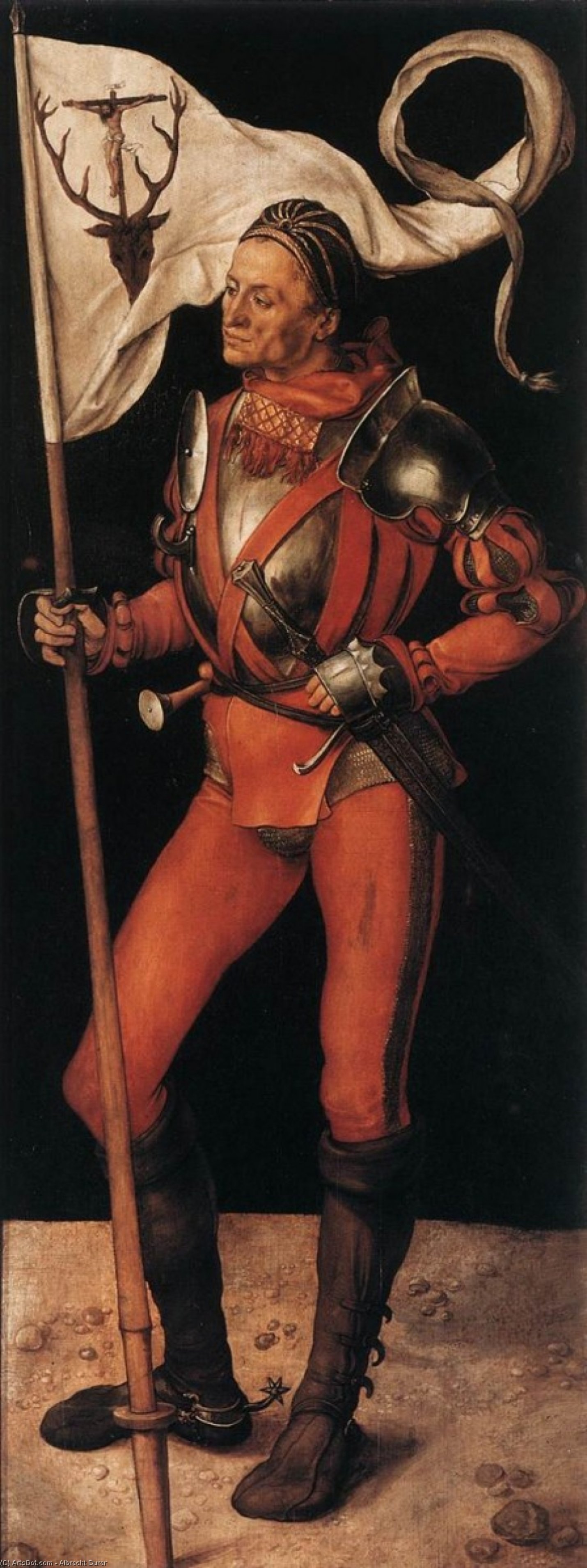
Witness the brilliance of Albrecht Dürer's 'Paumgartner Altar (Detail of Right Wing)' – a stunning oil painting capturing Renaissance artistry and detail. Explore this iconic masterpiece today!
Explore the art of Albrecht Dürer, a German Renaissance master! Discover iconic engravings like Melencolia I and detailed self-portraits – a pivotal figure in art history.
Discover European art history at the Alte Pinakothek in Munich! Explore Renaissance & Baroque masterpieces by Dürer, Rembrandt & Rubens within a stunning neoclassical setting.
A Triumph of Virtue: The Legend of Saint George
In the heart of the German Renaissance, Albrecht Dürer captured a moment of eternal struggle within the right wing of the Paumgartner Altar. Painted in 1503, this masterpiece presents far more than a mere depiction of a knight and a beast; it is a profound theological drama rendered with unparalleled precision. As the viewer’s eye meets St. George, clad in gleaming armor and poised with divine purpose, one feels the palpable weight of his righteous mission. The dragon, a dark and serpentine symbol of chaos and temptation, recoiled beneath the saint's strength, creating an allegorical dance between Christian virtue and the encroaching shadows of evil. This scene serves as a breathtaking embodiment of High Renaissance ideals, where the physical battle is but a mirror to the spiritual struggle occurring within the human soul.
Technical Brilliance and Renaissance Humanism
Dürer’s technical prowess is nothing short of miraculous, achieved through the delicate and disciplined application of oil paint on a lime panel. By employing meticulous glazing techniques, he built up layers of pigment that allow light to penetrate the surface, lending a luminous, almost ethereal quality to the figures. This mastery over light and shadow creates a sense of remarkable realism within a highly stylized framework. The composition follows a strict pyramidal structure, a hallmark of the humanist principles championed by the great masters of the era, which directs the gaze upward in a gesture of spiritual ascent. For the discerning collector or interior designer, this interplay of brilliance and depth offers a rich, textural complexity that breathes life into any curated space, providing a focal point that is both intellectually stimulating and visually captivating.
An Eternal Presence in Modern Spaces
Beyond its aesthetic splendor, this work serves as a window into the soul of Nuremberg during a period of immense cultural transformation. Commissioned by the prestigious Paumgartner family, the altar reflects the piety, wealth, and burgeoning humanist intellect of 16th-century Germany. To display a high-quality reproduction of such a significant piece is to invite a sense of historical gravity and contemplative peace into one's surroundings. It is an artwork that transcends time, embodying the timeless struggle for righteousness and the enduring beauty of the human spirit. Whether placed in a grand gallery or a sophisticated private study, Dürer’s vision remains an incomparable addition for those seeking to surround themselves with the very pinnacle of European art history.