A Window into the Soul: Albrecht Dürer’s ‘Portrait of a Man’
Albrecht Dürer's “Portrait of a Man,” completed in 1504, is more than just a likeness; it’s a meticulously crafted window into the psyche of a man caught between the formality of his era and the burgeoning individualism of the Renaissance. This intimate study, rendered in oil on canvas with a striking red background, transcends mere portraiture to become a profound meditation on identity, status, and the very act of seeing. Dürer, already establishing himself as a pivotal figure in German art, masterfully employs the techniques honed during his apprenticeship under Michael Wolgemut, blending meticulous detail with a subtle emotional depth that continues to resonate centuries later.
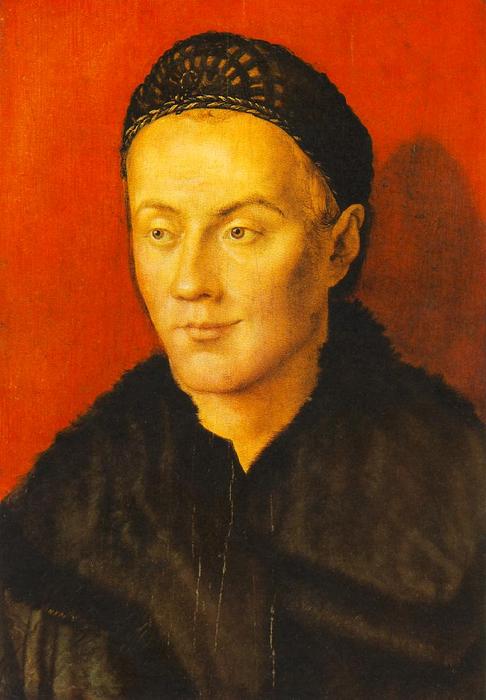
The painting immediately draws the eye to its subject – a man of indeterminate age, presented in a close-up composition that fosters an immediate sense of intimacy. His face, etched with the lines of experience and framed by a richly adorned headdress, is rendered with astonishing realism. Dürer’s mastery of glazing techniques—thin layers of oil paint meticulously built up to create luminous skin tones and vibrant fabrics—is particularly evident in the subtle play of light across the man's features and the luxurious fur collar. The sharp delineation of his eyes, a piercing blue, suggests an observant and perhaps slightly wary nature; they hold a direct gaze that challenges the viewer to engage with the portrait on a deeply personal level.
The Language of Detail: Technique and Craftsmanship
Dürer’s approach to this portrait is characterized by an almost obsessive attention to detail. Every fold in the fabric, every strand of hair, every minute imperfection of the skin is rendered with painstaking precision. This commitment to realism was not merely a technical exercise; it reflected Dürer's belief that art should accurately represent the world around us. The use of linear perspective, though subtly applied within the confines of the close-up framing, contributes to a sense of spatial depth and anchors the figure within his environment. The geometric shapes of the headdress – a chaperon, a symbol of status and protection – contrast with the organic curves of the face, creating a dynamic interplay between structure and form.
Furthermore, Dürer’s mastery of engraving—a skill he would later perfect—is evident in the preparatory sketches and studies that accompanied this painting. These drawings reveal his methodical approach to capturing the human form, meticulously analyzing proportions and angles before committing them to canvas. The influence of Italian Renaissance art is palpable, particularly in the idealized rendering of the face and the careful attention to anatomical accuracy, yet Dürer retains a distinctly Northern European sensibility, imbuing the portrait with a sense of quiet dignity and understated power.
Symbolism and Context: Status, Wealth, and Self-Representation
Beyond its technical brilliance, “Portrait of a Man” is rich in symbolic meaning. The opulent headdress, crafted from luxurious fabrics and adorned with geometric patterns, immediately signals the subject’s wealth and social standing. The chaperon itself was a symbol of protection and status, often worn by wealthy men during this period. The red background, a bold and dramatic choice, serves to isolate the figure and draw attention to his face – emphasizing his individuality within a context of societal expectations.
Considering Dürer’s own life and career, it's tempting to speculate about the identity of the sitter. Some scholars believe he may be a self-portrait in disguise, reflecting Dürer’s fascination with self-representation – a theme that would become increasingly prominent in his later works. The portrait aligns perfectly with the artistic trends of the time, showcasing a growing interest in individual portraits and their ability to convey personality and character. It stands as a testament to Dürer's skill and vision, solidifying his place as one of the most important artists of the Northern Renaissance.
Bringing Dürer’s Masterpiece Home: A High-Quality Reproduction
ArtsDot is proud to offer meticulously crafted hand-painted reproductions of Albrecht Dürer’s “Portrait of a Man.” Our skilled artisans replicate the artist's techniques and attention to detail, ensuring that your reproduction captures the luminous quality, subtle nuances, and profound emotional impact of the original. Whether you are an art collector, interior designer, or simply an admirer of Renaissance art, our reproductions provide a beautiful and authentic way to experience this iconic masterpiece in your own home. Explore the details and history of this remarkable portrait – available now as a stunning hand-painted reproduction.
Explore Albrecht Dürer’s ‘Self-portrait at 22’ | Discover ‘Face a Young Man’ by Dürer | View ‘Portrait of an Unknown Man’ by Dürer