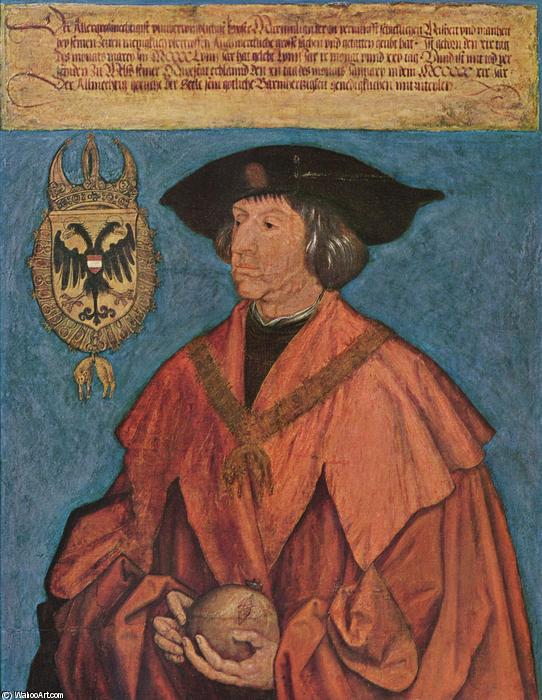
Portrait of Emperor Maximilian I – A Masterpiece of Northern Renaissance Realism
The *Portrait of Emperor Maximilian I*, created by Albrecht Dürer in 1519, stands as an enduring testament to the artistic achievements of the German Renaissance and a cornerstone of European art history. More than just a likeness of Holy Roman Emperor Maximilian I (1459-1519), it’s a meticulously crafted visual narrative that encapsulates the anxieties and aspirations of its time—a portrait imbued with profound symbolic meaning and executed with unparalleled technical precision. Located prominently at the Kunsthistorisches Museum in Vienna, Austria, this painting continues to captivate audiences with its haunting beauty and intellectual depth.
- Artist: Albrecht Dürer (1471-1528) – A Titan of His Era
- Year Created: 1519 – The Height of Maximilian’s Reign
- Medium: Oil on Panel – Demonstrating Mastery of Renaissance Technique
- Dimensions: 74 x 62 cm – Relatively Small Scale, Yet Monumental in Impact
Dürer's approach to portraiture distinguishes itself from its contemporaries through an unwavering commitment to realism and anatomical accuracy. Unlike idealized depictions favored by Venetian artists, Dürer sought to capture Maximilian’s physical presence with unflinching detail—a deliberate choice reflecting the humanist ideals prevalent during the Renaissance, which championed observation and rational understanding of the human form. The artist painstakingly dissected the emperor's anatomy, meticulously rendering musculature and bone structure to convey a sense of solidity and dignity. This dedication to realism extends beyond mere representation; it’s an assertion of intellectual curiosity and a desire to portray Maximilian as he truly was—a man grappling with the burdens of leadership and facing mortality head-on.
- Style: Northern Renaissance – Characterized by Detail, Clarity & Psychological Insight
- Technique: Oil Painting – Utilizing Glazes for Depth & Luminosity
- Composition: Three-Quarter View – Framing Maximilian in a Dignified Pose
The painting’s symbolism is equally compelling. Maximilian I holds a sphere—a motif frequently employed by Renaissance artists to represent the cosmos and, symbolically, the emperor's dominion over both earthly affairs and spiritual contemplation. The sphere’s placement in his hand underscores his role as ruler of a vast empire stretching from Austria to Spain, yet simultaneously hints at the limitations of human power against the immensity of creation. Beneath his gaze rests a pomegranate—a fruit laden with significance rooted in Christian iconography. As Stabius explained on the Arch of Honour, “although a pomegranate’s exterior is neither very beautiful nor endowed with a pleasant scent, it is sweet on the inside and is filled with a great many well-shaped seeds. Likewise the Emperor is endowed with many hidden qualities which became more and more apparent each day and continue to bear fruit.” The pomegranate symbolizes resurrection—a potent reminder of Maximilian’s faith and his belief in eternal life—and represents the unity of his empire amidst diversity.
- Symbolism: Cosmos & Dominion – Represented by the Sphere
- Symbolism: Resurrection & Unity – Embodied by the Pomegranate
Beyond its artistic merits, *Portrait of Emperor Maximilian I* serves as a valuable historical document. It offers invaluable insights into the psychological landscape of Maximilian I—a man burdened by responsibility and facing the inevitable decline of his reign. The emperor’s gaze is averted, conveying a sense of melancholy and resignation—a poignant portrayal of human vulnerability amidst grandeur. This subtle expression captures the essence of Maximilian's character—a ruler acutely aware of his mortality yet determined to uphold his dignity and legacy. Viewing this masterpiece evokes contemplation on themes of power, faith, and the passage of time—solidifying its place as one of the most significant works of Northern Renaissance art.
- Historical Context: Maximilian I’s Reign & The Holy Roman Empire
- Emotional Impact: Dignity, Melancholy & Reflection on Mortality
The painting's enduring appeal lies in its masterful blend of realism and symbolism—a testament to Dürer’s genius and a timeless exploration of the human condition. Its meticulous detail invites viewers to engage with its complexities, prompting reflection on themes of leadership, faith, and the inescapable realities of existence. As Karl Jäger eloquently described it, “The woodcut was perhaps made some time shortly after this. Unlike most of Dürer’s woodblock prints, it does not include the artist's monogram.” It remains a captivating visual experience—a window into a pivotal moment in European history and an enduring symbol of artistic excellence.