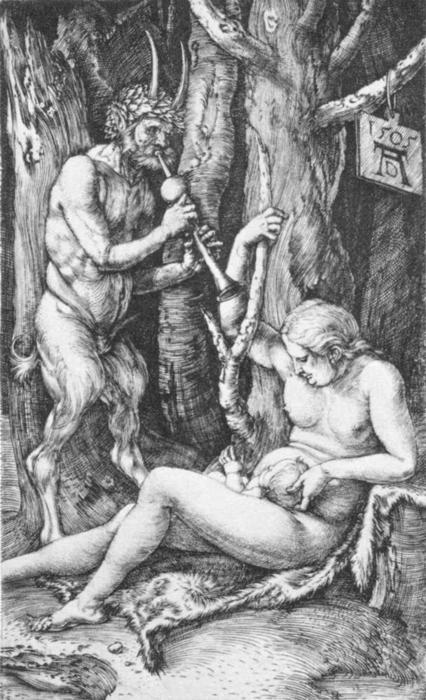
A Dramatic Tableau of Fatherhood Amidst Dark Forest Shadows
Albrecht Dürer’s “Satyr Family,” completed in 1505, stands as a testament to the Northern Renaissance fascination with classical mythology filtered through a distinctly Mannerist lens. More than just a meticulously rendered depiction of pagan figures—a satyr, his newborn child, and a companion—the engraving embodies a complex interplay between primal instinct and intellectual contemplation, capturing a moment frozen in time against a backdrop of brooding woodland gloom.
- Subject Matter: The artwork centers on the mythic tale of Saturn (Cronus), father of Zeus and Poseidon, who wrestles with his paternal responsibilities. Dürer reimagines this narrative as a serene domestic scene—a stark contrast to the violent myths of antiquity—where the satyr plays music for his infant son, symbolizing a reconsideration of traditional roles within the family unit.
- Style: Characteristic of Dürer’s oeuvre and firmly rooted in Mannerism, “Satyr Family” eschews idealized beauty for an unsettling realism. The artist deliberately disrupts conventional compositional harmony, prioritizing expressive gesture and psychological depth over strict adherence to perspective.
Technical Mastery: Drypoint and the Velvet Texture of Line
Dürer’s unparalleled skill as an engraver is immediately apparent in every detail of “Satyr Family.” He employed a groundbreaking technique known as drypoint—a method that involved incising lines directly into a copper plate using a stylus hardened with resin. This process created minuscule burrs on the surface, resulting in a velvety texture visible even in the printed image – a remarkable achievement for its time.
- Technique: The drypoint method ensured that ink clung to the burrs, producing richer tonal values and an unparalleled level of detail. Extensive hatching and crosshatching—a hallmark of Dürer’s style—were skillfully utilized to sculpt form and convey volume, creating a palpable sense of atmosphere.
- Materials: The engraving was executed on copper plate using etching needles and meticulously applied ink, demonstrating the artist's dedication to precision and craftsmanship.
Symbolism Beyond Representation: Darkness and Innocence Converge
Beyond its formal qualities, “Satyr Family” resonates with profound symbolic significance. The dark forest setting represents both the perilous challenges of parenthood and the inherent instability of human existence—a deliberate departure from idealized depictions of pastoral life. Simultaneously, the infant son embodies purity and innocence, juxtaposed against the satyr’s melancholic gaze and musical performance.
- Emotional Impact: Dürer's masterful portrayal evokes a sense of quiet contemplation mingled with unease—a reflection of the artist’s own intellectual curiosity and his willingness to confront uncomfortable truths.
- Historical Context: Produced during a period of artistic experimentation and philosophical inquiry, “Satyr Family” exemplifies the Renaissance spirit of questioning established conventions and exploring new avenues for expressing human emotion.
A Legacy of Detail and Observation
"Satyr Family" isn’t merely an image; it's a carefully constructed statement about humanity’s relationship with nature, myth, and the complexities of familial bonds. Dürer’s unwavering commitment to anatomical accuracy—evident in the rendering of the satyr’s musculature—combined with his masterful manipulation of line and tonal value secures its place as one of the most enduring masterpieces of Northern Renaissance art.