A Window Into Youthful Reflection
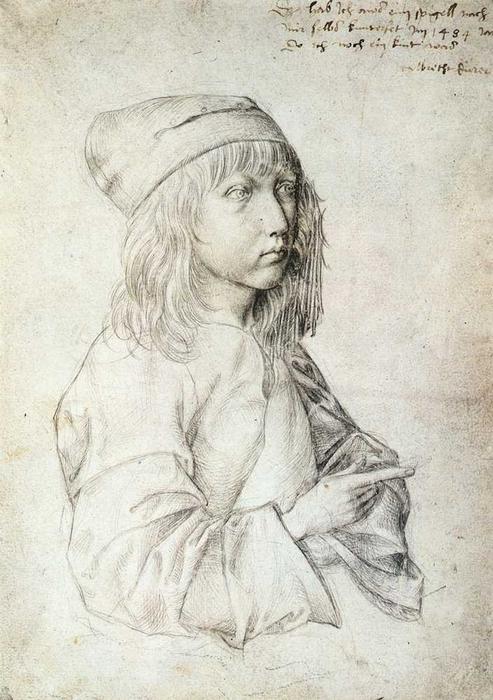
In the quiet corridors of art history, few images possess the raw, introspective power found in Albrecht Dürer’s "Self-Portrait at Thirteen." Created in 1484, this work serves as a profound psychological window into the formative years of a master who would eventually redefine the German Renaissance. At first glance, we encounter a young boy, his gaze steady and remarkably mature for his age, looking directly at the viewer with an intensity that suggests a soul already attuned to the nuances of observation. There is an understated elegance in this early self-representation, a sense of a burgeoning talent capturing not just his own likeness, but the very essence of a moment frozen in time. For collectors and lovers of fine art, this piece offers more than mere portraiture; it provides a rare glimpse into the inception of a legendary artistic vision.
The technical mastery displayed in such an early work is nothing short of breathtaking. Eschewing the vibrant layers of oil paint that would later define much of the Renaissance, Dürer utilized silverpoint—a delicate and demanding medium. By using a silver stylus to draw directly onto specially prepared paper, the young artist achieved a level of precision and tonal subtlety that is almost ethereal. The resulting image is characterized by fine, hair-like lines and soft, velvety shadows that create a lifelike texture, particularly evident in the rendering of his flowing hair and the gentle folds of his cap. This technique requires immense patience and a steady hand, as silverpoint allows for no errors, making every stroke a testament to Dürer’s innate discipline and his early commitment to the pursuit of perfection.
The Spirit of Nuremberg and Renaissance Humanism
To understand this portrait, one must look toward the vibrant atmosphere of 1484 Nuremberg. This was an era of profound intellectual transformation, where the movement of humanism began to celebrate individual potential and human dignity. Growing up in a city that served as a crucible for trade and innovation, Dürer was immersed in a world of meticulous craftsmanship. His apprenticeship under Michael Wolgemut exposed him to the intricate beauty of illuminated manuscripts and the emerging art of woodcut illustration, elements that clearly informed the precision seen in this self-portrait. The simplicity of the background—minimalistic and devoid of distracting detail—serves to focus all emotional weight onto the subject himself, emphasizing the humanist focus on the individual experience.
For those looking to bring a sense of historical depth and quiet contemplation into a curated space, a reproduction of this masterpiece offers an unparalleled opportunity. The artwork’s monochromatic elegance and fine detail make it a sophisticated choice for interior designers seeking to create focal points that evoke intellect and serenity. Whether placed in a study, a library, or a contemporary gallery setting, "Self-Portrait at Thirteen" commands attention through its subtle complexity. It is a piece that invites the viewer to linger, to observe the play of light on the silverpoint lines, and to connect with the enduring spirit of a young boy who was destined to become one of the greatest names in the history of Western art.