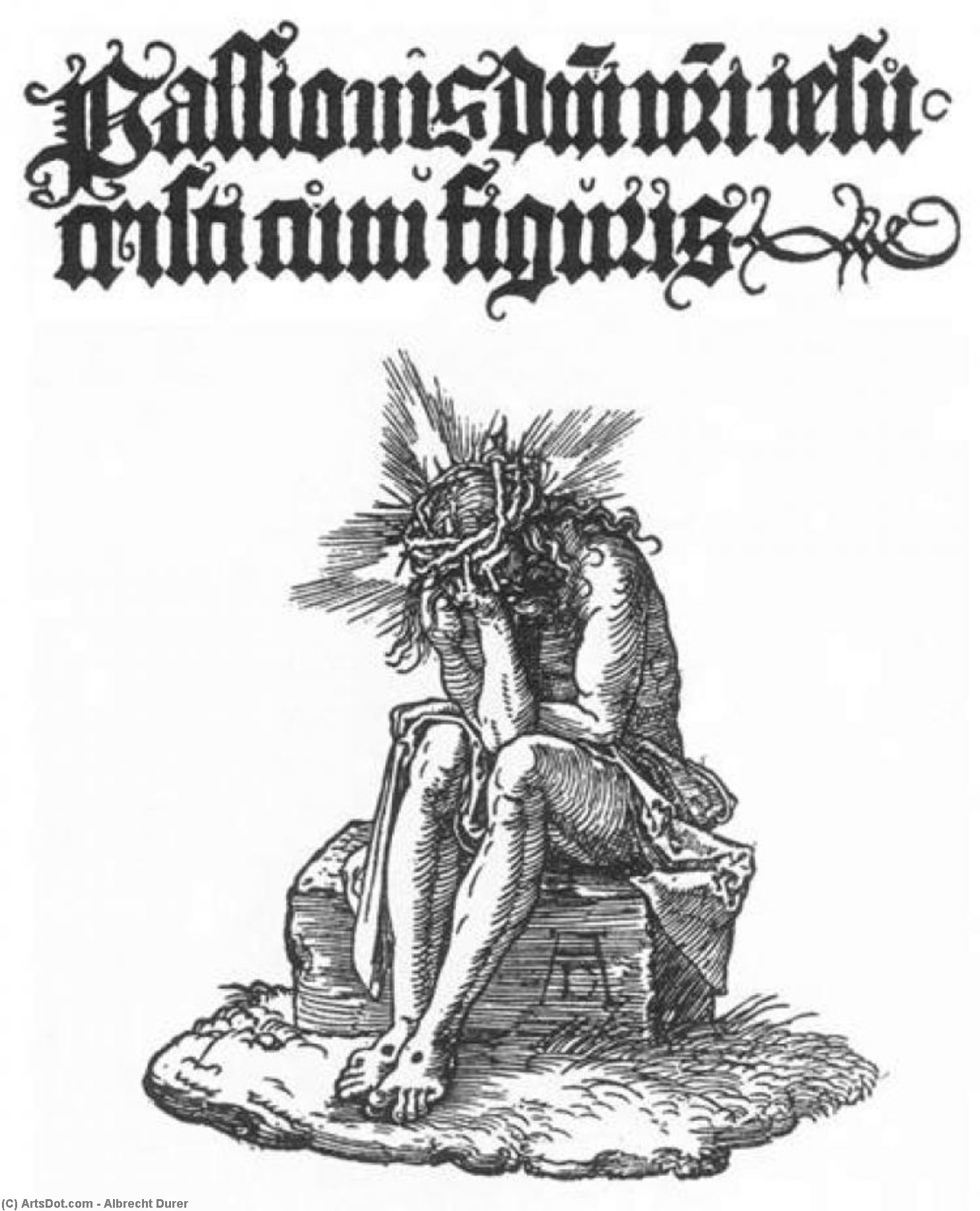
Albrecht Dürer’s poignant engraving, "Small Passion Title page," captures Christ's sorrowful anguish in a meticulously detailed Northern Renaissance style. This iconic black and white print evokes deep emotion and invites you to discover or own this timeless masterpiece.
A Portrait of Sorrow: Albrecht Dürer's "Small Passion Title Page"
Albrecht Dürer’s “Small Passion Title Page,” an engraving executed around 1507, is more than just a depiction of Christ; it’s a profound meditation on suffering, humility, and the very essence of human emotion. Emerging from the heart of the Northern Renaissance, this work embodies Dürer's unparalleled skill in capturing not only physical form but also the deeply felt spiritual weight of his subject. The image, rendered entirely in meticulously crafted black and white lines, immediately draws the viewer into a world of somber contemplation, inviting us to witness a moment of unbearable anguish.
Technical Mastery: An Engraver's Dance
- The Process: Dürer’s mastery lies in his meticulous application of engraving – a printmaking technique demanding immense precision and patience. He began with a copper or iron plate, painstakingly cutting lines using specialized tools to create the image. These weren't simply outlines; each line was deliberately varied in thickness and density, creating a dynamic interplay of light and shadow that breathes life into the figure.
- Hatching & Cross-Hatching: The use of hatching – parallel lines – and cross-hatching – intersecting lines – is particularly noteworthy. This technique allows Dürer to build up tonal values with astonishing subtlety, achieving a remarkable sense of texture in the Christ’s skin, the rough prickle of the crown of thorns, and even the folds of the drapery.
- A Flattened Perspective: Characteristic of engravings, the composition employs a flattened perspective, prioritizing clarity and detail over illusionistic depth. This deliberate choice emphasizes the symbolic weight of the scene rather than attempting to create a hyper-realistic representation.
Symbolism and Emotional Resonance
The power of “Small Passion Title Page” resides not just in its technical brilliance but also in its profound symbolism. The central figure, undoubtedly Christ, is depicted in an act of utter despair – his head bowed, his body slumped in a posture of agonizing sorrow. The crown of thorns, a universally recognized emblem of suffering and sacrifice, underscores the immense weight of his burden. The composition’s diagonal thrust, from left to right, amplifies this sense of downward movement, mirroring Christ's descent into pain and death. Beyond the overtly religious imagery, the work speaks to universal themes of human vulnerability and the enduring struggle against adversity.
A Window into the Renaissance
Dürer’s “Small Passion Title Page” is a quintessential example of Northern Renaissance art – a period defined by its emphasis on realism, meticulous detail, and symbolic meaning. Influenced by Italian masters like Botticelli and Leonardo da Vinci, Dürer nevertheless developed a distinctly German style characterized by an intense focus on human emotion and spiritual introspection. This engraving offers a tangible connection to this pivotal moment in artistic history, showcasing the innovative techniques and profound philosophical concerns that shaped the era.
Collecting the Legacy
A hand-painted reproduction of Dürer’s “Small Passion Title Page” is more than just an artwork; it's a portal to one of the most significant artistic achievements in human history. Its enduring appeal lies in its ability to evoke powerful emotions and stimulate contemplation, making it a fitting addition to any discerning collection or interior space. Contact ArtsDot.com today to commission a bespoke reproduction that captures the essence of this timeless masterpiece.