A Solitary Contemplation: Unpacking Albrecht Dürer’s “St. Jerome beside the pasture”
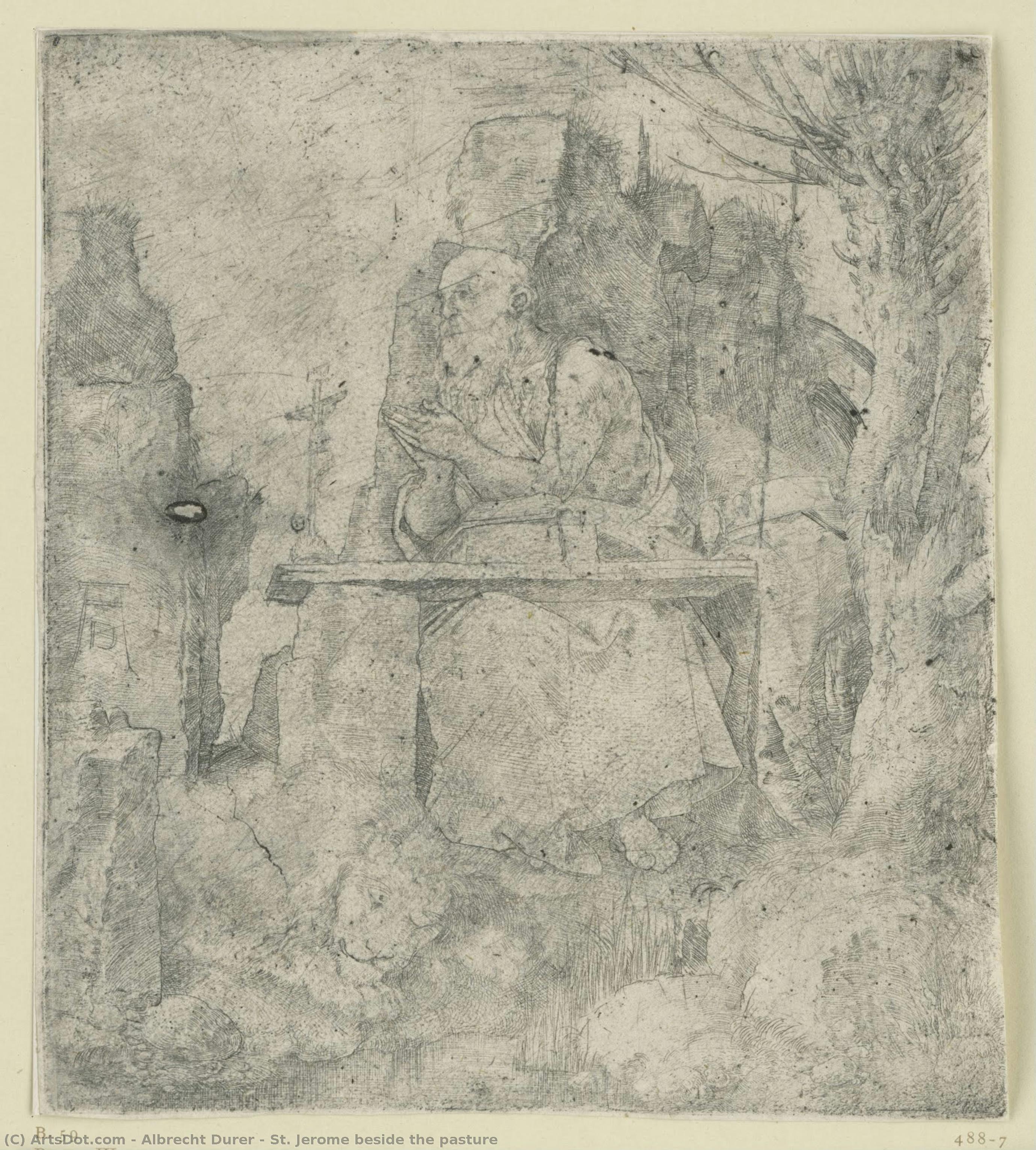
Albrecht Dürer's "St. Jerome beside the pasture," a meticulously rendered etching from around 1518, isn’t merely a portrait of a biblical figure; it’s a profound meditation on faith, solitude, and the enduring power of introspection. The image immediately draws you in with its stark contrasts – the cool, grey tones of the landscape against the warm, earthy hues of Jerome's robes, creating a visual dialogue between the earthly realm and the spiritual. Dürer masterfully employs hatching and cross-hatching techniques, building up layers of shadow to define form and texture with astonishing precision. This isn’t simply a depiction of a man; it’s an exploration of light and dark, of presence and absence, rendered with a level of detail that borders on obsessive.
The scene itself is deceptively simple: St. Jerome, the patron saint of scholars and translators, sits upon a weathered stone bench beneath a sprawling, autumnal sky. His head is bowed in deep thought, his hands clasped together as if in prayer or perhaps simply lost in contemplation. Two figures – one standing to his left, the other further back on the right – add an element of mystery, suggesting a moment of interruption, a fleeting connection within Jerome’s private world. The landscape, rendered with meticulous detail, isn't merely a backdrop; it feels almost alive, mirroring the saint’s internal state through its muted colors and subtle textures.
Renaissance Roots: Dürer’s Artistic Journey
Dürer’s artistic development is inextricably linked to the burgeoning Renaissance in Germany. Born in Nuremberg in 1471, he benefited from a rich artistic environment, initially apprenticed to Michael Wolgemut, a leading master of woodcuts and illuminated manuscripts. This early training instilled in him a rigorous approach to technique and an appreciation for classical ideals – values that would profoundly influence his later work. Dürer’s fascination with mathematics and perspective, evident throughout his oeuvre, reflects this commitment to order and precision. He wasn't simply imitating the past; he was actively engaging with it, pushing the boundaries of artistic representation while remaining deeply rooted in traditional methods.
The etching itself is a testament to Dürer’s mastery of printmaking. He experimented tirelessly with different techniques and materials, constantly refining his process to achieve an unprecedented level of tonal range and detail. “St. Jerome” showcases this dedication – the subtle gradations of grey, achieved through countless layers of meticulously applied lines, create a remarkable sense of depth and realism. This was revolutionary for its time, elevating woodcut printing from a primarily illustrative medium to one capable of capturing nuanced emotion and atmosphere.
Symbolism and Spiritual Resonance
Beyond the technical brilliance, “St. Jerome” is rich in symbolic meaning. The setting – a solitary pasture – immediately evokes themes of isolation and introspection. Jerome’s posture suggests a profound engagement with his faith, a willingness to withdraw from worldly distractions in order to commune with God. The act of translating the Vulgate Bible, Jerome's primary vocation, represents a bridge between languages and cultures, highlighting the importance of knowledge and understanding. The two figures observing him could symbolize temptation or perhaps simply the human condition – reminders that even in moments of profound spiritual contemplation, we are never truly alone.
The image resonates with a timeless quality, inviting viewers to contemplate their own relationship with faith, solitude, and the search for meaning. Dürer’s ability to capture such complex emotions through a seemingly simple composition is a testament to his genius – “St. Jerome beside the pasture” remains a powerful and enduring work of art.
Resources & Further Exploration