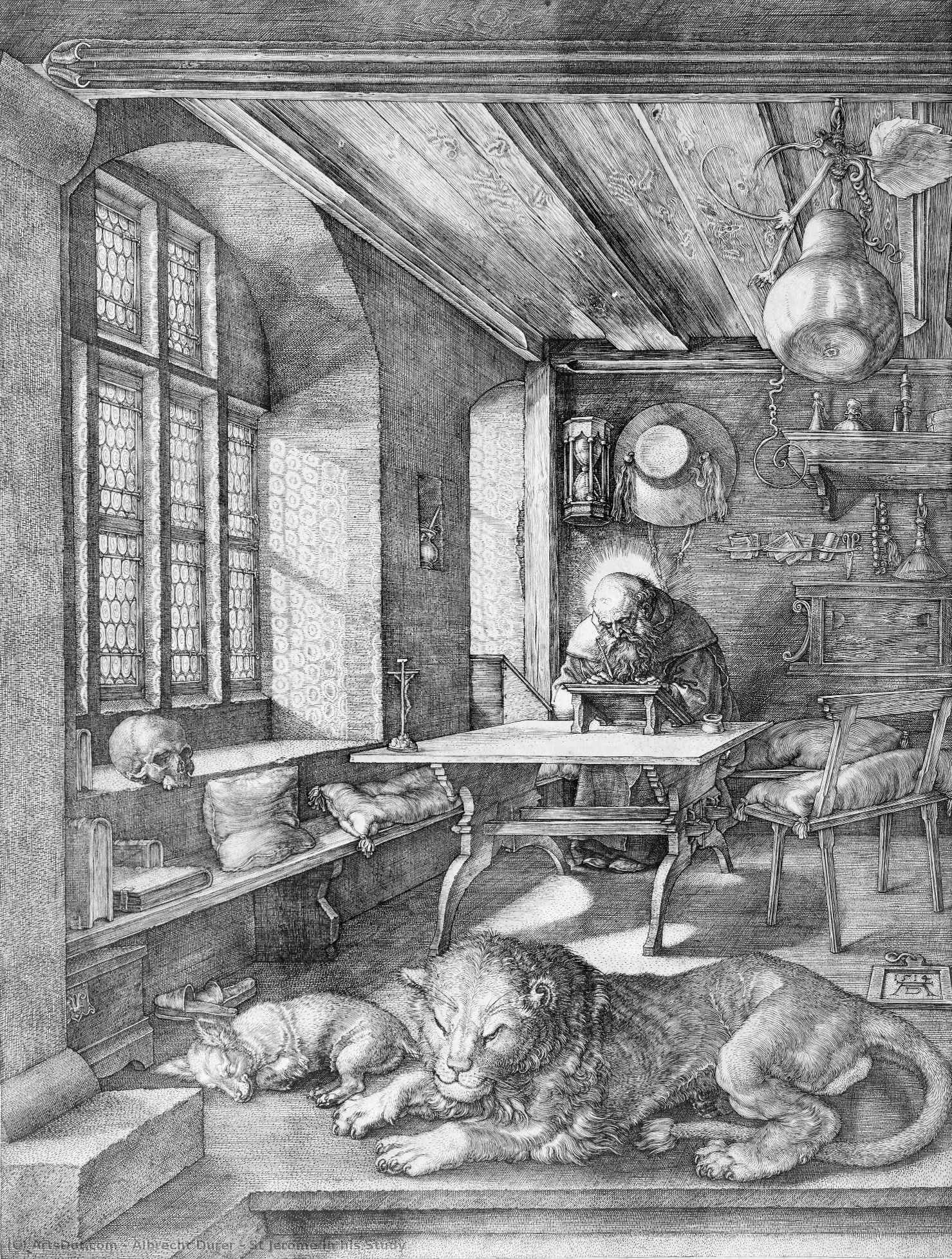
St Jerome in His Study: A Northern Renaissance Masterpiece
- Artist: Albrecht Dürer
- Date: 1514
- Technique: Engraving on Copper Plate
- Dimensions: 259 x 201 cm (Original Size)
A Glimpse into Scholarly Contemplation and Domesticity
Albrecht Dürer's "St Jerome in His Study" is a remarkable black and white engraving that transports viewers to the private world of a Christian scholar and hermit. Completed in 1514, this work exemplifies the meticulous detail and realism characteristic of Northern Renaissance printmaking. The scene depicts St. Jerome immersed in study within his richly detailed chamber, surrounded by symbols of faith, knowledge, and mortality. What sets this engraving apart is the unusual domesticity introduced by the presence of animals – a lion and dogs – creating a compelling juxtaposition of scholarly pursuit and tranquil companionship.
Technical Brilliance and Artistic Style
Dürer’s mastery of the engraving technique shines through in every line. The process involves meticulously cutting lines into a copper plate, inking it, and then pressing it onto paper to create the image. Dürer's skill is evident in his use of fine, precise lines to define textures – from the rough stone walls and wooden furniture to the smooth skin and draped fabrics. Hatching and cross-hatching techniques are expertly employed to create tonal variations and a convincing sense of volume. The composition utilizes linear perspective effectively, drawing the viewer's eye into the depth of the room. Light streams in from a large window on the left, casting dramatic shadows that highlight specific areas and emphasize the three-dimensionality of the scene.
Symbolism and Emotional Resonance
Beyond its technical brilliance, "St Jerome in His Study" is rich in symbolic meaning. The skull prominently displayed serves as a potent reminder of mortality and the fleeting nature of life. Books symbolize knowledge and scholarship, reflecting St. Jerome's dedication to translating the Bible into Latin (the Vulgate). The lion, often associated with St. Jerome in iconography, represents his protection and power, while the dogs signify loyalty and companionship. The overall mood is contemplative and somewhat melancholic, inviting viewers to reflect on themes of faith, knowledge, and the passage of time. Dürer masterfully blends these elements to create a scene that is both intellectually stimulating and emotionally resonant.
Historical Context and Dürer's Legacy
Albrecht Dürer (1471-1528) was a towering figure of the German Renaissance, born in Nuremberg. He received early training from Michael Wolgemut, mastering painting, drawing, and woodcut techniques. His travels to Italy exposed him to the works of Renaissance masters like Raphael and Giovanni Bellini, influencing his artistic development. "St Jerome in His Study" is one of Dürer’s renowned “Meisterstiche” (master engravings), alongside *Melencolia I* and *Knight, Death, and the Devil*. These prints are considered cornerstones of Western art, celebrated for their technical innovation and profound exploration of human experience. This engraving remains a testament to Dürer's genius and continues to captivate audiences centuries later.