A Masterpiece of Solitude and Spiritual Depth
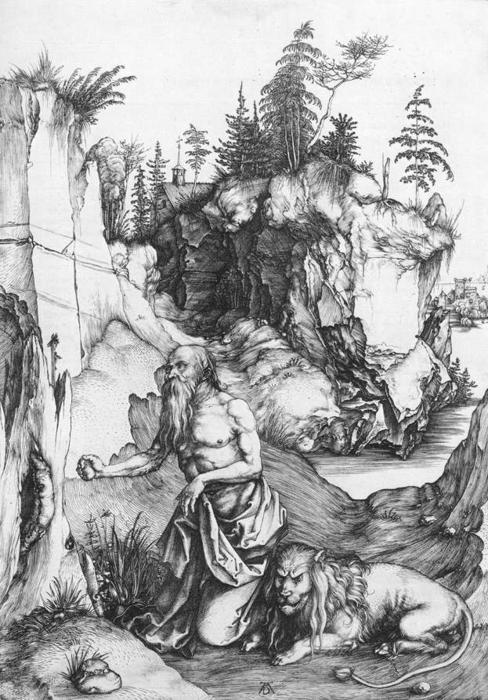
In the quiet, shadowed corners of the Northern Renaissance, few works capture the profound essence of human devotion as poignantly as Albrecht Dürer’s St Jerome Penitent in the Wilderness. Created around 1496, this exquisite engraving is far more than a mere religious illustration; it is a breathtaking window into a soul in communion with the divine. As one gazes upon the weathered face of the saint and the rugged landscape that surrounds him, there is an immediate, visceral sense of stillness. Dürer invites us into a world where the clamor of the material realm fades, replaced by the heavy, contemplative silence of the desert. For the discerning collector or lover of classical art, this piece offers a rare opportunity to possess a fragment of history that speaks to the timeless human search for meaning and grace.
The composition is a masterclass in structural harmony, utilizing a subtle pyramidal arrangement that anchors the viewer’s eye directly to the heart of the scene. At the base of this spiritual ascent sits St. Jerome, his posture bowed in humble repentance, embodying the very essence of penitence. Beside him, the presence of a lion—a creature often symbolizing both Christ and the taming of wild, earthly passions—adds a layer of profound symbolic weight. The landscape itself is not merely a backdrop but a living participant in the saint's journey; the craggy rocks and dense, meticulously rendered foliage create an atmosphere of isolation that emphasizes Jerome’s spiritual solitude. It is a scene that resonates deeply within any space, providing a focal point of intellectual and emotional gravity.
The Alchemy of Line and Light
What truly elevates this work to the pantheon of Renaissance greatness is Dürer’s unparalleled command over the medium of engraving. Without the use of color, the artist achieves a staggering range of tonal depth through the sheer virtuosity of his linework. Through the disciplined application of hatching and cross-hatching, Dürer breathes life into the inanimate. One can almost feel the rough, abrasive texture of the limestone outcrops and the heavy, coarse weight of the saint’s drapery. The interplay of light and shadow is orchestrated with such precision that a sense of three-dimensional volume emerges from the flat surface of the paper, creating an illusionistic depth that draws the viewer into the very thicket of the wilderness.
Every stroke of the engraver's tool serves a dual purpose: to define form and to evoke emotion. The fine, delicate lines used for the distant foliage suggest the soft haze of atmospheric perspective, while the deep, concentrated blacks in the shadowed folds of Jerome’s robes ground the figure with a sense of monumental permanence. For interior designers seeking to infuse a room with character, a high-quality reproduction of this engraving offers an unparalleled texture. It brings a sophisticated, monochromatic elegance that complements both minimalist modern settings and richly detailed classical interiors, acting as a testament to the enduring power of meticulous craftsmanship and the beauty of the monochrome.
A Legacy for the Modern Collector
To bring St Jerome Penitent in the Wilderness into a contemporary collection is to embrace the legacy of the German Renaissance. Dürer was a pioneer who bridged the gap between the medieval artisan tradition and the humanist intellect of the modern era. This print represents that pivotal moment in art history when technical mastery met profound philosophical inquiry. It is an artwork that does not merely decorate a wall; it commands a room, prompting reflection and conversation. Whether placed in a private study, a grand library, or a curated gallery space, this reproduction serves as a constant reminder of the beauty found in introspection and the enduring strength of faith and resilience.