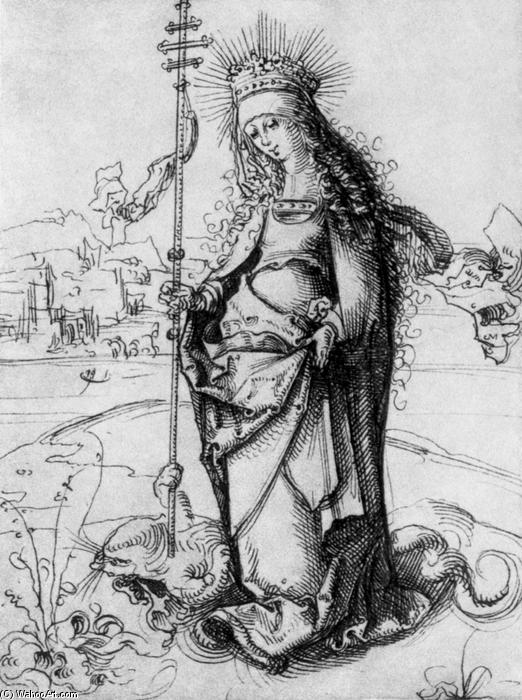
Albrecht Dürer’s stunning monochrome engraving of St. Margaret embodies Northern Renaissance precision with a powerful depiction of faith overcoming evil. This intricate engraving showcases Dürer's masterful use of hatching and line work, offering a timeless piece to admire or collect.
A Testament to Faith and Skill: Albrecht Dürer’s St. Margaret
Albrecht Dürer's St. Margaret stands as a cornerstone of Northern Renaissance art, a meticulously crafted engraving that transcends mere portraiture to become a profound meditation on faith, resilience, and the triumph of good over evil. Executed around 1500, this monochrome masterpiece exemplifies Dürer’s unparalleled mastery of engraving technique and his deep engagement with both religious symbolism and humanist ideals. The artwork's enduring power lies not just in its technical brilliance but also in the potent narrative it conveys – a story of unwavering devotion rendered with breathtaking precision.
- Subject Matter: The central figure is St. Margaret, a 7th-century princess renowned for her steadfast resistance to King Coel who attempted to force her into marriage. Her story became a powerful symbol of female piety and courage, making her an ideal subject for Dürer’s artistic explorations.
- Historical Context: Created during the High Renaissance, this engraving reflects the period's fascination with classical antiquity alongside its fervent religious devotion. Dürer was deeply influenced by both traditions, blending humanist concerns about human potential with a profound understanding of Christian iconography.
The Dance of Lines: Technique and Style
Dürer’s genius is immediately apparent in the engraving's execution. He employed the technique of engraving on copper or iron – a painstaking process involving meticulously incising a design into a metal plate with a burin. This plate was then inked and pressed onto paper, creating an image characterized by its remarkable clarity and detail. The artwork’s dominant feature is the masterful use of hatching and cross-hatching, techniques that allowed Dürer to create subtle gradations of tone and texture. These lines aren't simply decorative; they are fundamental to the work’s expressive power, defining the contours of St. Margaret’s garments, the folds of her drapery, and even the rough surface of the foliage beneath her feet. The deliberate layering of lines generates a remarkable sense of depth and volume, pulling the viewer into the scene.
Symbolism and Emotional Resonance
Beyond its technical virtuosity, St. Margaret is rich in symbolic meaning. The dragon or serpent, subdued at St. Margaret’s feet, represents the forces of evil that she resisted – temptation, sin, and worldly corruption. The angel hovering above, holding a banner bearing an inscription, signifies divine assistance and protection. The composition itself—with St. Margaret standing tall and resolute—conveys a powerful message of strength, resilience, and unwavering faith. The image evokes a sense of spiritual fortitude, inviting contemplation on the challenges of life and the enduring power of virtue.
A Legacy of Precision: Dürer’s Enduring Influence
Albrecht Dürer's St. Margaret remains a testament to his extraordinary skill and vision. It exemplifies the Northern Renaissance style, characterized by its meticulous detail, precise lines, and expressive use of hatching. Reproductions of this iconic work capture not only the beauty of Dürer’s artistry but also the profound spiritual message embedded within it. This engraving continues to inspire artists and collectors alike, solidifying its place as a pivotal masterpiece in the history of Western art.