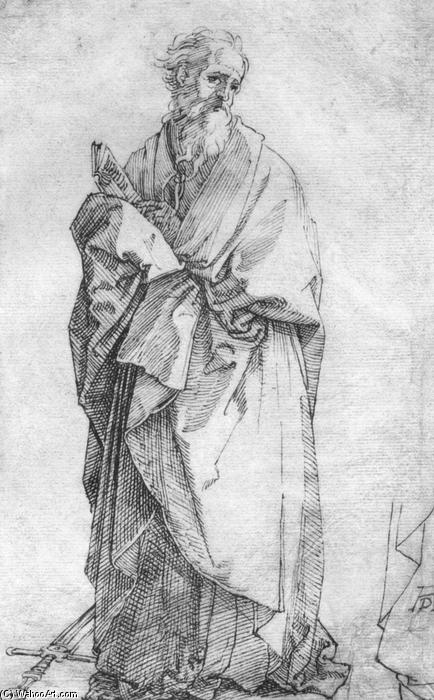
A meticulously detailed monochrome drawing by Albrecht Dürer depicting St. Paul in the Northern Renaissance style, showcasing intricate linework and hatching to capture the saint's contemplative pose and scholarly pursuits – a timeless piece perfect for art lovers.
A Study in Contemplation: Albrecht Dürer's St. Paul
Albrecht Dürer’s “St. Paul” stands as a testament to the meticulous artistry and profound intellectual engagement that defined the Northern Renaissance. Executed with remarkable precision in pen, ink, and meticulously crafted hatching, this monochrome drawing offers an intimate glimpse into the mind of one of history's most influential artists. Dating from around 1506-1508, a period marked by Dürer’s intense exploration of perspective and human anatomy, the work transcends mere portraiture; it embodies a spirit of deep contemplation and scholarly devotion.
- The Figure of Faith: The central subject, St. Paul, is rendered with an almost unnerving realism. His posture – standing in profile facing left – immediately draws the viewer into his presence, suggesting both strength and vulnerability. The subtle tilt of his head, coupled with the carefully delineated lines of his draped robe and flowing beard, conveys a sense of focused attention, as if he were deeply absorbed in the study of a scroll.
- A Dance of Lines: Dürer’s mastery lies not just in depicting form but in manipulating line itself. The extensive use of hatching and cross-hatching creates a remarkable illusion of volume and texture. Notice how these delicate lines build up the folds of the fabric, the rough grain of his beard, and even the subtle contours of his face. This technique, perfected over years of experimentation, is characteristic of Northern Renaissance drawing and anticipates later developments in printmaking.
- Process and Possibility: The inclusion of a partially visible preparatory sketch on the right side of the composition adds another layer of meaning. It’s not merely an accidental detail; it's a deliberate nod to the creative process, suggesting that Dürer was actively exploring different approaches before settling on this final iteration. This element speaks to his relentless pursuit of perfection and his willingness to experiment with new ideas.
Renaissance Roots and Northern Innovation
Dürer’s “St. Paul” firmly roots itself within the traditions of Italian Renaissance art, particularly in its emphasis on humanism and classical ideals. However, it also represents a crucial development in Northern European artistic practice. Unlike the predominantly color-based works emerging from Florence and Rome, Dürer favored monochrome studies, often using pen and ink to achieve unparalleled detail and tonal control. This preference was driven by the limitations of available pigments and a desire to explore the expressive potential of line alone.
- Nuremberg’s Influence: Born in Nuremberg, Dürer benefited from the city's thriving artisan culture and its burgeoning artistic scene. The workshop of Michael Wolgemut, where he began his training, exposed him to a diverse range of techniques – including woodcut illustration, which was particularly prevalent in Northern Europe – shaping his distinctive style.
- Perspective and Anatomy: Dürer’s meticulous study of perspective and human anatomy is evident throughout this drawing. He meticulously rendered the spatial relationships between Paul's body and the scroll, creating a sense of depth that belies the flatness of the medium. His anatomical studies, informed by classical texts and his own observations, demonstrate a profound understanding of the human form.
Symbolism and Emotional Resonance
Beyond its technical brilliance, “St. Paul” is imbued with symbolic meaning. The subject himself – one of Christianity’s most influential figures – represents faith, conversion, and intellectual pursuit. The scroll he holds suggests a dedication to scripture and theological study. The lighting, originating from the left, casts dramatic shadows that heighten the sense of drama and emphasize the figure's solemnity. The unfinished sketch hints at the ongoing nature of spiritual inquiry—a constant striving for understanding.
- Contemplation and Piety: The overall effect is one of profound contemplation and quiet piety. Dürer captures not just a physical likeness but also the inner state of a man deeply engaged with his faith.
- A Window into the Artist’s Mind: This drawing offers a rare glimpse into the mind of a master artist – his process, his concerns, and his unwavering commitment to excellence.
Collecting a Masterpiece: A Reproduction Opportunity
ArtsDot.com is proud to offer meticulously crafted hand-painted reproductions of Albrecht Dürer’s “St. Paul.” Each reproduction is created by skilled artisans who painstakingly recreate Dürer's techniques, ensuring an authentic representation of this iconic work. Whether you are a seasoned art collector, an interior designer seeking to elevate your space, or simply someone captivated by the beauty and power of Renaissance art, our reproductions provide a unique opportunity to own a piece of history.